备战2024年高考英语模拟卷07(九省新高考卷)
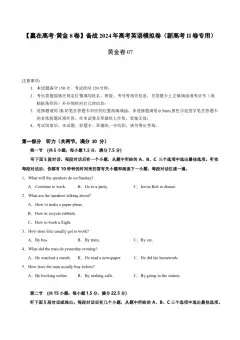
(考试时间:120分钟 试卷满分:150分)
注意事项:
1.答卷前,考生务必将自己的姓名、考生号等填写在答题卡和试卷指定位置上。
2.回答选择题时,选出每小题答案后,用铅笔把答题卡对应题目的答案标号涂黑。如需改动,
用橡皮擦干净后,再选涂其他答案标号。回答非选择题时,将答案写在答题卡上。写在本试卷上无
效。
3.考试结束后,将本试卷和答题卡一并交回。
第一部分:听力(共两节,满分 30 分)
第一节 听下面 5 段对话。每段对话后有一个小题,从题中所给的 A、B、C 三个选项中选出最佳选
项。听完每段对话后,你都有 10 秒钟的时间来回答有关小题和阅读下一小题。每段对话仅读一遍。
1.What color does the woman prefer?
A.Gray. B.Light blue. C.Cream.
2.When is the art gallery closed?
A.On Saturday. B.On Sunday. C.On Monday.
3.Where will the speakers meet?
A.At the station. B.In front of the cinema. C.At the church.
4.What does the man think of Professor White’s presentation?
A.Appealing. B.Confusing. C.Boring.
5.What are the speakers mainly talking about?
A.The smell of roses.
B.A relaxing way.
C.The man’s private garden.
第二节 听下面 5 段对话或独白。每段对话或独白后有几个小题,从题中所给的 A、B、C 三个选项
中选出最佳选项。听每段对话或独白前,你将有时间阅读各个小题,每小题 5 秒钟;听完后,各小题
将给出 5 秒钟的作答时间。每段对话或独白读两遍。
听下面一段较长对话,回答以下小题。
6.What is it that Bob cannot tolerate?
A.The high rent.
B.The noisy neighbor.C.The terrible traffic.
7.What does the woman suggest Bob do?
A.Share her brother’s apartment.
B.Move in Peter’s big house.
C.Call her brother,Tony.
听下面一段较长对话,回答以下小题。
8.Why is the mother unwilling to keep a young dog?
A.It costs money.
B.It needs extra care.
C.It affects her sleep.
9.How does the son feel about the pet dog?
A.Easy to teach.
B.Bright and friendly.
C.A good companion.
听下面一段较长对话,回答以下小题。
10.What is Daniel planning to do on Friday afternoon?
A.Go skating.
B.Go snowboarding.
C.Watch the Olympic Games.
11.Where is Daniel planning to go?
A.Genting Snow Park.
B.The Olympic Park.
C.His cousin’s home.
12.Who will go together with Daniel?
A.His cousin and parents.
B.His cousin and Judy.
C.His parents and Judy.
听下面一段较长对话,回答以下小题。
13.What did NASA call the area?
A.The Light of Venezuela.
B.The Lightning Capital of the World.
C.The Never-ending Storm of Catatumbo.
14.What causes so many storms in this area?
A.The warm ocean current.B.The strong mountain winds.
C.The special geographical location.
15.How many local people get struck by the lightning every year?
A.About 12%. B.About 30%. C.About 70%.
16.What can we learn from the conversation?
A.The man is afraid of lightening very much.
B.The locals are surprisingly fearless of lighting.
C.About 12,000 American people get hit in their lifetime.
听下面一段独白,回答以下小题。
17.How does the speaker find the dumplings?
A.Traditional and similar.
B.Delicious and various.
C.Healthy and tasty.
18.What’s the difference between Japanese dumplings and Chinese dumplings?
A.They are totally different in shapes.
B.The fillings are completely different.
C.The cooking methods are quite different.
19.Where does the speaker come from?
A.China. B.Japan. C.Italy.
20.What do we know about the Italian dumpling,ravioli?
A.They are in square shape.
B.The fillings are mainly cheese.
C.They are similar to Chinese dumplings.
第二部分 阅读(共两节,满分50分)
第一节 (共15小题;每小题2.5分,满分37.5分)
阅读下列短文,从每题所给的A、B、C、D四个选项中选出最佳选项。
A
Cricket Children’s Magazine Ages 0 —3 years∨Ages 4 — 6 years∨Ages 6 — 9 years∨Ages 9 — 14
years
Challenge curious young minds from 9 to 14 with Cricket Media’s Collection of magazines. Whether
your child is a promising poet or a future engineer, these award-winning publications are made for your kids.
CRICKET® MagazineCRICKET Magazine, our flagship publication, is the world leader in providing the highest-quality
fiction and nonfiction to children from 9 to 14. Since its premiere in 1973, CRICKET has delighted and
entertained generations of kids with contemporary stories and classic literature from the world’s best writers.
ADD TO CART
COBBLESTONETM Magazine
COBBLESTONE knows history doesn’t have to be dull and dry. Filled with fascinating true stories of
American history, every page is a living, breathing guide to how Americans lived from the 1600s to today. It
takes kids on a journey through history while exciting their imaginations and bringing the past to life!
ADD TO CART
FACESTTM Magazine
FACES magazine takes young readers around the world and back to learn about important inventions
and ideas from other cultures. From common customs to rules of the road, games to housing FACES uses
breathtaking photography and authentic local voices to bring the entire world right to your kids.
ADD TO CART
MUSE® Magazine
MUSE magazine is the arts and science magazine for kids from 9 to 14 who want to know how to keep
robots from taking over the world or whether animals can think, accompanied by high-quality illustration
and photography. Explore the world in a fun (and funny!) way with MUSE.
ADD TO CART
21.In which magazine will young readers probably read fun-filled history stories?
A.CRICKET® Magazine. B.COBBLESTONETM Magazine.
C.FACESTM Magazine. D.MUSE® Magazine.
22.What do FACESTM Magazine and MUSER® Magazine have in common?
A.They provide high-quality fictions.
B.They cover life in foreign countries.
C.They are vividly illustrated with photos.
D.They are packed with authentic local voices.
23.What is the text?
A.A science blog. B.A literature magazine.
C.An encyclopedia entry. D.A website advertisement.
B
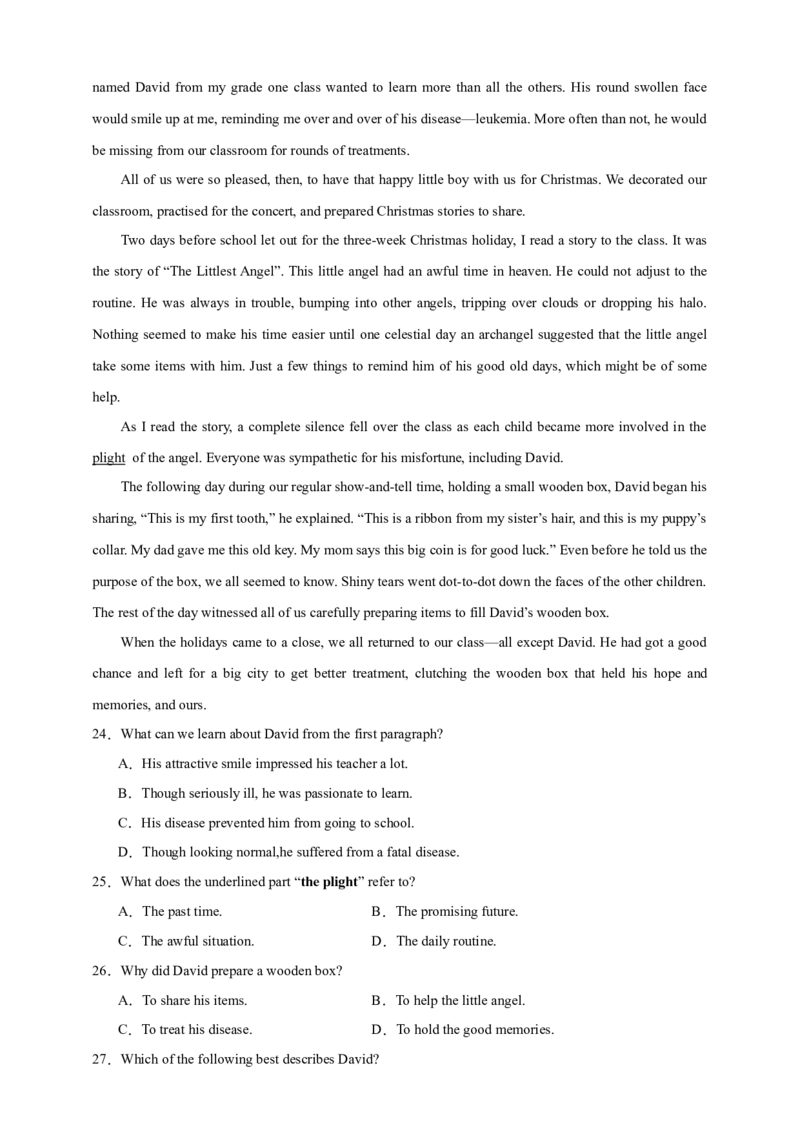
It was the winter when I taught in a small country school on the west coast of Vancouver Island. I had
three grades of little people in my class, all beaming with the desire to learn all they could. One little boynamed David from my grade one class wanted to learn more than all the others. His round swollen face
would smile up at me, reminding me over and over of his disease—leukemia. More often than not, he would
be missing from our classroom for rounds of treatments.
All of us were so pleased, then, to have that happy little boy with us for Christmas. We decorated our
classroom, practised for the concert, and prepared Christmas stories to share.
Two days before school let out for the three-week Christmas holiday, I read a story to the class. It was
the story of “The Littlest Angel”. This little angel had an awful time in heaven. He could not adjust to the
routine. He was always in trouble, bumping into other angels, tripping over clouds or dropping his halo.
Nothing seemed to make his time easier until one celestial day an archangel suggested that the little angel
take some items with him. Just a few things to remind him of his good old days, which might be of some
help.
As I read the story, a complete silence fell over the class as each child became more involved in the
plight of the angel. Everyone was sympathetic for his misfortune, including David.
The following day during our regular show-and-tell time, holding a small wooden box, David began his
sharing, “This is my first tooth,” he explained. “This is a ribbon from my sister’s hair, and this is my puppy’s
collar. My dad gave me this old key. My mom says this big coin is for good luck.” Even before he told us the
purpose of the box, we all seemed to know. Shiny tears went dot-to-dot down the faces of the other children.
The rest of the day witnessed all of us carefully preparing items to fill David’s wooden box.
When the holidays came to a close, we all returned to our class—all except David. He had got a good
chance and left for a big city to get better treatment, clutching the wooden box that held his hope and
memories, and ours.
24.What can we learn about David from the first paragraph?
A.His attractive smile impressed his teacher a lot.
B.Though seriously ill, he was passionate to learn.
C.His disease prevented him from going to school.
D.Though looking normal,he suffered from a fatal disease.
25.What does the underlined part “the plight” refer to?
A.The past time. B.The promising future.
C.The awful situation. D.The daily routine.
26.Why did David prepare a wooden box?
A.To share his items. B.To help the little angel.
C.To treat his disease. D.To hold the good memories.
27.Which of the following best describes David?A.Intelligent and diligent. B.Sociable and adventurous.
C.Strong-willed and ambitious. D.Optimistic and courageous.
C
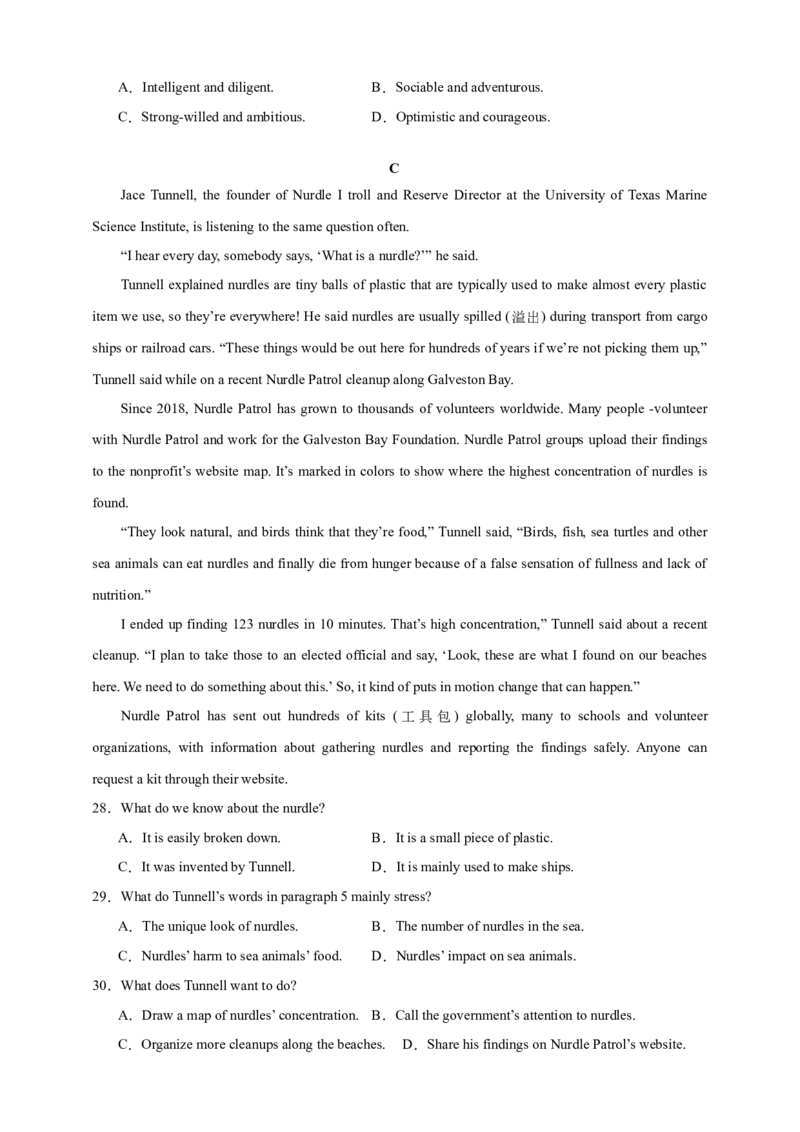
Jace Tunnell, the founder of Nurdle I troll and Reserve Director at the University of Texas Marine
Science Institute, is listening to the same question often.
“I hear every day, somebody says, ‘What is a nurdle?’” he said.
Tunnell explained nurdles are tiny balls of plastic that are typically used to make almost every plastic
item we use, so they’re everywhere! He said nurdles are usually spilled (溢出) during transport from cargo
ships or railroad cars. “These things would be out here for hundreds of years if we’re not picking them up,”
Tunnell said while on a recent Nurdle Patrol cleanup along Galveston Bay.
Since 2018, Nurdle Patrol has grown to thousands of volunteers worldwide. Many people -volunteer
with Nurdle Patrol and work for the Galveston Bay Foundation. Nurdle Patrol groups upload their findings
to the nonprofit’s website map. It’s marked in colors to show where the highest concentration of nurdles is
found.
“They look natural, and birds think that they’re food,” Tunnell said, “Birds, fish, sea turtles and other
sea animals can eat nurdles and finally die from hunger because of a false sensation of fullness and lack of
nutrition.”
I ended up finding 123 nurdles in 10 minutes. That’s high concentration,” Tunnell said about a recent
cleanup. “I plan to take those to an elected official and say, ‘Look, these are what I found on our beaches
here. We need to do something about this.’ So, it kind of puts in motion change that can happen.”
Nurdle Patrol has sent out hundreds of kits (工具包) globally, many to schools and volunteer
organizations, with information about gathering nurdles and reporting the findings safely. Anyone can
request a kit through their website.
28.What do we know about the nurdle?
A.It is easily broken down. B.It is a small piece of plastic.
C.It was invented by Tunnell. D.It is mainly used to make ships.
29.What do Tunnell’s words in paragraph 5 mainly stress?
A.The unique look of nurdles. B.The number of nurdles in the sea.
C.Nurdles’ harm to sea animals’ food. D.Nurdles’ impact on sea animals.
30.What does Tunnell want to do?
A.Draw a map of nurdles’ concentration. B.Call the government’s attention to nurdles.
C.Organize more cleanups along the beaches. D.Share his findings on Nurdle Patrol’s website.31.What is the best title for the text?
A.Group surveys the level of pollution in the sea
B.Group takes action to reduce the use of plastics
C.Group tries to deal with pollutant harming wildlife
D.Group looks for volunteers for its beach cleanups
D
Nocturnal (夜间的) exposure to blue light containing short wavelength emissions (450-500 nm) — the
kind of light produced by the screens of many devices raises blood sugar levels and increases sugar intake,
according to a study performed on Sudanian grass rats.
“Much of the artificial light we are exposed to comes from LED lights and screens, which emit high
levels of blue light,” said Anayanci Masis-Vargas from the Universities of Strasbourg and Amsterdam and
his colleagues. According to their study, retinal (网膜的) cells of the eye are sensitive to this blue light and
directly convey information to areas of the brain that control appetite.
In the study, the scientists exposed diurnal Sudanian grass rats to nighttime blue light (490 nm) and
measured their food consumption and glucose (葡萄糖) tolerance the following day. “In order to better
model human light exposure, the rats were diurnal, meaning awake during the day and asleep at night, rather
than the typical nocturnal laboratory rats which are awake during nighttime hours,” the researchers
explained. They found that after only one hour of nocturnal blue light exposure, glucose tolerance was
changed in the rats, a warning sign of pre-diabetes.
To investigate what happens with appetite control and food choice after exposure to blue light at night,
in the follow-up study, the rats were given the option to choose among a nutritionally balanced food, water,
pig fat, and sugar water. After the exposure to blue light, the study authors observed that the rats preferred
sugar water and drank more of it that night than during the nights with no blue light exposure. As the
experiment continued, the researchers noticed more exposure to blue light caused rats’ heavier bodies as
well.
“Limiting the amount of time that we spend in front of screens at night is, for now, the best measure to
protect ourselves from the harmful effects of blue light,” Masis-Vargas said. “In case it is necessary to be
exposed to device s at night, I would recommend the night mode features on the devices, which turn the
screens more orange and less blue or the use of blue light filtering glasses that are already available in the
market.”
32.According to the study,nocturnal exposure to blue light will ________.
A.affect blood pressure B.influence appetiteC.disturb the delivery of information D.decrease retinal cells of the eye
33.Why were diurnal rats used instead of nocturnal rats in the study?
A.Their sleep model is simpler to follow.
B.Their sugar intake is easier to measure.
C.Their light contact is similar to that of humans.
D.Their glucose tolerance is close to that of humans.
34.Which was NOT considered in the follow-up study?
A.Food choice. B.Animal weight.
C.Food consumption. D.Animal gender.
35.Which is the most effective way to lessen the harm of blue light according to Masis-Vargas?
A.Upgrading phone mode. B.Changing the color of the screen.
C.Restricting night screen time. D.Wearing blue light filtering glasses.
第二节 (共5小题;每小题2.5分,满分12.5分)
根据短文内容,从短文后的选项中选出能填入空白处的最佳选项。
As the trees drop their leaves and frosts advance in, we prepare our homes and ourselves for the winter
months. 36 When the seasons change, we know that we have to change our behavior to keep
ourselves safe and warm. Our feelings change like the seasons. Laughing, joyful and positive like summer;
sad, angry, and hopeless like winter. 37 However, it would not be practical to feel wonderful all
the time.
The phrase “emotional wintering” was popularized by Katharine May. She mentions emotional
wintering asks us to see our difficult or uncomfortable feelings as winters which we can get ready for and
live through. 38
Sometimes the emotional winters are caused by an event that makes us feel as though we want to
withdraw into ourselves. 39 We need to take time to replenish (补充) them while accepting that
we are sad. Whatever the cause, emotional wintering encourages us to accept that our emotional seasons are
normal and we should manage them as best we can.
40 To manage through challenging times, we need to adjust our habits, reassess our
expectations of ourselves, and ensure that we sustain ourselves appropriately. This process gives us the space
to explore the full range of emotions that make us human, and allows us to safely sit with a feeling, in
relative comfort, until it passes.
With the management, we believe we will be well by the time the next summer rolls around.
A.It prepares us for the coming spring.B.Different emotions come to all of us.
C.Emotional wintering asks us to change.
D.We can grow from challenging experience.
E.Thick socks and cosy blankets are brought out.
F.We expect to always live in our emotional summers.
G.At other times we simply use up our supplies of positivity.
第三部分 语言运用(共两节,满分30分)
第一节 (共15小题;每小题1分,满分15分)
阅读下面短文,从每题所给的A、B、C、D四个选项中选出可以填入空白处的最佳选项。
Dolphins. That’s how I got into trouble. My family were eating dinner when I 41 it up. I
mentioned a friend posting overly inspirational quotes accompanied by photos of rainbows, sunsets, heart-
shaped clouds, you 42 it. “Now she’s moved on to dolphins, I wonder if killer whales are 43
.” Everyone in my family 44 , except my 17-year-old daughter, Maggie. “You’re snarky (爱挖苦
的), Mom. You make fun of everything.” I wanted to argue, but Maggie gave me the teenage 45
shoulder.
All night I thought about what Maggie had said. Was she 46 ? Was I too snarky? Actually, I
wasn’t a 47 person. But around people I was comfortable with, I did tend to 48 things.
So for this New Year’s Resolution, I 49 I’d stop being snarky. The first few days, I wasn’t
expressing the snark, but the 50 kept running in my head. I, however, controlled them.
Gradually, I managed not only to stop being snarky, but to be 51 to others.
Several days later, I was in the regular supermarket. The check-out clerk was a sour woman who rarely
said anything apart from the 52 “welcome”. Noticing she seemed sad, I didn’t give the 53
in my usual way. Instead, I just 54 for her. I did something I’d never done before. I smiled at
her. She smiled back. I left the store feeling 55 somehow.
41.A.tore B.put C.brought D.picked
42.A.like B.name C.draw D.share
43.A.alive B.next C.dangerous D.past
44.A.screamed B.rose C.froze D.laughed
45.A.cold B.broad C.bony D.tense
46.A.pessimistic B.reliable C.right D.guilty
47.A.greedy B.ridiculous C.rigid D.mean
48.A.set aside B.put up with C.make fun of D.take down49.A.decided B.agreed C.pretended D.guessed
50.A.arguments B.comments C.jokes D.plans
51.A.kind B.blind C.humble D.plain
52.A.controlled B.required C.interrupted D.teased
53.A.assistance B.information C.response D.suggestion
54.A.felt B.behaved C.arose D.fought
55.A.clearer B.tougher C.milder D.lighter
第二节 (共10小题;每小题1.5分,满分15分)
阅读下面短文,在空白处填入1个适当的单词或括号内单词的正确形式。
When an important holiday comes, I usually think of what gifts to buy or prepare for my family
members. It is the act 56 (it)rather than the things you buy that matters. Either a small present, a text
message or a phone call can mean a lot to the receivers. 57 , I had never got anything from my son,
who is 58 university student. Parents never forget to celebrate their children's birthday, but their
children seem to be very forgetful. They seldom do something in return.
Life is unpredictable, and you never know what will happen tomorrow. When my son came back during
the summer vacation, my wife and I, as usual, 59 (meet)him at the station. On arriving home, much
60 my surprise, my son took out a fashionable wrist watch and gave it to me, 61 (say)it was a
birthday gift for me. You can imagine how 62 (surprise)and excited I was at that moment!
Some people say children get too much care and love from their parents, 63 they never express
thanks for. It is natural for people to have such concerns and 64 (worry), but things may not turn out
as badly as 65 (expect).
第四部分:写作(共两节,满分40分)
第一节 (满分15分)
66.假定你是李华,上周末你参加了学校组织的市科技馆研学活动。请你在校英文论坛发表一篇帖
子,分享此次经历,内容包括:
1. 活动过程;
2. 个人感悟;
3. 期待评论。
注意:
1. 词数80左右;
2. 可适当增加细节,以使行文连贯。An Unforgettable Tech Exploration Tour
_______________________________________________________________________________________
_______________________________________________________________________________________
_______________________________________________________________________________________
_______________________________________________________________________________________
_______________________________________________________________________________________
__________________
第二节:读后续写(满分25分)
阅读下面材料,根据其内容和所给段落开头语续写两段,使之构成一篇完整的短文。
It was Sally’s birthday, and Mother had made her a cake with even candles on it.
Mother, Sally, and Nan went to the beach for a picnic and took the birthday cake with them.
The two girls took off their shoes and stockings and waded in the water. They dug caves and built
castles in the sand.
Soon Mother was ready to cook dinner. So Nan and Sally ran up and down the beach, picking up dry
sticks. Then they piled the sticks together to make a fire, and Nan called Mother to light them.
“Nan,” said Mother, “these sticks will not burn. They are so close together that no air can get between
them. You must spread them out. Fire needs air to burn. Let me show you some-thing.”
Mother took a candle from Sally’s cake and lit it. Then she set it up in the sand.
“Now,” said Mother, “get me the glass jar we brought for water.”
She put the jar over the candle, and the candle flame changed slowly from yellow to blue.Then it went
out.
“No air can get through the glass jar,” said Mother. “After the fire burned all the air inside the jar, it
couldn’t get any more air, and the flame went out.”
Nan made another pile of sticks. This time she spread the sticks so that plenty of air could get between
them. When the fire was lit, it burned quickly.
“We can put this fire out if we pour sand on it,” said Mother. “The sand will keep air from the fire.”
“May I try it now?”asked Nan.
“Yes,” said her mother. “But be careful!”
Nan poured sand on a burning stick, and the flames went out.
“Before we leave, we will put out our fire by pouring sand on it,” said Mother.
After dinner Mother walked down the beach to hunt for shells. Sally and Nan stayed by the fire,looking at the smoke and flames.
Sally went near the fire to throw on more wood. Suddenly her dress caught fire. She began to scream.
注意:
1. 续写词数应为150左右;
2. 续写部分分为两段,每段的开头语已为你写好。
Nan was frightened, too, but she did not scream.
_______________________________________________________________________________________
_______________________________________________________________________________________
_______________________________________________________________________________________
_______________________________________________________________________________________
_______________________________________________________________________________________
______________________________
Mother heard Sally scream and came running back.