第9 讲 动词不定式2026 年高考英语语法专项突破(全国通
用)
(语法讲义+模拟练习+真题操练)
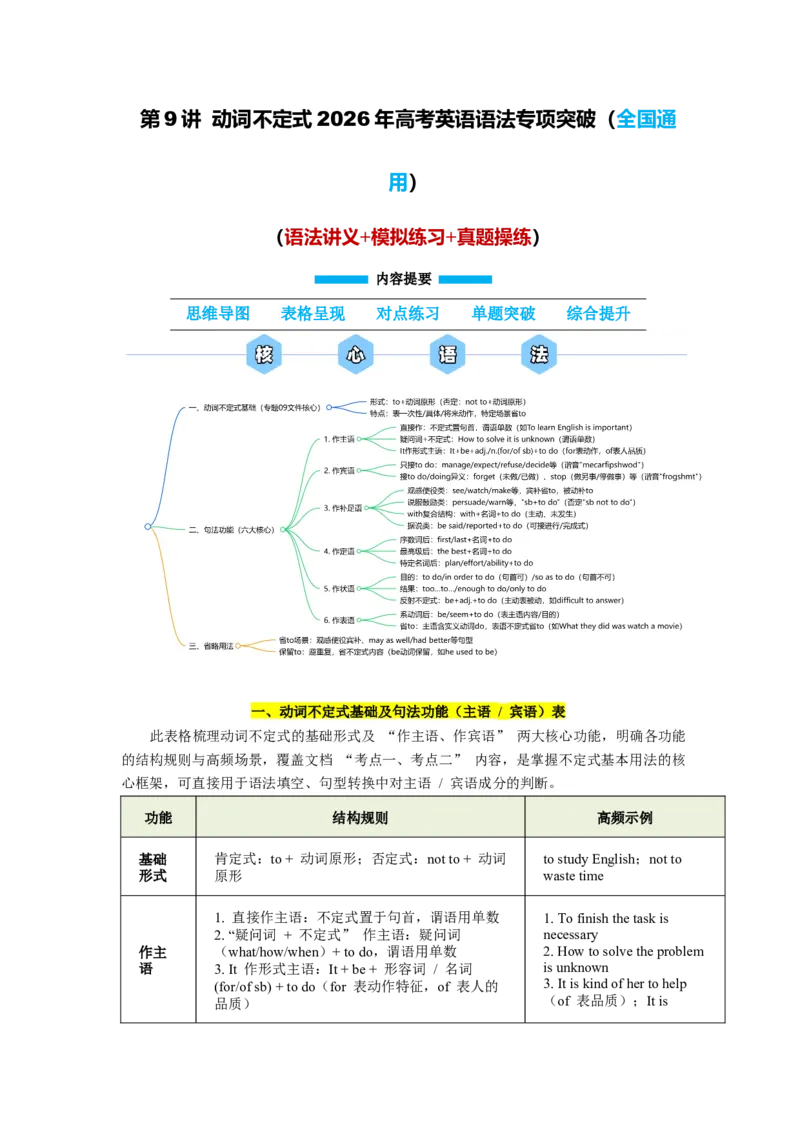
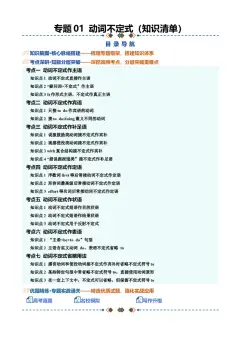
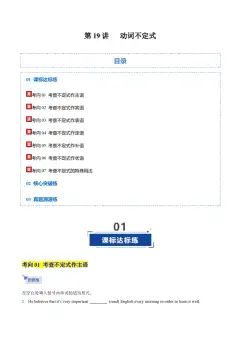
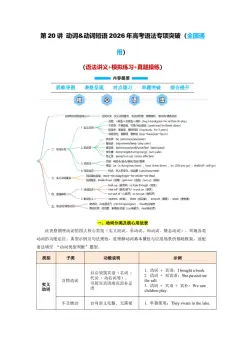
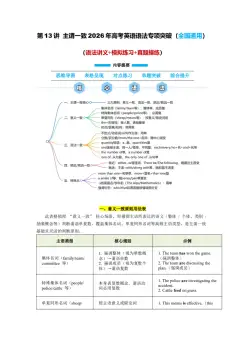
 内容提要
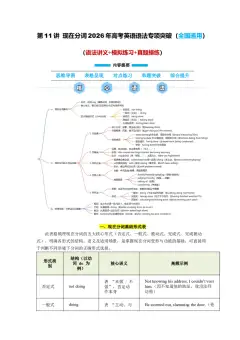
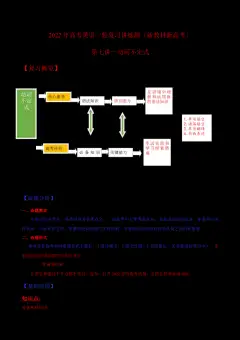
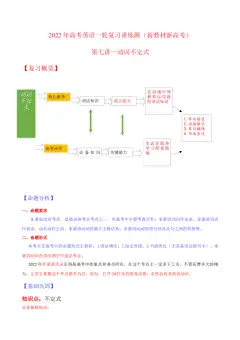
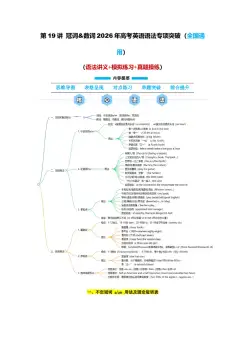
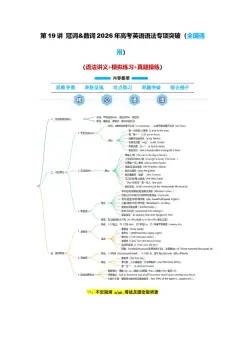
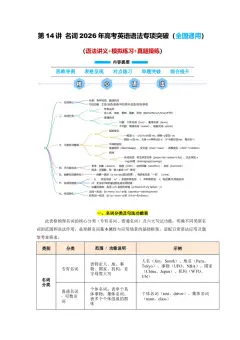
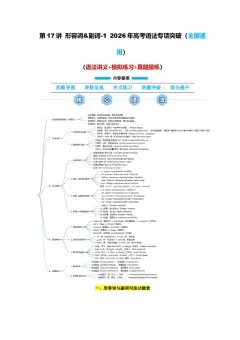
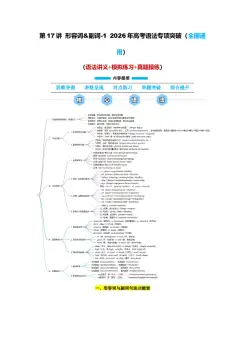
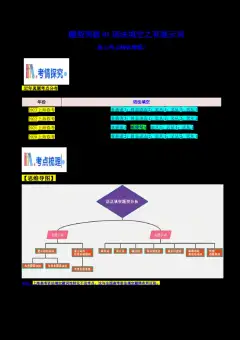
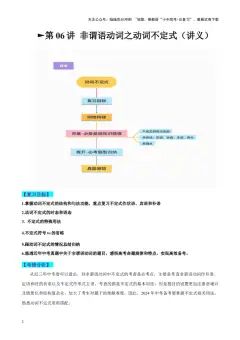
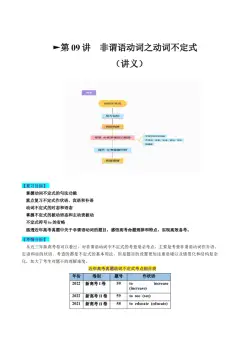
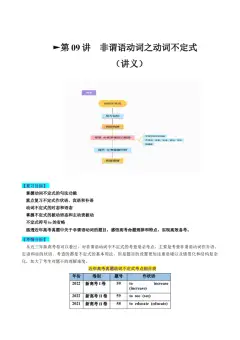
思维导图
表格呈现
对点练习
单题突破
综合提升
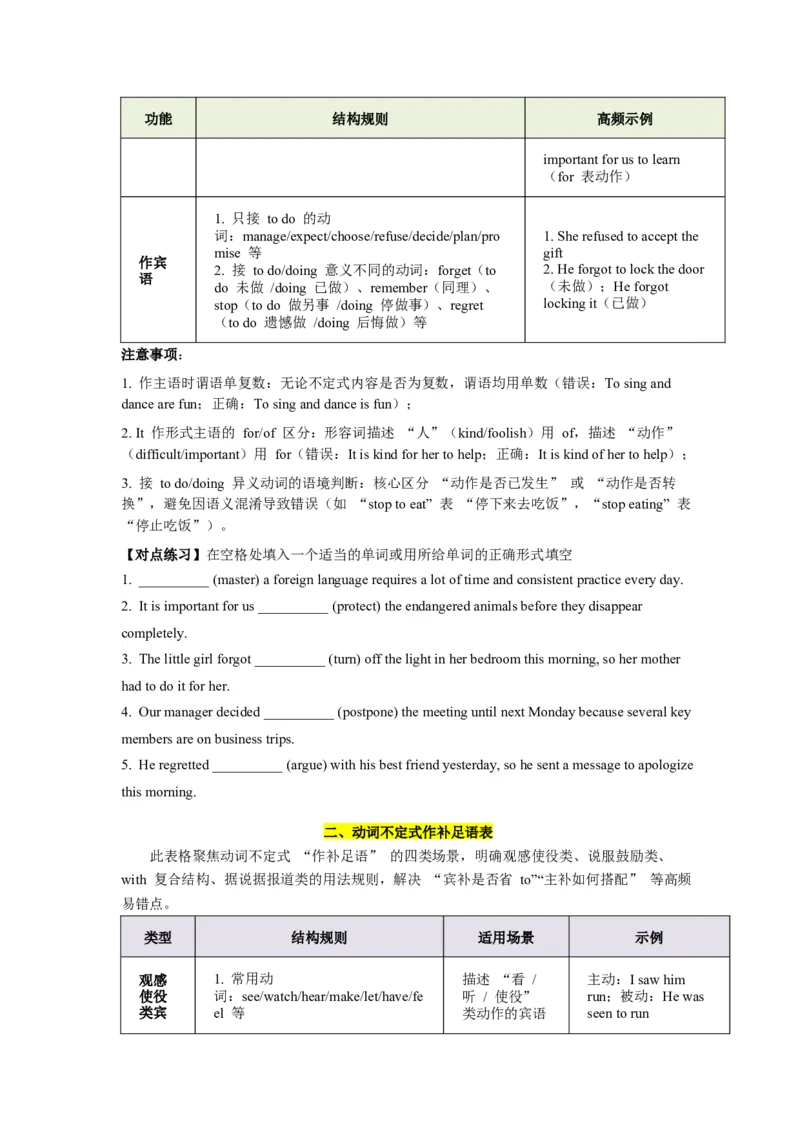
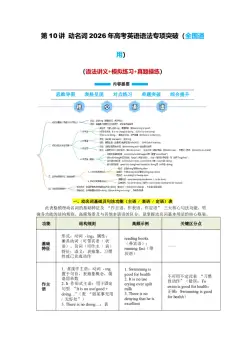
一、动词不定式基础及句法功能(主语 / 宾语)表
此表格梳理动词不定式的基础形式及 “作主语、作宾语” 两大核心功能,明确各功能
的结构规则与高频场景,覆盖文档 “考点一、考点二” 内容,是掌握不定式基本用法的核
心框架,可直接用于语法填空、句型转换中对主语 / 宾语成分的判断。
功能
结构规则
高频示例
基础
形式
肯定式:to + 动词原形;否定式:not to + 动词
原形
to study English;not to
waste time
作主
语
1. 直接作主语:不定式置于句首,谓语用单数
2. “疑问词 + 不定式” 作主语:疑问词
(what/how/when)+ to do,谓语用单数
3. It 作形式主语:It + be + 形容词 / 名词
(for/of sb) + to do(for 表动作特征,of 表人的
品质)
1. To finish the task is
necessary
2. How to solve the problem
is unknown
3. It is kind of her to help
(of 表品质);It is
功能
结构规则
高频示例
important for us to learn
(for 表动作)
作宾
语
1. 只接 to do 的动
词:manage/expect/choose/refuse/decide/plan/pro
mise 等
2. 接 to do/doing 意义不同的动词:forget(to
do 未做 /doing 已做)、remember(同理)、
stop(to do 做另事 /doing 停做事)、regret
(to do 遗憾做 /doing 后悔做)等
1. She refused to accept the
gift
2. He forgot to lock the door
(未做);He forgot
locking it(已做)
注意事项:
1. 作主语时谓语单复数:无论不定式内容是否为复数,谓语均用单数(错误:To sing and
dance are fun;正确:To sing and dance is fun);
2. It 作形式主语的 for/of 区分:形容词描述 “人”(kind/foolish)用 of,描述 “动作”
(difficult/important)用 for(错误:It is kind for her to help;正确:It is kind of her to help);
3. 接 to do/doing 异义动词的语境判断:核心区分 “动作是否已发生” 或 “动作是否转
换”,避免因语义混淆导致错误(如 “stop to eat” 表 “停下来去吃饭”,“stop eating” 表
“停止吃饭”)。
【对点练习】在空格处填入一个适当的单词或用所给单词的正确形式填空
1. __________ (master) a foreign language requires a lot of time and consistent practice every day.
2. It is important for us __________ (protect) the endangered animals before they disappear
completely.
3. The little girl forgot __________ (turn) off the light in her bedroom this morning, so her mother
had to do it for her.
4. Our manager decided __________ (postpone) the meeting until next Monday because several key
members are on business trips.
5. He regretted __________ (argue) with his best friend yesterday, so he sent a message to apologize
this morning.
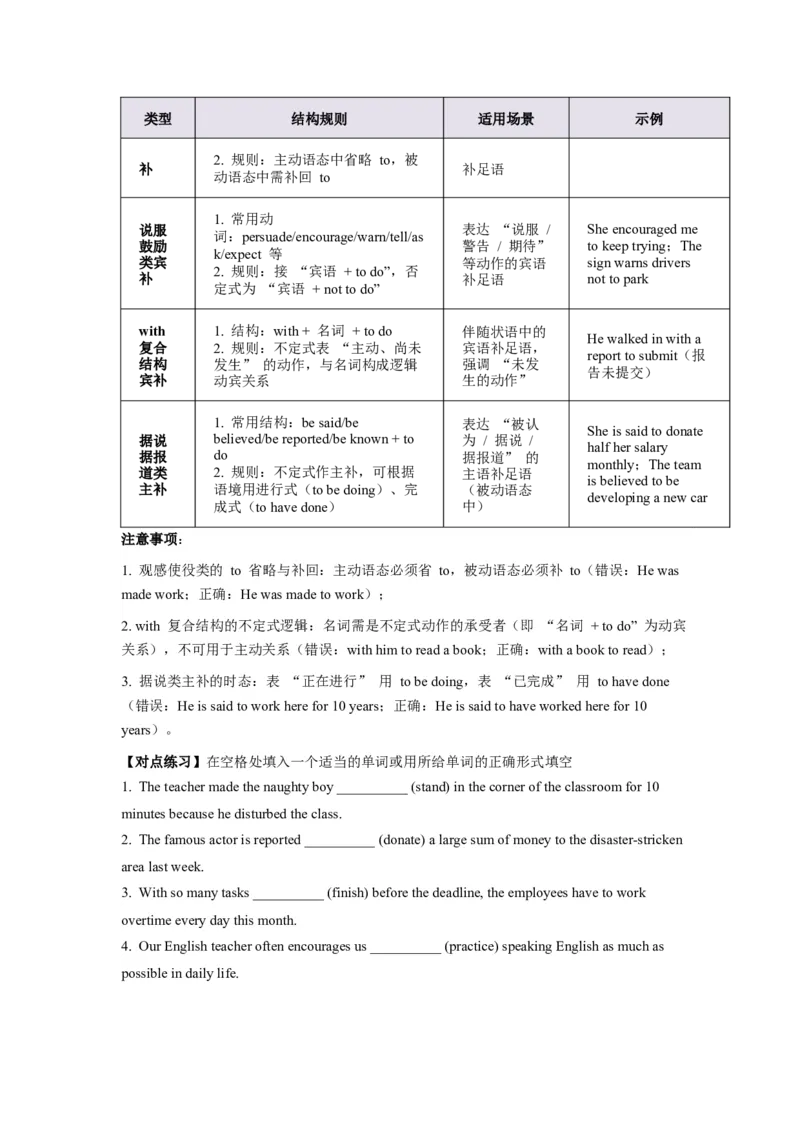
二、动词不定式作补足语表
此表格聚焦动词不定式 “作补足语” 的四类场景,明确观感使役类、说服鼓励类、
with 复合结构、据说据报道类的用法规则,解决 “宾补是否省 to”“主补如何搭配” 等高频
易错点。
类型
结构规则
适用场景
示例
观感
使役
类宾
1. 常用动
词:see/watch/hear/make/let/have/fe
el 等
描述 “看 /
听 / 使役”
类动作的宾语
主动:I saw him
run;被动:He was
seen to run
类型
结构规则
适用场景
示例
补
2. 规则:主动语态中省略 to,被
动语态中需补回 to
补足语
说服
鼓励
类宾
补
1. 常用动
词:persuade/encourage/warn/tell/as
k/expect 等
2. 规则:接 “宾语 + to do”,否
定式为 “宾语 + not to do”
表达 “说服 /
警告 / 期待”
等动作的宾语
补足语
She encouraged me
to keep trying;The
sign warns drivers
not to park
with
复合
结构
宾补
1. 结构:with + 名词 + to do
2. 规则:不定式表 “主动、尚未
发生” 的动作,与名词构成逻辑
动宾关系
伴随状语中的
宾语补足语,
强调 “未发
生的动作”
He walked in with a
report to submit(报
告未提交)
据说
据报
道类
主补
1. 常用结构:be said/be
believed/be reported/be known + to
do
2. 规则:不定式作主补,可根据
语境用进行式(to be doing)、完
成式(to have done)
表达 “被认
为 / 据说 /
据报道” 的
主语补足语
(被动语态
中)
She is said to donate
half her salary
monthly;The team
is believed to be
developing a new car
注意事项:
1. 观感使役类的 to 省略与补回:主动语态必须省 to,被动语态必须补 to(错误:He was
made work;正确:He was made to work);
2. with 复合结构的不定式逻辑:名词需是不定式动作的承受者(即 “名词 + to do” 为动宾
关系),不可用于主动关系(错误:with him to read a book;正确:with a book to read);
3. 据说类主补的时态:表 “正在进行” 用 to be doing,表 “已完成” 用 to have done
(错误:He is said to work here for 10 years;正确:He is said to have worked here for 10
years)。
【对点练习】在空格处填入一个适当的单词或用所给单词的正确形式填空
1. The teacher made the naughty boy __________ (stand) in the corner of the classroom for 10
minutes because he disturbed the class.
2. The famous actor is reported __________ (donate) a large sum of money to the disaster-stricken
area last week.
3. With so many tasks __________ (finish) before the deadline, the employees have to work
overtime every day this month.
4. Our English teacher often encourages us __________ (practice) speaking English as much as
possible in daily life.
5. The little boy was seen __________ (climb) the tall tree in the park yesterday afternoon, which
made his parents very worried.
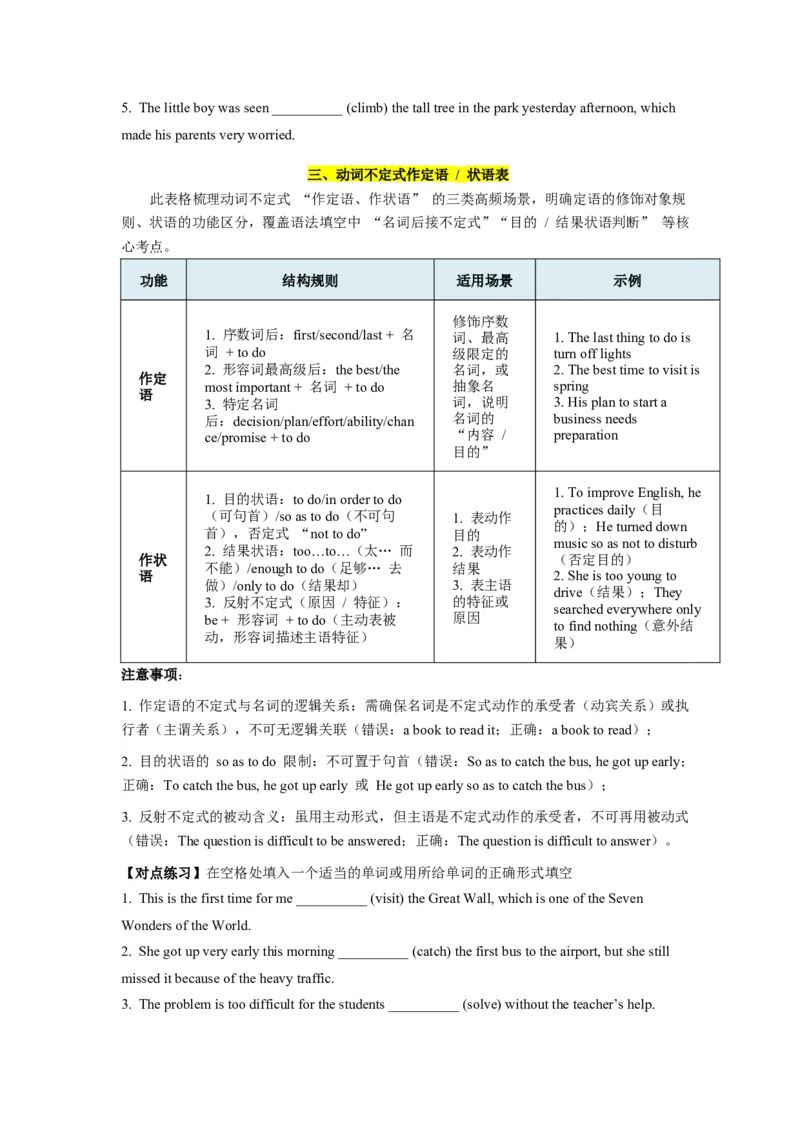
三、动词不定式作定语 / 状语表
此表格梳理动词不定式 “作定语、作状语” 的三类高频场景,明确定语的修饰对象规
则、状语的功能区分,覆盖语法填空中 “名词后接不定式”“目的 / 结果状语判断” 等核
心考点。
功能
结构规则
适用场景
示例
作定
语
1. 序数词后:first/second/last + 名
词 + to do
2. 形容词最高级后:the best/the
most important + 名词 + to do
3. 特定名词
后:decision/plan/effort/ability/chan
ce/promise + to do
修饰序数
词、最高
级限定的
名词,或
抽象名
词,说明
名词的
“内容 /
目的”
1. The last thing to do is
turn off lights
2. The best time to visit is
spring
3. His plan to start a
business needs
preparation
作状
语
1. 目的状语:to do/in order to do
(可句首)/so as to do(不可句
首),否定式 “not to do”
2. 结果状语:too…to…(太… 而
不能)/enough to do(足够… 去
做)/only to do(结果却)
3. 反射不定式(原因 / 特征):
be + 形容词 + to do(主动表被
动,形容词描述主语特征)
1. 表动作
目的
2. 表动作
结果
3. 表主语
的特征或
原因
1. To improve English, he
practices daily(目
的);He turned down
music so as not to disturb
(否定目的)
2. She is too young to
drive(结果);They
searched everywhere only
to find nothing(意外结
果)
注意事项:
1. 作定语的不定式与名词的逻辑关系:需确保名词是不定式动作的承受者(动宾关系)或执
行者(主谓关系),不可无逻辑关联(错误:a book to read it;正确:a book to read);
2. 目的状语的 so as to do 限制:不可置于句首(错误:So as to catch the bus, he got up early;
正确:To catch the bus, he got up early 或 He got up early so as to catch the bus);
3. 反射不定式的被动含义:虽用主动形式,但主语是不定式动作的承受者,不可再用被动式
(错误:The question is difficult to be answered;正确:The question is difficult to answer)。
【对点练习】在空格处填入一个适当的单词或用所给单词的正确形式填空
1. This is the first time for me __________ (visit) the Great Wall, which is one of the Seven
Wonders of the World.
2. She got up very early this morning __________ (catch) the first bus to the airport, but she still
missed it because of the heavy traffic.
3. The problem is too difficult for the students __________ (solve) without the teacher’s help.
4. He is one of the most experienced doctors __________ (perform) this kind of operation in our
hospital.
5. The young man has made a decision __________ (give up) smoking because his doctor warned
him of the health risks.
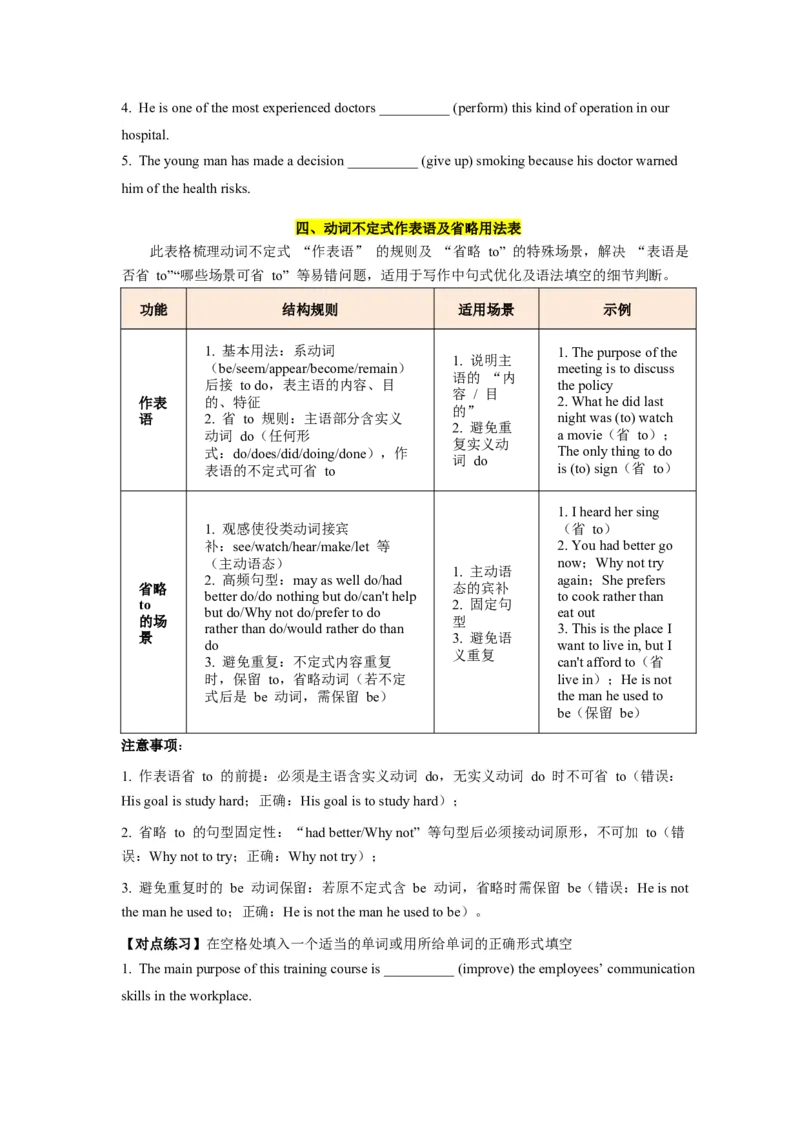
四、动词不定式作表语及省略用法表
此表格梳理动词不定式 “作表语” 的规则及 “省略 to” 的特殊场景,解决 “表语是
否省 to”“哪些场景可省 to” 等易错问题,适用于写作中句式优化及语法填空的细节判断。
功能
结构规则
适用场景
示例
作表
语
1. 基本用法:系动词
(be/seem/appear/become/remain)
后接 to do,表主语的内容、目
的、特征
2. 省 to 规则:主语部分含实义
动词 do(任何形
式:do/does/did/doing/done),作
表语的不定式可省 to
1. 说明主
语的 “内
容 / 目
的”
2. 避免重
复实义动
词 do
1. The purpose of the
meeting is to discuss
the policy
2. What he did last
night was (to) watch
a movie(省 to);
The only thing to do
is (to) sign(省 to)
省略
to
的场
景
1. 观感使役类动词接宾
补:see/watch/hear/make/let 等
(主动语态)
2. 高频句型:may as well do/had
better do/do nothing but do/can't help
but do/Why not do/prefer to do
rather than do/would rather do than
do
3. 避免重复:不定式内容重复
时,保留 to,省略动词(若不定
式后是 be 动词,需保留 be)
1. 主动语
态的宾补
2. 固定句
型
3. 避免语
义重复
1. I heard her sing
(省 to)
2. You had better go
now;Why not try
again;She prefers
to cook rather than
eat out
3. This is the place I
want to live in, but I
can't afford to(省
live in);He is not
the man he used to
be(保留 be)
注意事项:
1. 作表语省 to 的前提:必须是主语含实义动词 do,无实义动词 do 时不可省 to(错误:
His goal is study hard;正确:His goal is to study hard);
2. 省略 to 的句型固定性:“had better/Why not” 等句型后必须接动词原形,不可加 to(错
误:Why not to try;正确:Why not try);
3. 避免重复时的 be 动词保留:若原不定式含 be 动词,省略时需保留 be(错误:He is not
the man he used to;正确:He is not the man he used to be)。
【对点练习】在空格处填入一个适当的单词或用所给单词的正确形式填空
1. The main purpose of this training course is __________ (improve) the employees’ communication
skills in the workplace.
2. What the old craftsman did yesterday was __________ (repair) the ancient wooden chair that has
a history of over 100 years.
3. You had better __________ (check) the weather forecast before you go on a trip to the mountain
area, in case it rains suddenly.
4. The little boy said he would rather __________ (stay) at home and read books than go out to play
with his classmates.
5. She doesn’t like this dress, but she has no other clothes __________ (wear) to the party tonight, so
she has to take it.
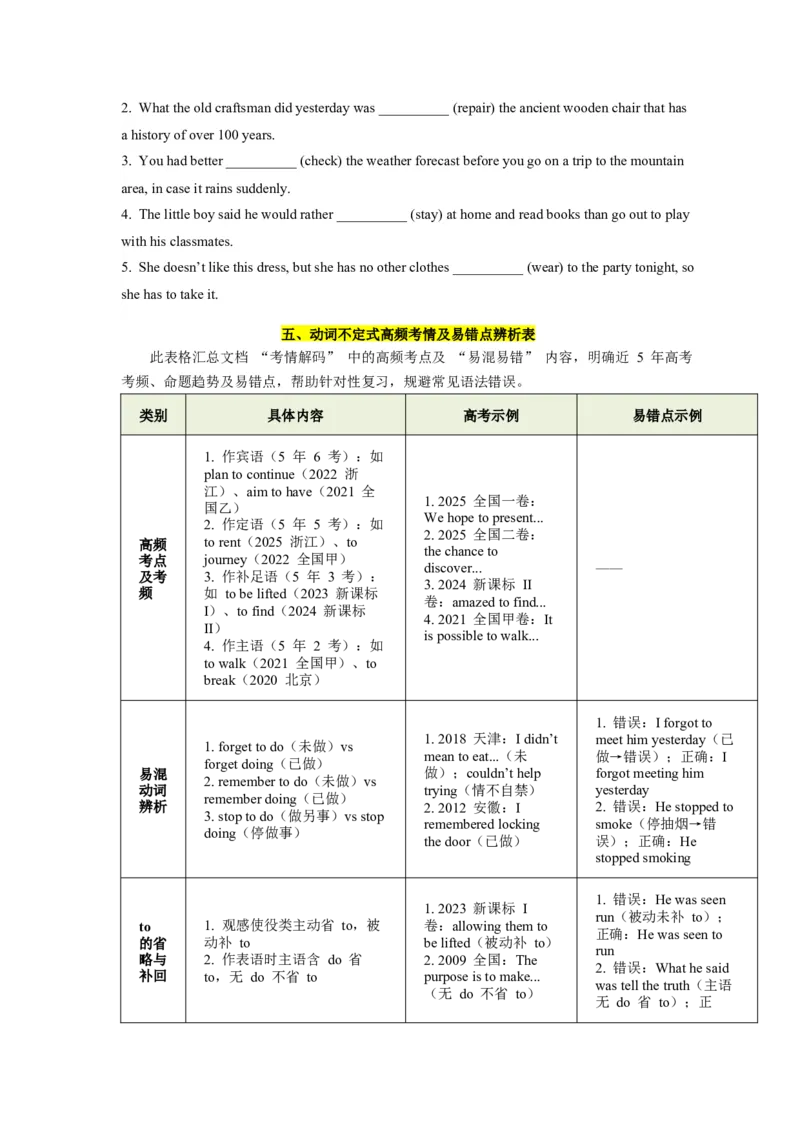
五、动词不定式高频考情及易错点辨析表
此表格汇总文档 “考情解码” 中的高频考点及 “易混易错” 内容,明确近 5 年高考
考频、命题趋势及易错点,帮助针对性复习,规避常见语法错误。
类别
具体内容
高考示例
易错点示例
高频
考点
及考
频
1. 作宾语(5 年 6 考):如
plan to continue(2022 浙
江)、aim to have(2021 全
国乙)
2. 作定语(5 年 5 考):如
to rent(2025 浙江)、to
journey(2022 全国甲)
3. 作补足语(5 年 3 考):
如 to be lifted(2023 新课标
I)、to find(2024 新课标
II)
4. 作主语(5 年 2 考):如
to walk(2021 全国甲)、to
break(2020 北京)
1. 2025 全国一卷:
We hope to present...
2. 2025 全国二卷:
the chance to
discover...
3. 2024 新课标 II
卷:amazed to find...
4. 2021 全国甲卷:It
is possible to walk...
——
易混
动词
辨析
1. forget to do(未做)vs
forget doing(已做)
2. remember to do(未做)vs
remember doing(已做)
3. stop to do(做另事)vs stop
doing(停做事)
1. 2018 天津:I didn’t
mean to eat...(未
做);couldn’t help
trying(情不自禁)
2. 2012 安徽:I
remembered locking
the door(已做)
1. 错误:I forgot to
meet him yesterday(已
做→错误);正确:I
forgot meeting him
yesterday
2. 错误:He stopped to
smoke(停抽烟→错
误);正确:He
stopped smoking
to
的省
略与
补回
1. 观感使役类主动省 to,被
动补 to
2. 作表语时主语含 do 省
to,无 do 不省 to
1. 2023 新课标 I
卷:allowing them to
be lifted(被动补 to)
2. 2009 全国:The
purpose is to make...
(无 do 不省 to)
1. 错误:He was seen
run(被动未补 to);
正确:He was seen to
run
2. 错误:What he said
was tell the truth(主语
无 do 省 to);正
类别
具体内容
高考示例
易错点示例
确:What he said was to
tell the truth
注意事项:
1. 结合考频重点复习:作宾语、定语、补足语是近 5 年高频考点,需重点掌握对应动词及
结构;
2. 易混动词的语境判断:通过 “动作是否已发生”“动作是否转换” 区分 to do/doing 的
含义,避免凭直觉判断;
3. to 的省略与补回的被动语态:牢记 “主动省、被动补”,这是高考语法填空的高频易错
点,需反复验证。
【对点练习】在空格处填入一个适当的单词或用所给单词的正确形式填空
1. The scientist is said __________ (work) on a new project about renewable energy recently, which
will be completed next year.
2. He stopped __________ (drink) a cup of coffee after he had been working on the computer for
two hours.
3. It is kind of you __________ (help) me carry the heavy luggage to the train station this morning.
4. The children were made __________ (clean) their own bedrooms every weekend by their parents
to develop their independence.
5. She remembered __________ (lock) the door before she left the office yesterday, but when she
came back this morning, she found it open.
一、单句语法填空:用所给单词的正确形式填空
1.(2025 高三上·江苏·专题练习)The theater aims

      (build) a bridge
between deaf and hearing worlds by performing Shakespeare’s comedy in sign language.
2.(2025·广东·二模)Fortunately, there is a huge industry of plastic-free products

(target) at eco-conscious consumers.
3.(2025 高三上·江苏·专题练习)                 (allow) for the bad weather, we should set
off right now.
4.(2023 高三·上海·专题练习)He repeated the question in an even sterner tone, “Where is
God!!?” Again the boy made no attempt        (answer).
5.(2023 高三·上海·专题练习)On their return, the father asked his son


(explain) what he had learnt.
6.(2025 高三上·江苏·专题练习)The ability

    (smile) is actually something
we are born with.
7.(2025·广东·二模)They are close friends, so nothing is likely                (threat) their
relationship which many people find harmonious.
8.(2022 高三上·浙江·专题练习)Larger amounts of caffeine can cause a problem

(call) caffeinism.
9.(23-24 高三上·福建·开学考试)                 (expose) to freezing weather, courageous
tourists and scientists still choose to visit Antarctica.
10.(2025 高三上·江苏·专题练习)The president agreed,

    (add) that he hope
for a peaceful solution.
11.(2022 高三·上海·专题练习)Yet they’re hard


  (beat) — when it comes
to recreational offerings, including nightlife, culture and entertainment .
12.(2023 高三·上海·专题练习)King Edgar was the first monarch               (bury) there
in 1065.
13.(2025 高三上·江苏·专题练习)I have agreed

      (go) with Alice to buy
some clothes.
14.(2025·江苏南京·一模)               (ease) this area’s water shortage, the local
government decided to construct a canal across the mountains, whose construction was remarkable
engineering achievement.
15.(2025·江苏南京·一模)Found in 2007, walls of the ruins and the surrounding water
conservation system combined to display a massive infrastructure base, construction of which is
estimated

      (take) 4,000 people a decade to accomplish.
Passage 1
(2023·新课标Ⅰ卷·高考真题)阅读下面短文,在空白处填入1 个适当的单词或括号内单词的
正确形式。
Xiao long bao (soup dumplings), those amazing constructions of delicate dumpling wrappers,
encasing hot,     1               (taste) soup and sweet, fresh meat, are far and away my
favorite Chinese street food. The dumplings arrive steaming and dangerously hot. To eat one, you
have to decide whether     2               (bite) a small hole in it first, releasing the stream and
risking a spill (溢出),     3               to put the whole dumpling in your mouth, letting the
hot soup explode on your tongue. Shanghai may be the     4               (recognize) home of
the soup dumplings but food historians will actually point you to the neighboring canal town of
Nanxiang as Xiao long Bao’s birthplace. There you will find them prepared differently — more
dumpling and less soup, and the wrappers are pressed     5               hand rather than
rolled. Nanxiang aside, the best Xiao long bao have a fine skin, allowing them     6

(lift) out of the steamer basket without tearing or spilling any of     7               (they)
contents. The meat should be fresh with     8               touch of sweetness and the soup
hot, clear and delicious.
No matter where I buy them, one steamer is     9               (rare) enough, yet two
seems greedy, so I am always left       10                 (want) more next time.
Passage 2
(2025·广东·模拟预测)阅读下面短文,在空白处填入1 个适当的单词或括号内单词的正确形
式。
How can a timeless story come alive again?     1               (stage) at the Esplanade
— Theatres on the Bay in Singapore, the Chinese classic, A Dream of Red Mansions, attracted an
audience of about 7,000, marking the start of its first overseas tour.
The dance drama unfolds a centuries-old tale, rich with love and


 2

(lose). As the curtain slowly rose, the audiences     3               (draw) into a world of
traditional Chinese beauty. Inspired by classical ink paintings, the stage design combined folding
screens, silk curtains, tables and soft lights     4               (create) a space rooted in
Chinese aesthetics (美学) . Then the Jia family’s mansion appeared,     5               delicate
columns and roofs reflecting the elegance of the. Qing Dynasty. At the center
   6

(stand) Jia Baoyu, dressed in red, and the fates of the “12 beauties” began to emerge.
The director and choreographer (编舞者), Li Xing and Li Chao, artfully wove the number12
into the performance — 12 bunches of flowers, 12 high-back chairs, 12 colors, and 12 dance pieces,
each symbolizing     7               unique aspect of the journey of “12 beauties”. Their lives,
8               revealed their emotional depth and complexity, came to life in dance through the
eyes of Jia.
Audiences were impressed by the rich storytelling, graceful choreography, and     9

(strike) stage design, calling it a feast for the senses. “We hope this work of art helps more people
engage with Chinese culture and promotes     10               (deep) understanding between
traditions,” said Liao Yi, general manager of the Jiangsu Centre for the Performing Arts.
Passage 3
(2024·全国甲卷·高考真题)阅读下面短文, 在空白处填入1 个适当的单词或括号内单词的正
确形式。
Although parks of all sizes and types exist at any level, the national parks, in particular, tend
1               (catch) our attention because of their large size and variety. They are     2

(treasure) of American heritage (遗产). How did the national park system come about? On a cool,
starry night in mid-September 1870, four men relaxed before a campfire along the Firehole River in
3               is now northwestern Wyoming. They     4              (be) part of a 15-
member exploring party that had spent almost five awesome weeks in witness of the natural beauties
there.
What should     5              (do) with such a beautiful place? They wondered out
loud. This area, with     6               (it) unique and breathtaking natural beauty, must be
well preserved     7               all people of the nation to enjoy — as a national park. They
all agreed and vowed (承诺) to promote the idea at the     8               (complete) of their
journey. Their promotional work paid off. Two years later, 18 years before Wyoming became a state,
Yellowstone became the first national park in the United States and the world. Yellowstone was the
9               (large) United States national park — 2.2 million acres — until Wrangell-Saint
Elias in southern Alaska,      10                became a national monument in 1978, took the
honors as a national park in 1980 with 12.3 million acres.
Passage 4
(2025·陕西商洛·模拟预测)阅读下面短文,在空白处填入1 个适当的单词或括号内单词的正
确形式。
For the over 20 rangers (护林员) in the Wanglang National Nature Reserve, apart     1

protecting the forest, they serve another critical function — education.
Located in the northern tip of Sichuan, Wanglang is     2               (little) well
known than the nearby scenic areas of Jiuzhaigou. But it offers something different.     3

(particular) in the summer months, the reserve’s rangers have a busy schedule acting as guides and
educators to many tour groups. They teach them about the forest, environmental protection, and the
local species, forest     4               (manage).
This service makes Wanglang different from other nature reserves,


 5

(enable) it to carve out its own niche in nature education. The 323-square-kilometer park, about the
size of the island of Malta,     6               (visit) by a diverse range of people, from
elementary and high school students to scholars, as well as families and botany enthusiasts from
overseas.
“Despite the growing number of visitors,     7               brings in a lot of income,”
Zhao Lianjun, director of the Wanglang reserve said, “conservation will always remain     8

only key focus.” Wanglang was one of the very first nature reserves in the country     9

(offer) nature education, according to Zhao.     10               (found) as a wild giant panda
reserve in 1965, Wanglang’s long tradition of cooperating with research institutions have made it a
prime location for nature education.
Passage 5
(2025·广西·一模)阅读下面短文,在空白处填入1 个适当的单词或括号内单词的正确形式。
Cultural policymakers and experts from China and Malaysia are now crafting an action plan
for protecting and promoting the lion dance, a tradition that has leaped across borders and
generations, after     1               (submit) a joint bid to UNESCO in late March to
recognize the art form as a shared intangible cultural heritage.
The     2               (apply) follows a commitment made in     3

statement signed last year, which said the two countries have agreed to work together on the
multinational nomination (提名) to officially put the lion dance     4               the
UNESCO Representative List of the Intangible Cultural Heritage of Humanity.
    5               (typical) performed during festivals and celebrations, the lion dance,
which integrates martial arts, dance and music, was brought to Malaysia by Chinese immigrants and
6               (develop) gradually into a cross-cultural spectacle enjoyed by diverse
communities in the Southeast Asian nation.
This     7               (include) development not only broadens the reach of the lion
dance, but also inspires local artists to innovate. In the 1980s, Malaysian performers reshaped the
traditional Chinese lion dance through the creation of the high-pole lion dance. The creative art form
8               (recognize) as Malaysia’s national intangible cultural heritage in 2007.
“    9               there are overseas Chinese, there’s the lion dance,” said Chin Yew
Sin, president of Malaysia’s Oriental Culture Research Centre. He suggested that China and Malaysia
expand their cooperation to include more Southeast Asian countries where the lion dance is popular,
such as Thailand and Indonesia,      10                (enhance) regional cultural exchanges.