Passage 1(2024 湖北武汉五调)   主题:人与动物
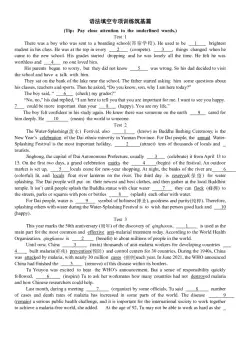
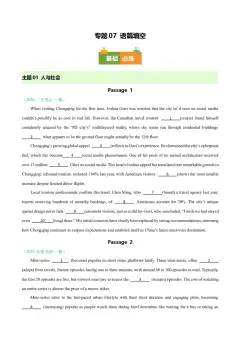
  The first step of ice 1.

 (fish) is getting the net, which is usually over two kilometers
long, ready to put under the ice. Then the workers will put the net down at a 2.

 (choose)
spot, and take it up in the distance of the vast lake.
3.

  this is actually achieved is an interesting process. First up, a series of holes are
drilled into the ice about a meter and a half thick. They drill a hole every 50 meters or so and
they’ll keep doing that until they’ve drilled the holes the entire way around a circle with a
diameter(直径) of one kilometer. Meanwhile, another team gets to work, 4.

 (extend) the
main hole using a 5.

 (tradition) ice pick. Eventually, a long piece of bamboo will 6.

(employ) to thread the rope of the net into the next hole they have drilled 50 meters away. And
these guys will continue like that around the entire outside of the circle until the rope 7.


(reach) the other side of the circle one kilometer away. At the same time, back at the mother hole,
the net is being lowered slowly 8.

  surely, meter by meter until it is 9.


(complete) submerged under the ice. In the distance, the diggers have reached the other side of the
circle and are now working on digging the hole that the net will eventually come out 10.


.
Passage 2(2024 江苏苏锡常镇四市二模)   主题:文化遗产
  China has thousands of years of 1.

 (record) history. However, the history of Chinese
furniture is even longer than 2.

  of its writing, which can be traced back to the Hemudu
Culture.
During the Ming and Qing dynasties, most of the furniture was hand-made using high-quality
hardwood 3.

  raw materials, which are now rare and expensive. Ordinary people often use
wood such as pine, elm, and beech, but the quality between the woods 4.

 (differ) greatly.
Classical furniture is mostly made by hand. Modern machines cannot 5.

 (complete)
replace handwork. The shapes carved by the machine are neat but the lines are rigid and lacking in
vitality.
The most delicate aspect of Chinese classical furniture is the structural part of the furniture—
mortise-and-tenon(榫卯) work. Combining pieces of wood together, 6.

 (use) nothing more
than the wood itself, is a basic skill of all carpenters(木匠) in ancient China. It was first discovered
in the wooden structure of the Hemudu site 7.

  the ancestors lived more than 5,000 years
ago. This structure is from the wisdom of the Chinese working people and fully represents the 8.

(create) and artistry(艺术技巧) of humanity.
Ancient Chinese 9.

 (philosophy) have been expressed in traditional Chinese furniture.
For example, Confucianism emphasizes gentleness and moderation. 10.


 (achieve) those,
skilled carpenters properly matched the curves and straight lines of the furniture. That’s why Chinese
furniture always displays both balance and stability.
Passage 3(2024 江苏苏州考前练习,改编)   主题:重大历史事件
  Towards the end of March 1974, a group of farmers gathered in a field in the Chinese province
of Shaanxi, about 20 miles from the city of Xi’an. 1.

 (bother) by droughts and knowing
that the area was rich in underground springs, the men began to clear the soil and build 2.


much-needed well. About a few metres down, however, they made an unusual discovery: lying in the
ground before them 3.

 (be) several broken terracotta(陶土) pieces. 4.

 (interest),
the men kept digging, and before long a series of sculpted terracotta body parts began to emerge.
Although the farmers   weren’t exactly sure 5.

  they had discovered, they informed the
local authorities.
A few weeks later, the news reached an archaeologist(考古学家) named Zhao Kangmin, who
cycled to the site in a state of great 6.

 (excite). By the time Zhao arrived, more pieces 7.
(unearth). He managed to put the pieces together into a pair of terracotta warriors, both measuring
1.78 metres 8.

  height. When the news reached Beijing later that year, the government
launched further digging, 9.

 (eventual) leading to the discovery of over 7,000 individual
figures, each 10.


 (bear) unique facial features. Thus, the so-called terracotta warriors were
found.
Passage 4(2024 湖北部分学校三模,改编)   主题:跨文化沟通
  When Juni Stefanus Santoso from Indonesia rode a camel in a desert in Dunhuang, Gansu
Province—an important cultural center on the Silk Road 1.

  cultures from the East and the
West met and mixed hundreds of years ago—he felt like he was “stepping into another world” that
was foreign, and very different from his previous 2.

 (impress) of China.
On a four-day trip to Dunhuang in late April, Santoso, together with other foreign students,
mostly from nations along the Silk Road, 3.

 (be) on a cultural journey to explore the
desert landscape, to visit the local museum, 4.

  to communicate with students from the
Dunhuang College of Northwest Normal University. All of these activities offered the 23-year-old
Indonesian an impressive experience, 5.

  which he could learn the culture of ancient
China.
“It was so 6.

 (amaze). It’s like another side of the country,” says Santoso. Before he
came to China, he thought it was 7.

  country full of technology-related companies—an
impression that was supported by the fast and convenient technology-8.

 (drive) services
that came to be a part of his daily life when he moved to Tianjin.
“I was impressed by China’s science and technologies before coming to China. You can do
everything on your phone,” says Santoso, 9.

 (refer) to services like electronic payment and
online shopping.
The cultural trip, however, showed Santoso a view of China how art and goods were transported
along the Silk Road more than a thousand years ago. The young man said he 10.


 (teach)
a little bit about the Silk Road in his middle school history class.
Passage 5(2024 湖南师大附中二模)   主题:文化遗产
  Butter arguably makes everything better—even tea. Yak(牦牛) butter tea, a traditional drink of
China’s Tibetan ethnic group, is catching on with its 1.

 (salt) and unexpected flavor.
For Jason, who works at Café Himalaya in New York City, 2.

  butter in the cup of
tea before him ideally comes from a yak. 3.

 , in New York yak butter is pretty hard to
come by, so Jason, as well as anyone who orders it at Café Himalaya, has to make do with butter
4.

  a cow. Back in Xizang, yak butter is plentiful, yet no one knows exactly when yak
butter 5.

 (add) to hot tea for the first time.
The 6.

 (introduce) of this hot butter tea provided Tibetans with warmth and
supplemented their meager(贫乏的) diet. Also known as Tibetan medicine, it is believed to be able
to 7.

 (sharp) one’s mind and body. Today it is part of Tibetan hospitality to offer guests
butter tea and refill the bowl again and again until it’s time for goodbyes—at which point a polite
guest will drink up 8.

  is left.
To non-Tibetans, yak butter may taste strange at first as it makes for a very different taste than
the sweet butter 9.

 (produce) by corn-fed cows. Some of them find it helpful 10.


(think) of it as a sort of light soup rather than as tea.
Passage 6(2024 江苏泰州一模)   主题:艺术
  The traditional Chinese painting is 1.

 (fundamental) an abstract art form. Objects in
Chinese paintings are a less direct copy of the natural world, 2.

  comparison to Western
paintings. Actually, the Chinese painting aims to demonstrate a 3.

 (harmony) relation
between the natural world and human emotion.
What Chinese painters would like to produce in their paintings is not a visual effect of colors
and patterns that Western painters tend 4.

 (achieve). The description of objects in
Chinese paintings is by no means accurate because few painters 5.

 (concern) about their
exact size or shape. What they want to seek is a spiritual world in their mind 6.


nature provides exactly basic elements. This is how Chinese painters view nature. Remote mountains
and running streams 7.

 (be) the primary materials of their thinking and creating since
ancient times. Chinese artists often say that the artists first need to have a thorough and deep
understanding of natural 8.

 (exist) before drawing.
With a long history of China, generations of Chinese painters express thoughts on the material
world through this unique art form and leave valuable treasures to the Chinese. Nowadays, the
Chinese painting, as 9.

  important part of global culture, has become increasingly
attractive across the world, 10.


 (enjoy) great popularity at home and abroad.
Passage 7(2024 湘豫名校联考第四次模拟)   主题:世界遗产
  China, the ancient civilization famous for its engineering skills, has added four more of its
irrigation projects 1.

  the World Heritage Irrigation Structures (WHIS) list, thus 2.


(increase) its total number of listed projects to 34. These projects 3.

 (wide) known for
their historical value and scientific experience, 4.

 (be) a testament(证明) of China’s rich
heritage and widespread distribution of irrigation engineering.
The Qimenyan Irrigation System in Anhui Province, is a wonder dating back to the Western
Han Dynasty. For over 2,000 years, it has been a 5.

 (rely) system of irrigation and flood
control. The Hongze Lake Irrigation System located in Jiangsu Province 6.

 (use) for
irrigation and farming since the Eastern Han Dynasty. Huoquan Spring Irrigation System in Shanxi
Province boasts a history of nearly 1,400 years. It serves multiple purposes, 7.

  include
irrigation, water supply, ecology, and tourism. Baini Weirs in Hubei Province continue to function in
irrigation, flood control, drought relief, and water supply.
The WHIS list is a globally 8.

 (recognize) platform by the International Commission
on Irrigation and Drainage (ICID), 9.

  international organization established in 1950. ICID
promotes scientific and technological exchanges on irrigation and flood control. With the 10.


(late) additions, the WHIS list now has a total of 159 projects across the globe.
Passage 8(2024 广东茂名高州三模)   主题:文化遗产
  The centuries-old scraping(刮) massage, gua sha, has become a fashion among young people
who show off the bruises(痧痕) it creates.
1.

  a youth lifestyle social media platform, a young woman posted pictures of herself
wearing a T-shirt, in which she showed her bruises and described them as “cool”. She is one of the
many who regard gua sha as an efficient way to ease muscle pains and 2.

 (tired).
Many shared 3.

 (they) gua sha experiences and tips, such as using homemade scraping
tools and different meridians in the body to relax.
The meridians 4.

 (translate) from jingmai in Chinese, refer to paths through which life
energy 5.

 (flow) in the body and to organs.
The practice is 6.

  exceptional form of traditional Chinese massage that uses a small
and flat tool to scrape the surface of skin along the meridians, 7.

 (leave) red bruising as a
sign of released toxins.
The folk treatment 8.

  originated in ancient China has enjoyed huge popularity among
the older generation. The treatment is used for 9.

 (condition) considered not serious enough
to go to hospital, according to an article in the magazine Sanlian Lifeweek.
Some describe gua sha as “the Chinese way to cure the stress from the workplace”, saying the
pain and stress that 10.


 (bring) by a session are more pleasurable than parties or a
weekend at the seaside.
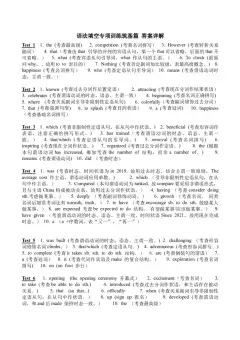
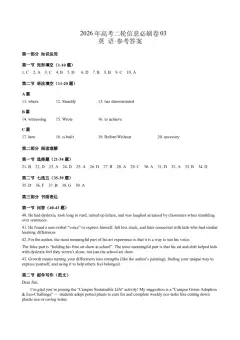
一答案
1. fishing 2. chosen 3. How 4. extending 5. traditional 6. be employed
7. reaches/has reached 8. but  9. completely 10. of
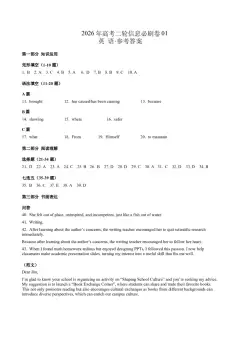
二答案
1. recorded 2. that 3. as 4. differs 5. completely
6. using 7. where 8. creativity 9. philosophies  10. To achieve
三答案
1. Bothered 2. a 3. were 4. Interested 5. what
6. excitement 7. had been unearthed 8. in 9. eventually 10. bearing
四答案
1. where 2. impression 3. was 4. and 5. from/through 6. amazing 7. a       8. driven
9. referring 10. was taught
五答案
1. salty 2. the 3. However 4. from 5. was added
6. introduction 7. sharpen 8. what 9. produced
10. to think
六答案
1. fundamentally 2. in 3. harmonious 4. to achieve
5. are concerned 6. where 7. have been 8. existence 9. an  10. enjoying
七答案
1. to 2. increasing 3. widely 4. are 5. reliable
6. has been used 7. which 8. recognized 9. an 10. latest
八答案
1.On 2. tiredness 3. their 4. translated 5. flows 6. an 7. leaving 8. that/which 9.
conditions 10. are brought