备战2024年高考英语模拟卷05(九省新高考卷)
(考试时间:120分钟 试卷满分:150分)
注意事项:
1.答卷前,考生务必将自己的姓名、考生号等填写在答题卡和试卷指定位置上。
2.回答选择题时,选出每小题答案后,用铅笔把答题卡对应题目的答案标号涂黑。如需改动,
用橡皮擦干净后,再选涂其他答案标号。回答非选择题时,将答案写在答题卡上。写在本试卷上无
效。
3.考试结束后,将本试卷和答题卡一并交回。
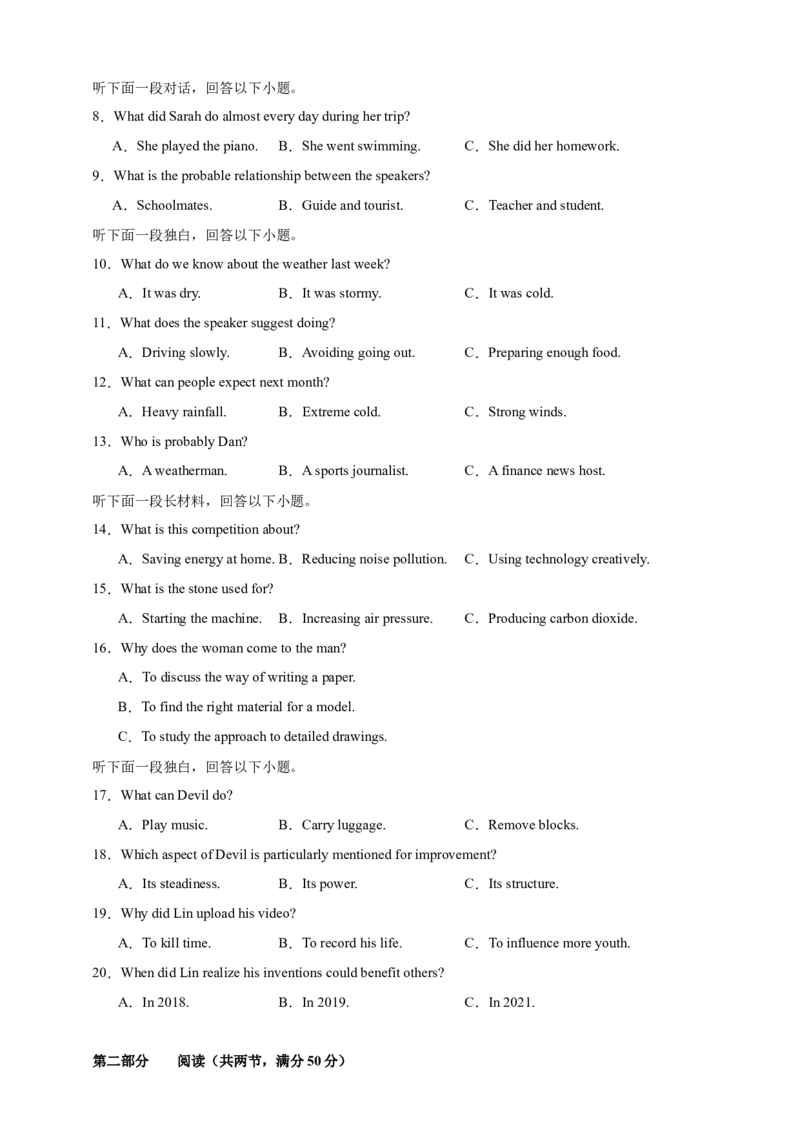
第一部分:听力(共两节,满分 30 分)
第一节 听下面 5 段对话。每段对话后有一个小题,从题中所给的 A、B、C 三个选项中选出最佳选
项。听完每段对话后,你都有 10 秒钟的时间来回答有关小题和阅读下一小题。每段对话仅读一遍。
1.How does the man usually go to work?
A.By car. B.By bike. C.By taxi.
2.When will the train arrive?
A.At 4:50. B.At 5:10. C.At 10:15.
3.Where does the conversation probably take place?
A.In a restaurant. B.In a class. C.In a family.
4.Why does the woman congratulate the man?
A.He’s getting married. B.He becomes a doctor. C.He’s just become a father.
5.How does the man find the advice from the woman?
A.Ridiculous. B.Helpful. C.Funny.
第二节 听下面 5 段对话或独白。每段对话或独白后有几个小题,从题中所给的 A、B、C 三个选项
中选出最佳选项。听每段对话或独白前,你将有时间阅读各个小题,每小题 5 秒钟;听完后,各小题
将给出 5 秒钟的作答时间。每段对话或独白读两遍。
听下面一段较长对话,回答以下小题。
6.What will the woman do this Sunday?
A.Review her lessons. B.Take a math exam. C.Tend to her cousins.
7.Who is expert at making pizzas?
A.Alice. B.Peter. C.Mike.听下面一段对话,回答以下小题。
8.What did Sarah do almost every day during her trip?
A.She played the piano. B.She went swimming. C.She did her homework.
9.What is the probable relationship between the speakers?
A.Schoolmates. B.Guide and tourist. C.Teacher and student.
听下面一段独白,回答以下小题。
10.What do we know about the weather last week?
A.It was dry. B.It was stormy. C.It was cold.
11.What does the speaker suggest doing?
A.Driving slowly. B.Avoiding going out. C.Preparing enough food.
12.What can people expect next month?
A.Heavy rainfall. B.Extreme cold. C.Strong winds.
13.Who is probably Dan?
A.A weatherman. B.A sports journalist. C.A finance news host.
听下面一段长材料,回答以下小题。
14.What is this competition about?
A.Saving energy at home.B.Reducing noise pollution. C.Using technology creatively.
15.What is the stone used for?
A.Starting the machine. B.Increasing air pressure. C.Producing carbon dioxide.
16.Why does the woman come to the man?
A.To discuss the way of writing a paper.
B.To find the right material for a model.
C.To study the approach to detailed drawings.
听下面一段独白,回答以下小题。
17.What can Devil do?
A.Play music. B.Carry luggage. C.Remove blocks.
18.Which aspect of Devil is particularly mentioned for improvement?
A.Its steadiness. B.Its power. C.Its structure.
19.Why did Lin upload his video?
A.To kill time. B.To record his life. C.To influence more youth.
20.When did Lin realize his inventions could benefit others?
A.In 2018. B.In 2019. C.In 2021.
第二部分 阅读(共两节,满分50分)第一节 (共15小题;每小题2.5分,满分37.5分)
阅读下列短文,从每题所给的A、B、C、D四个选项中选出最佳选项。
A
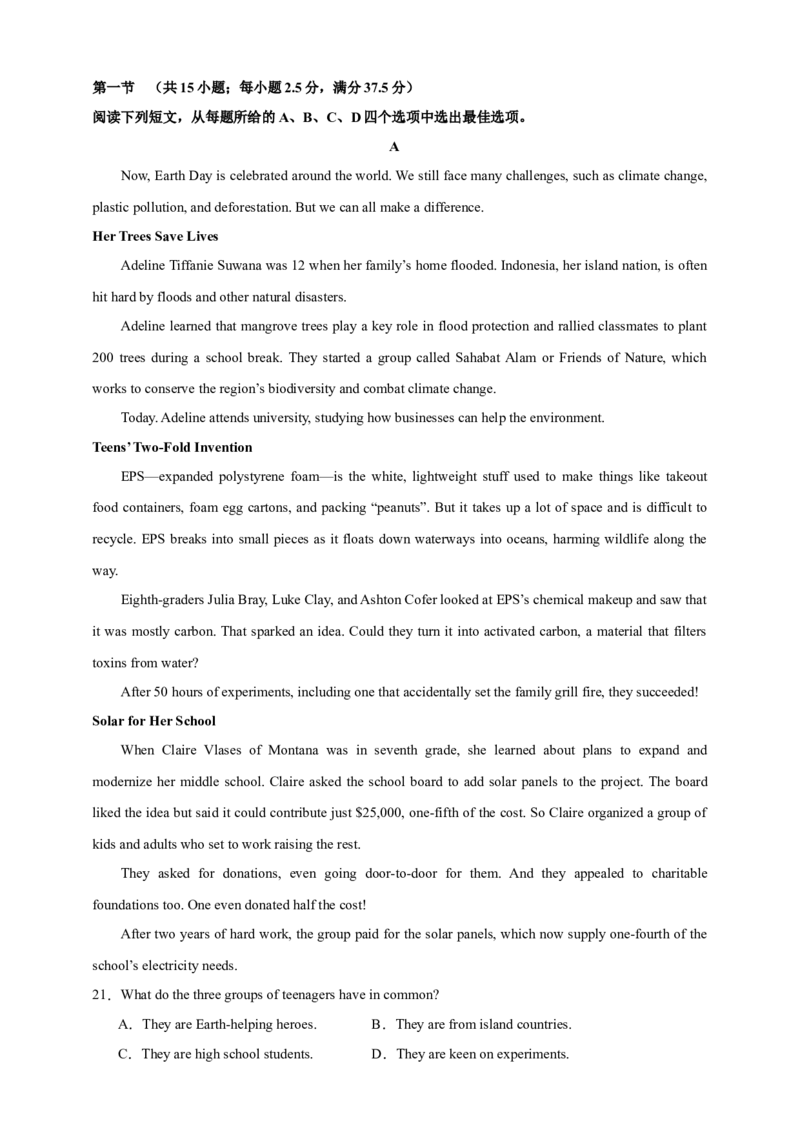
Now, Earth Day is celebrated around the world. We still face many challenges, such as climate change,
plastic pollution, and deforestation. But we can all make a difference.
Her Trees Save Lives
Adeline Tiffanie Suwana was 12 when her family’s home flooded. Indonesia, her island nation, is often
hit hard by floods and other natural disasters.
Adeline learned that mangrove trees play a key role in flood protection and rallied classmates to plant
200 trees during a school break. They started a group called Sahabat Alam or Friends of Nature, which
works to conserve the region’s biodiversity and combat climate change.
Today. Adeline attends university, studying how businesses can help the environment.
Teens’ Two-Fold Invention
EPS—expanded polystyrene foam—is the white, lightweight stuff used to make things like takeout
food containers, foam egg cartons, and packing “peanuts”. But it takes up a lot of space and is difficult to
recycle. EPS breaks into small pieces as it floats down waterways into oceans, harming wildlife along the
way.
Eighth-graders Julia Bray, Luke Clay, and Ashton Cofer looked at EPS’s chemical makeup and saw that
it was mostly carbon. That sparked an idea. Could they turn it into activated carbon, a material that filters
toxins from water?
After 50 hours of experiments, including one that accidentally set the family grill fire, they succeeded!
Solar for Her School
When Claire Vlases of Montana was in seventh grade, she learned about plans to expand and
modernize her middle school. Claire asked the school board to add solar panels to the project. The board
liked the idea but said it could contribute just $25,000, one-fifth of the cost. So Claire organized a group of
kids and adults who set to work raising the rest.
They asked for donations, even going door-to-door for them. And they appealed to charitable
foundations too. One even donated half the cost!
After two years of hard work, the group paid for the solar panels, which now supply one-fourth of the
school’s electricity needs.
21.What do the three groups of teenagers have in common?
A.They are Earth-helping heroes. B.They are from island countries.
C.They are high school students. D.They are keen on experiments.22.How much did one of the charitable organizations donate for solar panels?
A.$25,000. B.$50,000. C.$62,500. D.$125,000.
23.What is the purpose of the passage?
A.To give models for colorful school activities.
B.To explore the ways to deal with plastic pollution.
C.To inspire people to act for environmental problems.
D.To display the amazing power of effective cooperation.
B
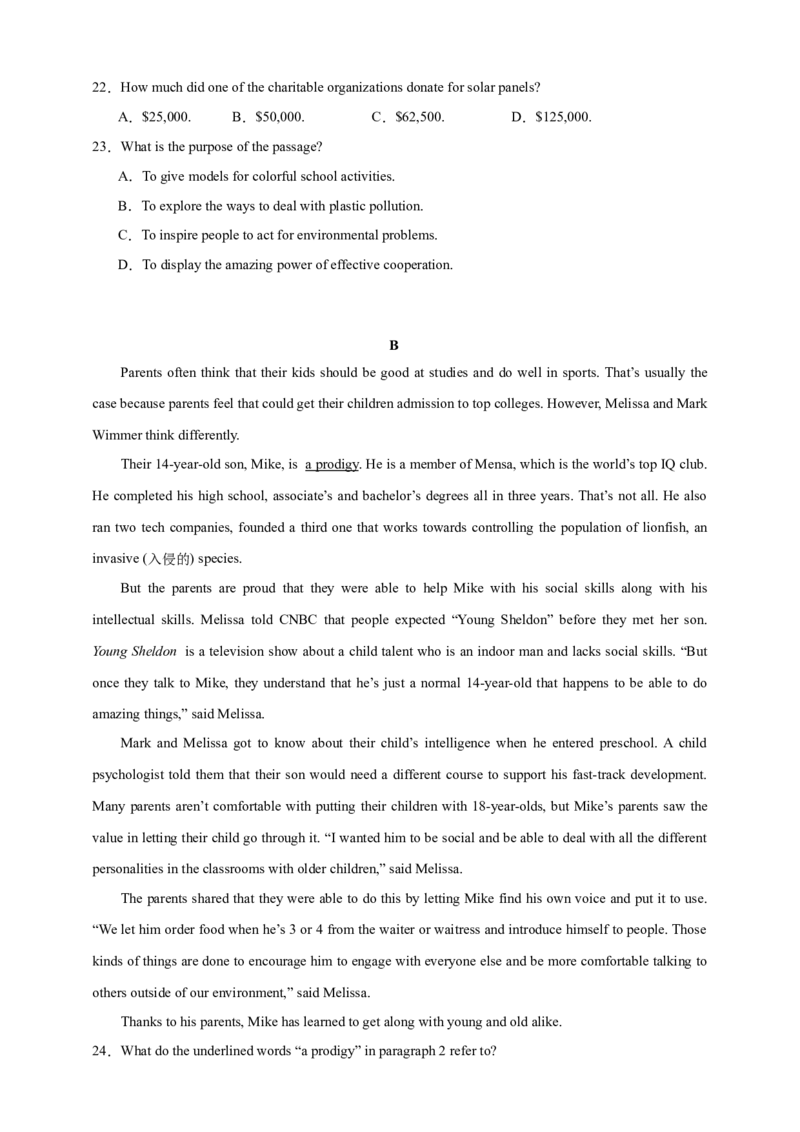
Parents often think that their kids should be good at studies and do well in sports. That’s usually the
case because parents feel that could get their children admission to top colleges. However, Melissa and Mark
Wimmer think differently.
Their 14-year-old son, Mike, is a prodigy. He is a member of Mensa, which is the world’s top IQ club.
He completed his high school, associate’s and bachelor’s degrees all in three years. That’s not all. He also
ran two tech companies, founded a third one that works towards controlling the population of lionfish, an
invasive (入侵的) species.
But the parents are proud that they were able to help Mike with his social skills along with his
intellectual skills. Melissa told CNBC that people expected “Young Sheldon” before they met her son.
Young Sheldon is a television show about a child talent who is an indoor man and lacks social skills. “But
once they talk to Mike, they understand that he’s just a normal 14-year-old that happens to be able to do
amazing things,” said Melissa.
Mark and Melissa got to know about their child’s intelligence when he entered preschool. A child
psychologist told them that their son would need a different course to support his fast-track development.
Many parents aren’t comfortable with putting their children with 18-year-olds, but Mike’s parents saw the
value in letting their child go through it. “I wanted him to be social and be able to deal with all the different
personalities in the classrooms with older children,” said Melissa.
The parents shared that they were able to do this by letting Mike find his own voice and put it to use.
“We let him order food when he’s 3 or 4 from the waiter or waitress and introduce himself to people. Those
kinds of things are done to encourage him to engage with everyone else and be more comfortable talking to
others outside of our environment,” said Melissa.
Thanks to his parents, Mike has learned to get along with young and old alike.
24.What do the underlined words “a prodigy” in paragraph 2 refer to?A.A gifted person. B.A famous student.
C.A brilliant biologist. D.A successful businessman.
25.What can we infer about the child in the show Young Sheldon?
A.He likes to make friends. B.He is a well-rounded man.
C.He is a popular child actor. D.He is poor at dealing with people.
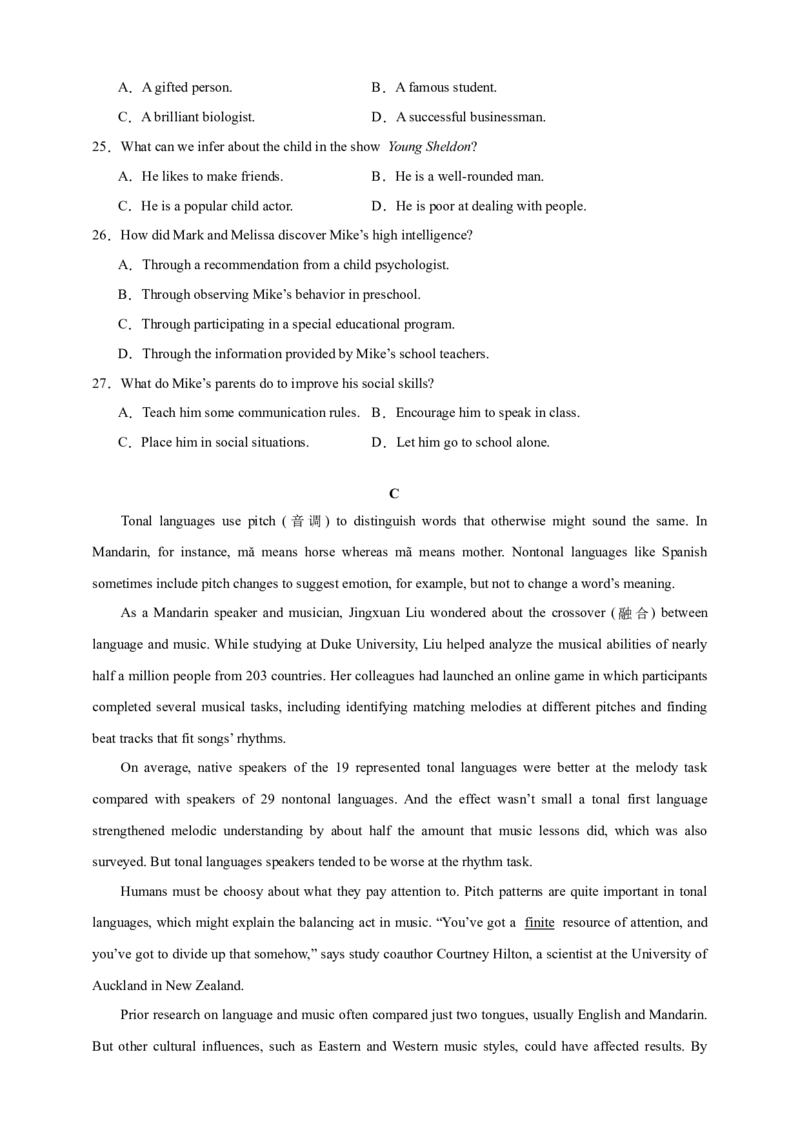
26.How did Mark and Melissa discover Mike’s high intelligence?
A.Through a recommendation from a child psychologist.
B.Through observing Mike’s behavior in preschool.
C.Through participating in a special educational program.
D.Through the information provided by Mike’s school teachers.
27.What do Mike’s parents do to improve his social skills?
A.Teach him some communication rules. B.Encourage him to speak in class.
C.Place him in social situations. D.Let him go to school alone.
C
Tonal languages use pitch (音调) to distinguish words that otherwise might sound the same. In
Mandarin, for instance, mă means horse whereas mã means mother. Nontonal languages like Spanish
sometimes include pitch changes to suggest emotion, for example, but not to change a word’s meaning.
As a Mandarin speaker and musician, Jingxuan Liu wondered about the crossover (融合) between
language and music. While studying at Duke University, Liu helped analyze the musical abilities of nearly
half a million people from 203 countries. Her colleagues had launched an online game in which participants
completed several musical tasks, including identifying matching melodies at different pitches and finding
beat tracks that fit songs’ rhythms.
On average, native speakers of the 19 represented tonal languages were better at the melody task
compared with speakers of 29 nontonal languages. And the effect wasn’t small a tonal first language
strengthened melodic understanding by about half the amount that music lessons did, which was also
surveyed. But tonal languages speakers tended to be worse at the rhythm task.
Humans must be choosy about what they pay attention to. Pitch patterns are quite important in tonal
languages, which might explain the balancing act in music. “You’ve got a finite resource of attention, and
you’ve got to divide up that somehow,” says study coauthor Courtney Hilton, a scientist at the University of
Auckland in New Zealand.
Prior research on language and music often compared just two tongues, usually English and Mandarin.
But other cultural influences, such as Eastern and Western music styles, could have affected results. Byexamining a wide range of people, the new study included languages never estimated in this way and
reached more generalizable conclusion.
“Our result here is showing that the language someone speaks which is an important part of culture —
also shapes cognition,” Hilton says.
28.Why did Liu’s colleagues launch the online game?
A.To attract more students to do the research.
B.To learn about different people’s musical abilities.
C.To confirm the role of music in people’s language learning.
D.To find the difference between tonal languages and nontonal ones.
29.What were native speakers of tonal languages better at than those of nontonal languages?
A.Finding beat tracks. B.Suggesting emotion.
C.Distinguishing word meanings. D.Figuring out matching melodies.
30.What does the underlined word “finite” in paragraph 4 mean?
A.Valued. B.Limited. C.Special. D.Potential.
31.Which of the following words can best describe Liu’s study?
A.Ground-breaking. B.Brain-washing. C.Inefficient.D.Unreliable.
D
Professors at the University of California San Diego have developed microrobots, which can be a
potential treatment for life-threatening cases of bacterial pneumonia, a serious disease affecting lungs and
making breathing difficult. In mice, the microrobots safely removed pneumonia-causing bacteria in the lungs
and resulted in 100% survival while untreated mice all died within three days after infection.
The microrobots are made of algae (藻类) cells whose surfaces are covered with substances that are
filled with antibiotics (抗生素). The algae provides movement, which allows the microrobots to swim
around and make antibiotics go directly to more bacteria in the lungs, helping absorb bacteria and clear them
of infected cells. This give the microrobots the ability to reduce bacterial infection, which in turn makes
them more effective at fighting lung infection.
The work is a joint effort by engineering professors Joseph and Zhang Liangfang. Together, they have
pioneered the development of tiny drug-delivering robots that can be safely used in live animals to treat
bacterial infections in the stomach and blood. Treating bacterial lung infection is the latest in their line of
work.
“In the traditional treatment, sometimes only a very small number of antibiotics will get into the lungs.
That’s why many current antibiotic treatments for pneumonia don’t work as well as needed,” said VictorNizet, a co-worker of Joseph and Zhang “Based on these mouse data, we see that the microrobots could
potentially improve the use of antibiotics to kill bacteria and save more patients’ lives.”
The work is still at the proof-of-concept stage. The team plans to do more basic research to understand
exactly how the microrobots interact with the immune system (免疫系统). Next steps also include studies to
confirm the effectiveness of the microrobot treatment before testing it in larger animals and eventually, in
humans. “We’re pushing the boundary further in the field of targeted drug delivery,” said Zhang.
32.How do microrobots work?
A.By doing targeted drug delivery.
B.By interacting with antibiotic-filled matter.
C.By producing algae cells in lungs.
D.By separating harmful cells from healthy ones.
33.What is Victor Nizet’s attitude towards the invention?
A.Doubtful. B.Subjective. C.Cautious. D.Favorable.
34.What does the team expect of the microrobots?
A.They’ll inspire a new line of research.
B.They’ll help strengthen the immune system.
C.They’ll have a wider range of application.
D.They’ll be a further proof of their concept.
35.What is the text mainly about?
A.A scientific invention treating deadly cancers.
B.Tiny swimming robots helping treat pneumonia.
C.A major breakthrough made in antibiotic research.
D.Microrobots employed in the engineering field.
第二节 (共5小题;每小题2.5分,满分12.5分)
根据短文内容,从短文后的选项中选出能填入空白处的最佳选项。
Go on a 15-minute Tour
Didn’t someone say that life is about the journey, not the destination? 36 when you are focused
only on getting to the next meeting, starting your next class period, or hurrying to send an email, you’re
missing all of the people between Points A and B.
To commit some time to the journey, take some time to walk around where you work and notice your
surroundings. 37 Also, some of the smaller yet critical social clues that exist right under your nose
will be concentrated on again.38 Things to look for include the look and feel of people’s work spaces, the timing of when
different people move around the office, and which people seek interaction versus those who stay at their
desks all day.
After your first observation tour, select a different day to tour your workspace for moods. Other
people’s moods can provide you with critical clues about how things are going. 39 Focus on what
you see, hear, and pick up on in other people.
Schedule 15 minutes to tour your workplace twice a week for a month and be sure to avoid making too
many assumptions or conclusions — just simply observe. 40
A.You’ll be amazed at what you see along the way.
B.Spare a little time to closely monitor each person’s progress.
C.Notice what people may be feeling when you drop by to talk briefly.
D.During any workday, take just 15 minutes to observe neglected things.
E.You generally love the breathtaking landscape and people’s performances.
F.Going on a short tour will help you get in tune with other people and their emotions.
G.To become socially aware, remember to enjoy the journey and notice people along the way.
第三部分 语言运用(共两节,满分30分)
第一节 (共15小题;每小题1分,满分15分)
阅读下面短文,从每题所给的A、B、C、D四个选项中选出可以填入空白处的最佳选项。
I found a wonderful picture of Maolan karst cones online and presented it to the innkeeper. “You can’t
go there,” the innkeeper 41 me. “The viewing platform has been closed due to 42 that too
many visitors could cause geological damage.”
Despite our disappointment, we 43 an alternative: a seven-hour hike through the “funnel
forest”. Initially, we were 44 to run the risk. However, I had 45 the tourism motto in the
nature reserve: “If you don’t do it now, you won’t do it in your lifetime.” Three of our group 46
decided to venture into the forest. The innkeeper responded with a knowing 47 : “Great. Bear Grylls
went there.”
The next morning, we set off with a local 48 . Rain came and went three times, and before I
actually 49 to climb over the first mountain, I had already got wet to the skin. I was a walking 50
of mud and water.
Our guide, in his 50s, behaved like a botanist, introducing the locally specific plants to us, but I was
hardly in the 51 . Every step sank into the muddy, sucking ground. Every log or rock in front of uswas a physical 52 . “One can never reach those places without strong willpower,” I murmured,
reciting that millennium-old 53 , over and over again.
Sinkholes and entrances to underground rivers kept popping up along our 54 . Thinking of them
leading to an unknown world, I began to 55 the road that I can control even more.
Wandering in a green chaos without any obvious landmarks is also breathtaking.
41.A.answered B.told C.followed D.favored
42.A.news B.matters C.concerns D.conclusions
43.A.worked out B.took in C.set down D.ruled out
44.A.unwilling B.surprised C.calm D.inspired
45.A.forgotten B.promoted C.interpreted D.noticed
46.A.shortly B.lately C.eventually D.suddenly
47.A.taste B.tone C.smile D.sigh
48.A.botanist B.keeper C.farmer D.guide
49.A.managed B.decided C.planned D.agreed
50.A.visitor B.mixture C.log D.stranger
51.A.eagerness B.mood C.humor D.pity
52.A.contact B.energy C.activity D.challenge
53.A.prediction B.line C.deal D.secret
54.A.route B.landmark C.platform D.rock
55.A.guarantee B.ignore C.doubt D.appreciate
第二节 (共10小题;每小题1.5分,满分15分)
阅读下面短文,在空白处填入1个适当的单词或括号内单词的正确形式。
With less people 56 (choose) to make sugar paintings, the traditional Chinese folk craft
might have become a distant memory in some ways. However, a 38-year-old craftsman, Li Jiangzhong,
devotes himself to 57 (keep) the art of sugar painting alive.
Li worked as a miner for more than ten years. After 58 mine closed down, Li turned 59
housing decoration, until he 60 (force) to give that up due to a finger injury. Earlier this year, he
discovered sugar painting, something he really had an interest in.
Since there was no sugar painting craftsman in his village, he studied by 61 (he) through large
quantities of videos and information on the Internet. Li loved painting when he was young, and he found it
easy to learn the skill in sugar painting. He soon mastered the skill and could make 62 (vary)
sugar paintings. A sugar painting is made with 63 (melt) brown or white sugar. Craftsman normallypaint animals and flowers on a stone board 64 the syrup (糖浆). When the sugar cools down,
65 appears is a piece of sugar art.
第四部分:写作(共两节,满分40分)
第一节 (满分15分)
66.假设你是校学生会主席李华,下周是你校的体育周。请你给交换生Jim写一封电子邮件,介绍
体育周的活动内容,并邀请他参加其中一项运动。内容包括:1.介绍体育周;2.发出邀请。
注意:1.写作词数应为80个左右;2.请按如下格式在答题卡的相应位置作答。
Dear Jim,
_______________________________________________________________________________________
_______________________________________________________________________________________
_______________________________________________________________________________________
_______________________________________________________________________________________
_______________________________________________________________________________________
________________________________________
Yours sincerely,
Li Hua
阅读下面材料,根据其内容和所给段落开头语续写两段,使之构成一篇完整的短文。
Ali and his younger sister, Zahra, lived with their parents in a poor neighborhood. Their moth- er was
very sick and their father was struggling to finda job, and they had only a little money with which to buy
food. As they had not paid the rent for sever al months, the landlord was breathing down their necks.
One day, Ali took Zahra's shoes to a shoe re pairman to be fixed, but he lost them on the way home. It
wasn’t until he got home that he realized he had lost the shoes. He was afraid that his parents would be
angry and disappointed, so he begged his sister to keep it secret. Zahra agreed and the two decided to share
Ali’s running shoes. Zahra's school hours were in the morning, so she would wear them first. After school,
she would rush back and give them to Ali. He could then run to his school, which began in the afternoon.
Although he ran as fast as he could, Ali often arrived late and was warned by the school.
Ali heard about a long distance race that was held for the boys in the city.When he learned that the third
prize was a new pair of shoes, he decided to take part. He ran home excitedly and promised his sister that he
would win her the new shoes.
The day of race arrived. Ali had a strong start, but halfway through the race he began to get tired and
his legs began to ache. Getting more and more exhausted he thought only of Zahra and his promise to her.
Dreaming of the new shoes he would win for his sister gave him strength, and he stayed right be hind thetwo fastest runners, determined to finish third. Suddenly, as the finish line drew near, another runner
collided(碰撞) with Ali from behind and he crashed to the ground.
Ali looked up and saw the other boys rushing ahead.
_______________________________________________________________________________________
_______________________________________________________________________________________
_______________________________________________________________________________________
_______________________________________________________________________________________
_______________________________________________
Filled with delight, Ali walked home quickly.
_______________________________________________________________________________________
_______________________________________________________________________________________
_______________________________________________________________________________________
_______________________________________________________________________________________
_______________________________________________