第1页/共15页
学科网(北京)股份有限公司
2025 年度第一学期同凯中学八年级英语学科
阶段一检测试卷
Part 2 Phonetics, Vocabulary and Grammar
(第二部分 语音、词汇和语法) (共28 分)
I. Choose the best answer (选择最恰当的答案,每题只有一个正确答案) (本大题共10 题,每
题1 分,共10 分).
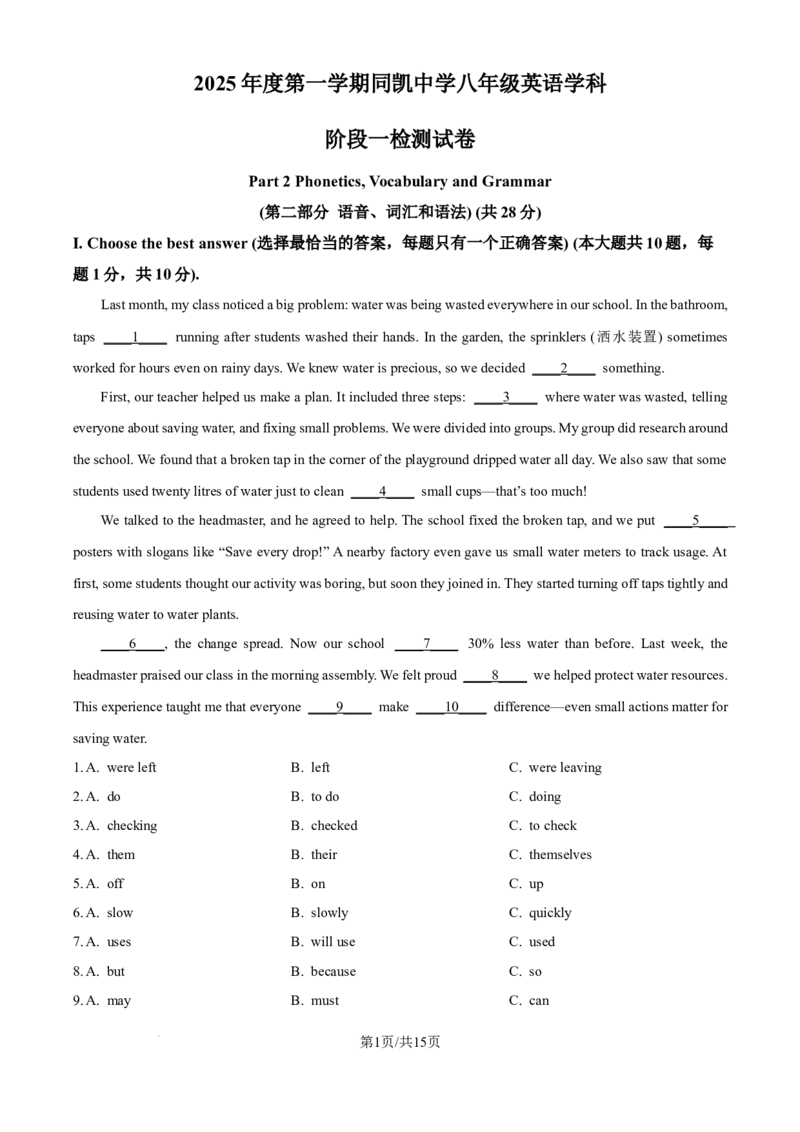
Last month, my class noticed a big problem: water was being wasted everywhere in our school. In the bathroom,
taps ____1____ running after students washed their hands. In the garden, the sprinklers (洒水装置) sometimes
worked for hours even on rainy days. We knew water is precious, so we decided ____2____ something.
First, our teacher helped us make a plan. It included three steps: ____3____ where water was wasted, telling
everyone about saving water, and fixing small problems. We were divided into groups. My group did research around
the school. We found that a broken tap in the corner of the playground dripped water all day. We also saw that some
students used twenty litres of water just to clean ____4____ small cups—that’s too much!
We talked to the headmaster, and he agreed to help. The school fixed the broken tap, and we put ____5____
posters with slogans like “Save every drop!” A nearby factory even gave us small water meters to track usage. At
first, some students thought our activity was boring, but soon they joined in. They started turning off taps tightly and
reusing water to water plants.
____6____, the change spread. Now our school ____7____ 30% less water than before. Last week, the
headmaster praised our class in the morning assembly. We felt proud ____8____ we helped protect water resources.
This experience taught me that everyone ____9____ make ____10____ difference—even small actions matter for
saving water.
1. A. were left
B. left
C. were leaving
2. A. do
B. to do
C. doing
3. A. checking
B. checked
C. to check
4. A. them
B. their
C. themselves
5. A. off
B. on
C. up
6. A. slow
B. slowly
C. quickly
7. A. uses
B. will use
C. used
8. A. but
B. because
C. so
9. A. may
B. must
C. can
第2页/共15页
学科网(北京)股份有限公司
10. A. /
B. the
C. a
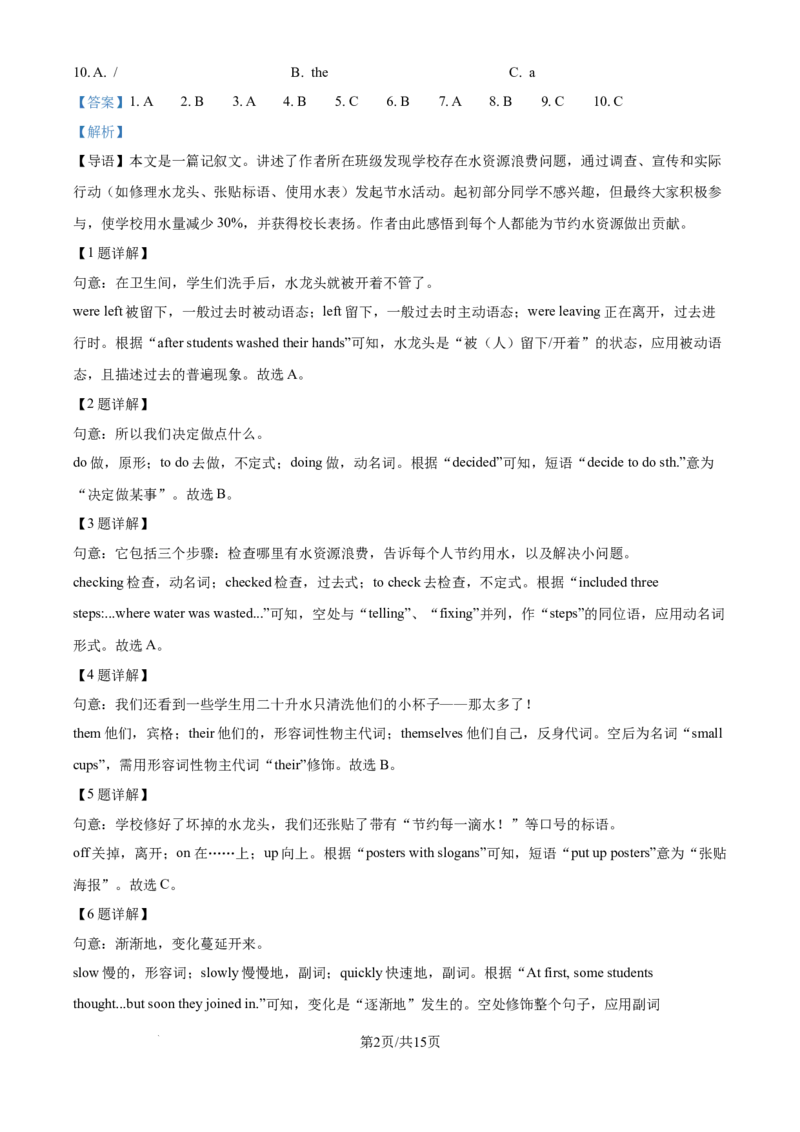
【答案】1. A    2. B    3. A    4. B    5. C    6. B    7. A    8. B    9. C    10. C
【解析】
【导语】本文是一篇记叙文。讲述了作者所在班级发现学校存在水资源浪费问题,通过调查、宣传和实际
行动(如修理水龙头、张贴标语、使用水表)发起节水活动。起初部分同学不感兴趣,但最终大家积极参
与,使学校用水量减少30%,并获得校长表扬。作者由此感悟到每个人都能为节约水资源做出贡献。
【1 题详解】
句意:在卫生间,学生们洗手后,水龙头就被开着不管了。
were left 被留下,一般过去时被动语态;left 留下,一般过去时主动语态;were leaving 正在离开,过去进
行时。根据“after students washed their hands”可知,水龙头是“被(人)留下/开着”的状态,应用被动语
态,且描述过去的普遍现象。故选A。
【2 题详解】
句意:所以我们决定做点什么。
do 做,原形;to do 去做,不定式;doing 做,动名词。根据“decided”可知,短语“decide to do sth.”意为
“决定做某事”。故选B。
【3 题详解】
句意:它包括三个步骤:检查哪里有水资源浪费,告诉每个人节约用水,以及解决小问题。
checking 检查,动名词;checked 检查,过去式;to check 去检查,不定式。根据“included three
steps:...where water was wasted...”可知,空处与“telling”、“fixing”并列,作“steps”的同位语,应用动名词
形式。故选A。
【4 题详解】
句意:我们还看到一些学生用二十升水只清洗他们的小杯子——那太多了!
them 他们,宾格;their 他们的,形容词性物主代词;themselves 他们自己,反身代词。空后为名词“small
cups”,需用形容词性物主代词“their”修饰。故选B。
【5 题详解】
句意:学校修好了坏掉的水龙头,我们还张贴了带有“节约每一滴水!”等口号的标语。
off 关掉,离开;on 在……上;up 向上。根据“posters with slogans”可知,短语“put up posters”意为“张贴
海报”。故选C。
【6 题详解】
句意:渐渐地,变化蔓延开来。
slow 慢的,形容词;slowly 慢慢地,副词;quickly 快速地,副词。根据“At first, some students
thought...but soon they joined in.”可知,变化是“逐渐地”发生的。空处修饰整个句子,应用副词
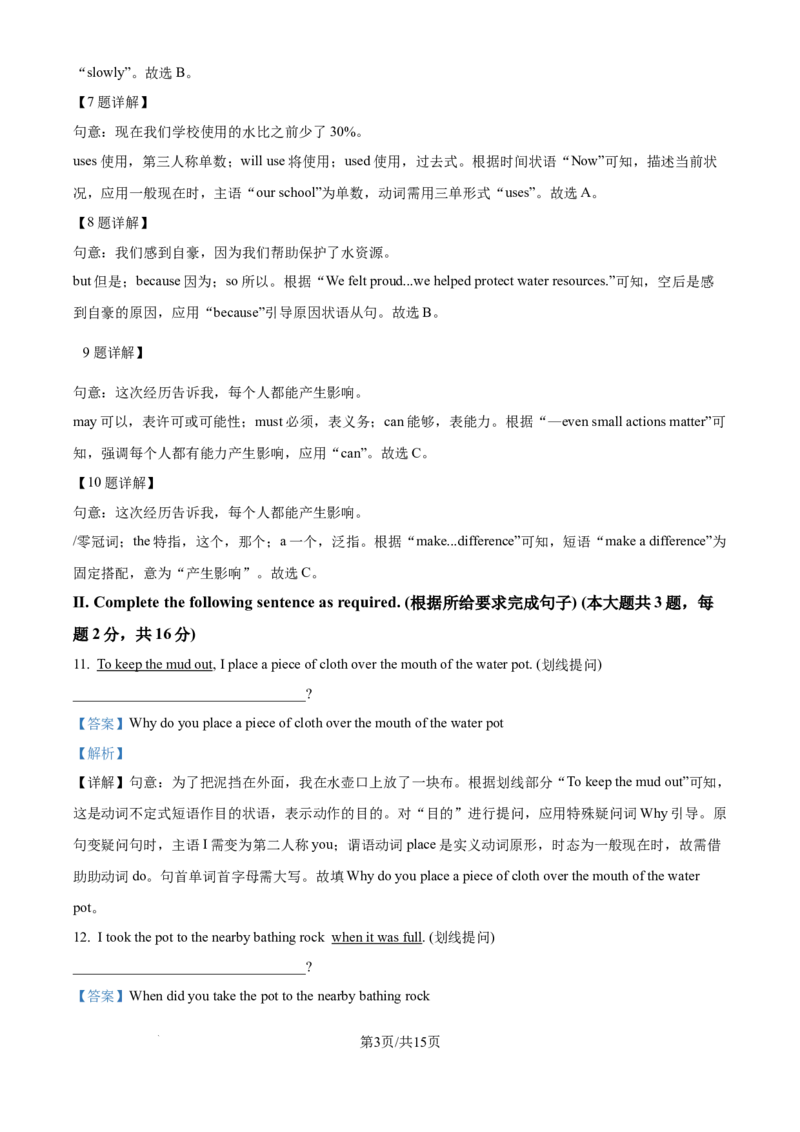
第3页/共15页
学科网(北京)股份有限公司
“slowly”。故选B。
【7 题详解】
句意:现在我们学校使用的水比之前少了30%。
uses 使用,第三人称单数;will use 将使用;used 使用,过去式。根据时间状语“Now”可知,描述当前状
况,应用一般现在时,主语“our school”为单数,动词需用三单形式“uses”。故选A。
【8 题详解】
句意:我们感到自豪,因为我们帮助保护了水资源。
but 但是;because 因为;so 所以。根据“We felt proud...we helped protect water resources.”可知,空后是感
到自豪的原因,应用“because”引导原因状语从句。故选B。
9 题详解】
句意:这次经历告诉我,每个人都能产生影响。
may 可以,表许可或可能性;must 必须,表义务;can 能够,表能力。根据“—even small actions matter”可
知,强调每个人都有能力产生影响,应用“can”。故选C。
【10 题详解】
句意:这次经历告诉我,每个人都能产生影响。
/零冠词;the 特指,这个,那个;a 一个,泛指。根据“make...difference”可知,短语“make a difference”为
固定搭配,意为“产生影响”。故选C。
II. Complete the following sentence as required. (根据所给要求完成句子) (本大题共3 题,每
题2 分,共16 分)
11. To keep the mud out, I place a piece of cloth over the mouth of the water pot. (划线提问)
_________________________________?
【答案】Why do you place a piece of cloth over the mouth of the water pot
【解析】
【详解】句意:为了把泥挡在外面,我在水壶口上放了一块布。根据划线部分“To keep the mud out”可知,
这是动词不定式短语作目的状语,表示动作的目的。对“目的”进行提问,应用特殊疑问词Why 引导。原
句变疑问句时,主语I 需变为第二人称you;谓语动词place 是实义动词原形,时态为一般现在时,故需借
助助动词do。句首单词首字母需大写。故填Why do you place a piece of cloth over the mouth of the water
pot。
12. I took the pot to the nearby bathing rock when it was full. (划线提问)
_________________________________?
【答案】When did you take the pot to the nearby bathing rock
第4页/共15页
学科网(北京)股份有限公司
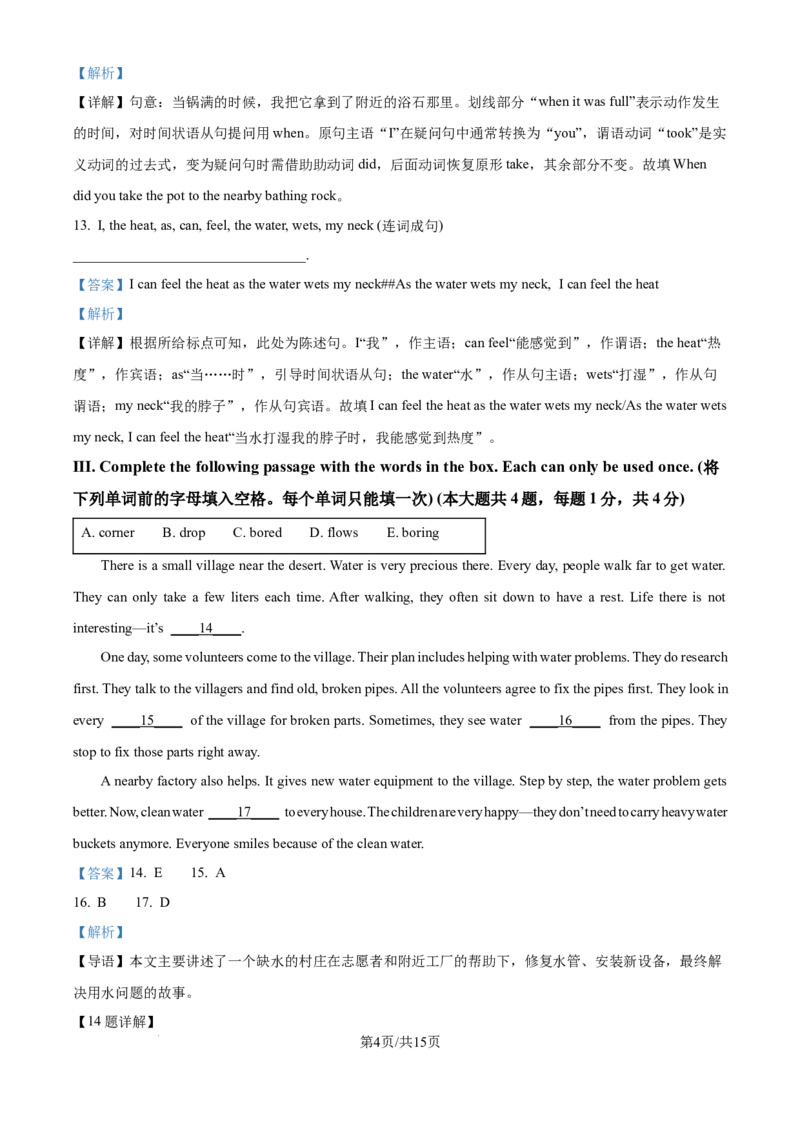
【解析】
【详解】句意:当锅满的时候,我把它拿到了附近的浴石那里。划线部分“when it was full”表示动作发生
的时间,对时间状语从句提问用when。原句主语“I”在疑问句中通常转换为“you”,谓语动词“took”是实
义动词的过去式,变为疑问句时需借助助动词did,后面动词恢复原形take,其余部分不变。故填When
did you take the pot to the nearby bathing rock。
13. I, the heat, as, can, feel, the water, wets, my neck (连词成句)
_________________________________.
【答案】I can feel the heat as the water wets my neck##As the water wets my neck, I can feel the heat
【解析】
【详解】根据所给标点可知,此处为陈述句。I“我”,作主语;can feel“能感觉到”,作谓语;the heat“热
度”,作宾语;as“当……时”,引导时间状语从句;the water“水”,作从句主语;wets“打湿”,作从句
谓语;my neck“我的脖子”,作从句宾语。故填I can feel the heat as the water wets my neck/As the water wets
my neck, I can feel the heat“当水打湿我的脖子时,我能感觉到热度”。
III. Complete the following passage with the words in the box. Each can only be used once. (将
下列单词前的字母填入空格。每个单词只能填一次) (本大题共4 题,每题1 分,共4 分)
A. corner    B. drop    C. bored    D. flows    E. boring
There is a small village near the desert. Water is very precious there. Every day, people walk far to get water.
They can only take a few liters each time. After walking, they often sit down to have a rest. Life there is not
interesting—it’s ____14____.
One day, some volunteers come to the village. Their plan includes helping with water problems. They do research
first. They talk to the villagers and find old, broken pipes. All the volunteers agree to fix the pipes first. They look in
every ____15____ of the village for broken parts. Sometimes, they see water ____16____ from the pipes. They
stop to fix those parts right away.
A nearby factory also helps. It gives new water equipment to the village. Step by step, the water problem gets
better. Now, clean water ____17____ to every house. The children are very happy—they don’t need to carry heavy water
buckets anymore. Everyone smiles because of the clean water.
【答案】14. E    15. A
16. B    17. D
【解析】
【导语】本文主要讲述了一个缺水的村庄在志愿者和附近工厂的帮助下,修复水管、安装新设备,最终解
决用水问题的故事。
【14 题详解】
第5页/共15页
学科网(北京)股份有限公司
句意:那里的生活毫无趣味,十分无聊。根据“Life there is not interesting”及备选词可知,此处指生活很无
趣。boring“无聊的”,形容词,通常用来修饰事物。故填E。
【15 题详解】
句意:他们在村子的每个角落寻找破损的部件。根据“They look in every...of the village for broken parts.”及
备选词可知,志愿者们在村子的角落里寻找破损的部件。corner“角落”,名词。短语in every corner 意为
“在每个角落”。故填A。
【16 题详解】
句意:有时,他们会看到水从管子里滴出来。根据“broken pipes…they see water…from the pipes.”及备选词
可知,管子破了,所以能看到水流出来。see sth. do sth.意为“看见某物做某事”,此处用动词原形。
drop“滴下;落下”,动词。故填B。
【17 题详解】
句意:现在,干净的水流到了家家户户。根据“Now, clean water…to every house”及备选词可知,干净的水
流到了家家户户。flows“(液体、气体等)连续流动”符合语境,clean water 是不可数名词,动词应用第
三人称单数形式。故填D。
IV. Complete the sentences with the words in their proper forms. (用单词的适当形式填空) (共
8 分)
18. There are many ________ in Jinshan. However, the air quality is still good there. (factory)
【答案】factories
【解析】
【详解】句意:金山有许多工厂。然而那里的空气质量仍然很好。factory“工厂”,many 后接可数名词复
数形式。故填factories。
19. Tyler likes to sit on the ________ floor of the double-decker bus because he can look farther. (two)
【答案】second
【解析】
【详解】句意:泰勒喜欢坐在双层公交车的第二层,因为他可以看得更远。two“二”,基数词;根据
“double-decker bus”和“floor”可知,此处表示楼层顺序,需用序数词second“第二”,作定语修饰名词
“floor”。故填second。
20. Shabanu throws ________ hair forward and pours water over it. (she)
【答案】her
【解析】
【详解】句意:Shabanu 把头发向前甩,并把水倒在上面。根据“hair”可知,此处应用形容词性物主代词
修饰名词,表示“她的”头发。she 是主格,意为“她”,其形容词性物主代词为her。故填her。
第6页/共15页
学科网(北京)股份有限公司
21. Tyler read a novel last summer holiday and he found a chapter very ________. (touch)
【答案】touching
【解析】
【详解】句意:泰勒去年暑假读了一本小说,他发现其中一个章节非常感人。touch“触摸;触动”,动词;
此处需要用形容词作宾语补足语,修饰名词chapter,touch 的形容词形式touching 表示“感人的”,用来
形容事物具有让人感动的特质。故填touching。
22. Alice received her broken takeaway order but she didn’t make a ________. (complain)
【答案】complaint
【解析】
【详解】句意:爱丽丝收到了她破损的外卖,但她没有投诉。根据“didn’t make a…”可知,冠词a 后面应
接名词形式。complain 是动词,意为“投诉,抱怨”,其名词形式为complaint。固定短语make a
complaint 意为“提出投诉”。故填complaint。
23. We should raise our ________ of saving water because water is precious. (aware)
【答案】awareness
【解析】
【详解】句意:我们应该提高节水意识,因为水是很珍贵的。aware“意识到的”,形容词,根据“our”
可知,形容词性物主代词后加名词,aware 的名词为awareness。故填awareness。
24. Most students want to sit in the front of the classroom in order to hear the teacher ________. (clear)
【答案】clearly
【解析】
【详解】句意:大多数学生想要坐在教室前排,为了清楚地听老师讲课。clear“清楚的”,形容词;此处需
要用副词修饰动词hear,clear 的副词形式是clearly。故填clearly。
25. Sorry for the ________. What can I help you with? (convenient)
【答案】inconvenience
【解析】
【详解】句意:抱歉带来不便。我能为你做些什么?convenient 是形容词,意为“方便的”;根据“Sorry
for the…”可知,此处需用名词形式,且结合语境“道歉”,应是“带来不便”,应用convenient 的反义词
的名词形式inconvenience“不方便,麻烦”。故填inconvenience。
Part 3 Reading and Writing (第三部分 阅读和写话 47%)
I. Reading comprehension. (阅读理解) (共24 分)
A. Choose the best answer. (选择最恰当的答案) (共6 分)
Digital technology is changing our lives in many good ways. It makes daily tasks easier and helps us connect
第7页/共15页
学科网(北京)股份有限公司
with the world better.
First, it helps with learning. Before, students could only learn from books and teachers at school. Now, with
apps like online classes and educational videos, we can study at home or anywhere. If we don’t understand a math
problem, we can watch a video to learn it again. This makes learning more flexible.
Second, it improves communication. Long ago, people sent letters which took weeks to arrive. Now, we use
Wechat, WhatsApp or video calls. We can talk to grandparents who live far away and even see their faces. It feels
like they are right beside us.
Third, it makes our life more convenient. We don’t need to carry much cash. We can pay for food or books with
our phones. When we want to go somewhere, apps like maps help us find the best way. They even tell us when the
bus will come.
Lastly, it helps with health. Some apps can track our steps or sleep. Doctors can also use technology to check
patients’ health better. For example they can look at test results online quickly.
Digital technology is really a great helper. It makes our lives happier and easier. We should learn to use it well
to make our future better.
26. Where did students mainly learn before digital technology?
A. Online classes.
B. Books and school teachers.
C. Educational videos.
D. Learning apps.
27. How long did it take for letters to arrive long ago?
A. A few minutes.
B. A few hours.
C. A few weeks.
D. A few days.
28. Which app is NOT mentioned for communication?
A. Map apps.
B. WhatsApp.
C. Wechat.
D. Video call apps.
29. What can we use our phones to do for convenience according to the passage?
A. Track sleep.
B. Pay for things.
C. Watch educational videos.
D. Talk to grandparents.
30. What can some health apps track?
A. Test results.
B. Bus arrival time.
C. Steps or sleep.
D. Math problems.
31. What does the passage mainly tell us?
A. How to use digital technology well.
B. The history of digital technology.
C. The problems of digital technology.
D. How digital technology improves our lives.
【答案】26. B    27. C    28. A    29. B    30. C    31. D
【解析】
【导语】本文主要介绍了数字技术从学习、沟通、生活便利、健康四个方面给人们的生活带来的积极改变,
第8页/共15页
学科网(北京)股份有限公司
最后总结指出数字技术是生活的好帮手,我们应该学会善用它来创造更好的未来。
【26 题详解】
细节理解题。根据“Before, students could only learn from books and teachers at school.”可知,以前,学生只
能从书本和学校的老师那里学习。故选B。
27 题详解】
细节理解题。根据“Long ago, people sent letters which took weeks to arrive.”可知,很久以前,人们寄信,
信件要花数周才能送达。故选C。
【28 题详解】
细节理解题。根据“Now, we use Wechat, WhatsApp or video calls.”可知,现在,我们会使用微信、
WhatsApp 或者视频通话。故选A。
【29 题详解】
细节理解题。根据“We don’t need to carry much cash. We can pay for food or books with our phones.”可知,
我们不需要携带大量现金,能用手机支付食物或书籍的费用。故选B。
【30 题详解】
细节理解题。根据“Some apps can track our steps or sleep.”可知,一些应用可以追踪我们的步数或睡眠情
况。故选C。
31 题详解】
主旨大意题。根据文章可知,全文从学习、沟通、生活便利、健康四个方面介绍数字技术对生活的积极改
变。故选D。
B. Choose the best answer and complete the passage. (选择最恰当选项完成短文) (每题1 分,
共7 分)
Layla was 10 years old. She lived in the Kenyan savanna. One morning, she woke up early ____32____ the
sun came up.
The village well had no ____33____ left. It dried up last week. So Layla took her clay pot. She walked with
the women to the river. The river was 5 kilometers away.
“Stay near me,” her grandma said. She wiped sweat from her face. By mid-morning, the sun was very hot.
Layla’s shoulders hurt from carrying the pot. But she thought of her little brother. He cried because he was ____34____.
When they got to the river, Layla stopped. The riverbanks were cracked. Only a little muddy water trickled
through. “Where is the water?” she said quietly.
A man from the city was there. He studied nature. He knelt down next to her. “There was no rain, and people
第9页/共15页
学科网(北京)股份有限公司
used too much water,” he said. “Now it’s dry. But we can help. We can build tanks to ____35____ rainwater. We
can plant trees to keep water in the ____36____.”
Layla ran back to the village. She told everyone the man’s idea. The villagers worked together. They dug tanks.
They ____37____ acacia trees. They only used water when they really needed it.
Three months later, it rained. The tanks filled with water. The river started to flow again. Layla drank cool water
from her pot. She smiled.
“Water is life,” she told her brother. “We ____38____ always take care of it.”
32 A. while
B. until
C. before
D. because
33. A. water
B. food
C. money
D. people
34. A. sick
B. tired
C. hungry
D. thirsty
35. A. make
B. waste
C. save
D. protect
36. A. desert
B. ground
C. river
D. factory
37. A. planted
B. cut down
C. treated
D. spread
38. A. may
B. must
C. can
D. ought
【答案】32. C    33. A    34. D    35. C    36. B    37. A    38. B
【解析】
【导语】本文主要讲述了生活在肯尼亚草原上的小女孩Layla 经历村庄干旱缺水,后来在一位来自城市的
专家的指导下,村民们通过修建蓄水池收集雨水和植树来改善环境,最终迎来了降雨和水源的故事,揭示
了“水是生命,必须珍惜”的主题。
【32 题详解】
句意:一天早上,她在太阳升起之前就早早醒了。
while 当……时候;until 直到;before 在……之前;because 因为。根据“she woke up early...the sun came
up.”可知,早早就醒了,所以应是在太阳升起前之前醒的。故选C。
【33 题详解】
句意:村子里的水井已经没有水了。
water 水;food 食物;money 钱;people 人。根据“It dried up last week.”以及“Layla took her clay pot…to
the river.”可知,井干了,Layla 去河边取水,说明井里没有水。故选A。
【34 题详解】
句意:他哭了,因为他渴了。
sick 生病的;tired 疲劳的;hungry 饥饿的;thirsty 口渴的。根据“It dried up last week…She walked with the
women to the river…”可知,她的弟弟哭是因为缺水而感到口渴。故选D。
【35 题详解】
第10页/共15页
学科网(北京)股份有限公司
句意:我们可以建造蓄水池来储存雨水。
make 制作;waste 浪费;save 储存,节省;protect 保护。根据“The tanks filled with water.”可知,建造蓄水
池是为了储存雨水。故选C。
【36 题详解】
句意:我们可以种树来把水分储存在地下。
desert 沙漠;ground 地面,地下;river 河流;factory 工厂。根据“We can plant trees to keep water”可知,树
木的根系有助于保持水土,将水分锁在地下。故选B。
【37 题详解】
句意:他们种下了金合欢树。
planted 种植;cut down 砍倒;treated 对待;spread 传播
根据“We can plant trees to keep water”可知,村民
们采纳了建议,开始种植树木。故选A。
【38 题详解】
句意:我们必须一直爱护它。
may 可能;must 必须;can 能够;ought 应该。根据“Water is life”可知,此处强调保护水资源的重要性及
必要性,语气强烈,应用“must”。故选B。
C. Read the passage and complete the tasks. (根据短文完成任务) (54-57 题,每题2 分,58 题3
分)
Water talk
Daisy was in the bathroom. She was brushing her teeth and the tap was on. Water was pouring into the washbasin
and vanishing (突然消失) down the drain (下水道).
“Turn the tap off,” a voice said loudly. Daisy froze. She looked around, but saw no one. “Turn that tap off. You’re
wasting water!” The voice sounded impatient.
This time Daisy obeyed. “Who… who are you?”  Daisy’s voice was faint.
“I’m a drop of water. It’s not easy for me to get here. Do you know where I’m from?”
“From the tap, I suppose,” said Daisy.
“Yes, but before that?” Water said. “A few days ago, I was floating comfortably in a cloud in Jiangxi, enjoying
the view. Then the cloud dropped me into a stream and I sped down the mountain into the Yangtze River. The Yangtze
River carried me to a lake. I relaxed there for a few days, and then I travelled a long way and ran into the Huangpu
River. Then it was time to get cleaned up.”
“Cleaned up?” Daisy sounded puzzled.
“Yes. I was dirty after my journey so they took me to a water treatment works. They gave me a thorough cleaning
and added a few chemicals to me. Then I travelled in the pipes under the streets. I waited there until you called me,
第11页/共15页
学科网(北京)股份有限公司
and here I am.”
Daisy said, “So this is the end of your journey.”
“No. When you’ve finished with me, I’ll go to a sewage plant (污水处理厂). Then they’ll pump me into the
river and I’ll be back in the sea again.”
“Again?”
“Yes. That’s where I came from in the first place. Remember not to waste me or pollute me. I’m precious, like
liquid gold. See you.”
“Wait a minute. What do you mean by liquid gold?”  But there was no reply. The water was gone.
39. What was Daisy doing in the bathroom when she left the tap on?
_______________________________________
40. How did Daisy feel when she turned off the tap?
_______________________________________
41. Before reaching the tap in Daisy’s house, what places did the drop of water go through (please name at least
4)?
_______________________________________
42. How did the drop of water get cleaned?
_______________________________________
43. Where is the end of the water’s journey? Why do you think so?
_______________________________________
【答案】39. She was brushing her teeth.
40. She felt afraid/frightened/puzzled...
41. A cloud in Jiangxi, the Yangtze River, the Huangpu River, a water treatment works.
42. It was given a complete cleaning and a few chemicals were added to it in a water treatment works.
43. The end is also the beginning. Because water’s journey is a cycle—it returns to the sea, evaporates, forms clouds,
and falls as rain again.
【解析】
【导语】本文是一篇记叙文。文章通过黛西在洗手间开水龙头刷牙时,与一滴水展开的奇幻对话,生动地
讲述了这滴水从江西的云朵到长江、黄浦江,再经水处理厂净化,最终通过管道到达水龙头的漫长旅程,
并揭示了水循环(使用后进入污水处理厂,再排入河流、回归大海)的奥秘,传达了节约用水、珍惜水资
源的深刻道理。
【39 题详解】
根据文章第1 段“She was brushing her teeth and the tap was on.”可知,当黛西开着水龙头时,她正在刷牙。
第12页/共15页
学科网(北京)股份有限公司
故填She was brushing her teeth.
【40 题详解】
根据文章第2、3 段黛西的反应“Daisy froze.”以及她“faint”的声音和提问“Who...who are you?”,可以推
断她当时感到害怕、惊恐或困惑。故填She felt afraid/frightened/puzzled...
【41 题详解】
根据水滴的自述“A few days ago, I was floating...in a cloud in Jiangxi...dropped me into a stream...into the
Yangtze River...carried me to a lake...ran into the Huangpu River...they took me to a water treatment works.”可知,
在到达黛西家的水龙头前,水滴经过了江西的云朵、小溪、长江、湖泊、黄浦江、水处理厂等地方。任选
其中四个作答即可。故填A cloud in Jiangxi, the Yangtze River, the Huangpu River, a water treatment works.
【42 题详解】
根据水滴的话“They gave me a thorough cleaning and added a few chemicals to me.”可知,水滴是在水处理厂
通过彻底的清洁和添加一些化学物质来变干净的。故填It was given a complete cleaning and a few chemicals
were added to it in a water treatment works.
【43 题详解】
本题为开放性推理题,要求回答水滴旅程的终点在哪里并说明原因。根据水滴最后的解释“I’ll go to a
sewage plant...I’ll be back in the sea again...That’s where I came from in the first place.”可知,水的旅程是一个
循环:使用后处理,排入河流,回归大海,再蒸发成云,降为雨...因此,它的“终点”也是新一轮旅程的
“起点”,或者说它没有真正的终点。故填The end is also the beginning. Because water’s journey is a cycle—
it returns to the sea, evaporates, forms clouds, and falls as rain again.
II. Translate the following sentences into English. (翻译) (共10 分)
44. 为什么水对我们如此重要? (important)
____________________________________
【答案】Why is water so important to us?
【解析】
【详解】该句针对事实提问,为一般现在时,Why 为疑问词,表示“为什么”;is 系动词;water“水”,
主语;so important“如此重要”,表语;to us“对我们”,介词短语作状语。故填Why is water so important
to us?
45. 我恐怕那会有一点无聊。(afraid)
____________________________________
【答案】I’m afraid that will be a little boring.
【解析】
【详解】根据汉语意思可知,本句为一般现在时。“我”英文为“I”置于句首,首字母大写;“恐怕”英
第13页/共15页
学科网(北京)股份有限公司
文为“am afraid”,主语为I,be 动词用am;“那”英文为“that will be”;“有一点”英文为“a
little”;“无聊”英文为“boring”。故填I’m afraid that will be a little boring.
46. 我们应该把这些想法传递给每个人。(spread)
____________________________________
【答案】We should spread these ideas to everyone.
【解析】
【详解】根据汉语意思可知,本句表达建议或责任,时态为含有情态动词的一般现在时。“我们应该”对
应“We should”,其中“We”句首需大写;“把这些想法传递给每个人”对应“spread these ideas to
everyone”,其中“spread”是动词原形,“to everyone”是介词短语作状语。故填We should spread these ideas
to everyone.
47. 我想要投诉这个笔记本电脑。(complaint)
____________________________________
【答案】I want to make a complaint about this laptop./I would like to make a complaint about this laptop.
【解析】
【详解】根据汉语意思可知,本句为一般现在时。“我”英文为“I”,句子主语,置于句首,首字母大写;
“想要”英文为“want to do/would like to do”;“投诉”英文为“make a complaint about”;“这个”英
文为“this”;“笔记本电脑”英文为“laptop”。故填I want to make a complaint about this laptop./I would
like to make a complaint about this laptop.
48. 重启可以解决这个问题。(solve)
____________________________________
【答案】To restart it can solve the problem.
【解析】
【详解】该句陈述事实,可以用一般现在时表达。To restart it“重启(某个设备)”,此处用it 指代某个设
备,不定式短语作主语;can 情态动词;solve“解决”,谓语;the problem“这个问题”,宾语。故填To
restart it can solve the problem.
III. Write at least 60 words after reading the following situation. (请阅读以下情境后写一封至
少60 个单词的倡议书。注意:不得出现考生真实信息,如学校名称,考生姓名等) (共13 分)
49. 花园学校即将开展“水资源保护周”活动,目的是为了增强大家的节水护水意识。假设你是学校此
次活动宣传组的李华,请你以“Water Protection:A Shared Responsibility”为题,写一份倡议书。
要求:给出在学校、家庭以及公共场所等不同场景下可行的节水护水建议,至少各一条,且尝试使用
并列结构来列举观点,让表达更具条理性和感染力。
注明:抄袭阅读语篇中的语句,不得分。
第14页/共15页
学科网(北京)股份有限公司
____________________________________________________________________________________________
____________________________________________________________________________________________
____________________________________________________________________________________________
____________________________________________________________________________________________
____________________________________________________________________________________________
____________________________________________________________________________________________
____________________________________________________________________________________________
____________________________________________________
【答案】
例文                              Water Protection: A Shared Responsibility
Dear schoolmates,
     Water is precious, and protecting it is our duty. Here are some practical tips for different places.
     At school, we can reuse water from washing hands to clean floors. At home, taking shorter showers saves
much water. In public, always turn off taps tightly after use.
     Remember, every drop counts. Let’s act together to save water!
Li Hua
From the Publicity Group
【解析】
【详解】[总体分析]
①题材:倡议书;
②时态:一般现在时;
③提示:围绕学校、家庭、公共场所的节水建议展开,需使用并列结构增强条理。
[写作步骤]
第一步,点明主题,强调水资源保护的重要性;
第二步,用并列结构分场景提出建议(学校、家庭、公共场所);
第三步,呼吁行动,强化倡议感染力。
[亮点词汇]
precious
①
珍贵的
reuse
②
重复利用
tap
③
水龙头
count
④
重要
[高分句型]
第15页/共15页
学科网(北京)股份有限公司
Here are some practical tips for different places.
①
(运用了倒装结构)
At school, we can reuse water from washing hands to clean floors.
②
(运用了介词短语作地点状语)
Remember, every drop counts.
③
(运用了省略句,增强感染力)