第1页/共7页
学科网(北京)股份有限公司
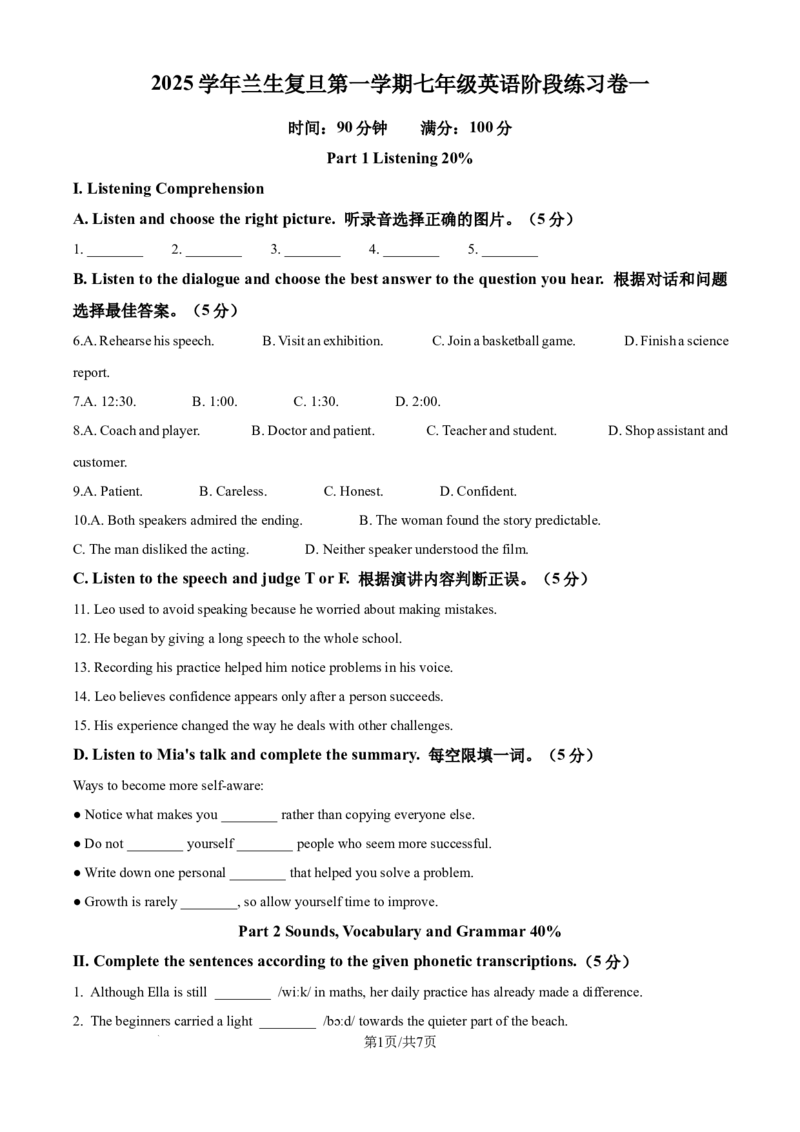
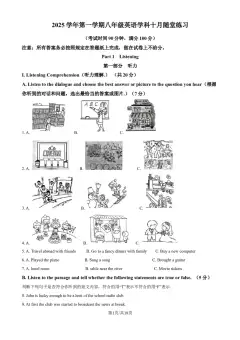
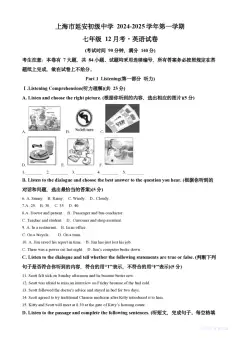
2025 学年兰生复旦第一学期七年级英语阶段练习卷一
时间:90 分钟    满分:100 分
Part 1 Listening 20%
I. Listening Comprehension
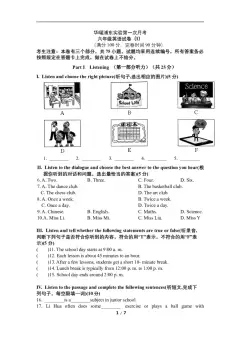
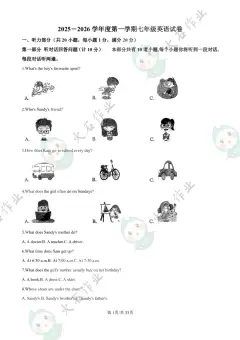
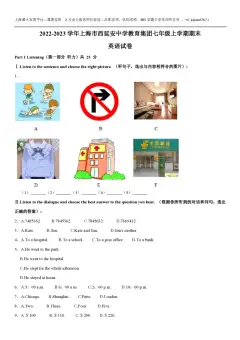
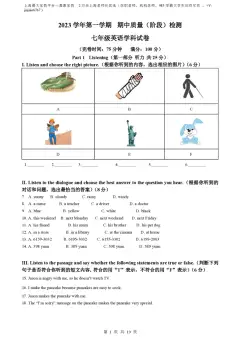
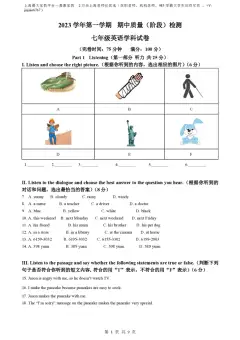
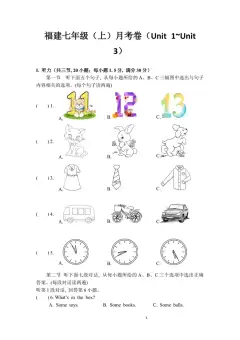
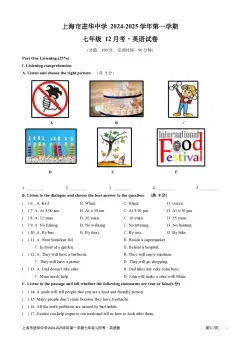
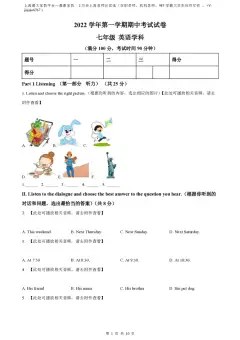
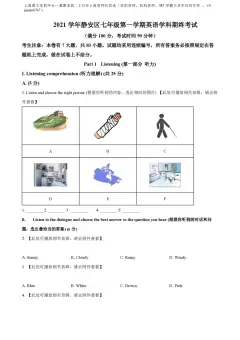
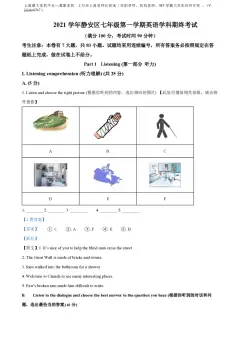
A. Listen and choose the right picture. 听录音选择正确的图片。(5 分)
1. ________    2. ________    3. ________    4. ________    5. ________
B. Listen to the dialogue and choose the best answer to the question you hear. 根据对话和问题
选择最佳答案。(5 分)
6.A. Rehearse his speech.        B. Visit an exhibition.        C. Join a basketball game.        D. Finish a science
report.
7.A. 12:30.        B. 1:00.        C. 1:30.        D. 2:00.
8.A. Coach and player.        B. Doctor and patient.        C. Teacher and student.        D. Shop assistant and
customer.
9.A. Patient.        B. Careless.        C. Honest.        D. Confident.
10.A. Both speakers admired the ending.        B. The woman found the story predictable.
C. The man disliked the acting.        D. Neither speaker understood the film.
C. Listen to the speech and judge T or F. 根据演讲内容判断正误。(5 分)
11. Leo used to avoid speaking because he worried about making mistakes.
12. He began by giving a long speech to the whole school.
13. Recording his practice helped him notice problems in his voice.
14. Leo believes confidence appears only after a person succeeds.
15. His experience changed the way he deals with other challenges.
D. Listen to Mia's talk and complete the summary. 每空限填一词。(5 分)
Ways to become more self-aware:
● Notice what makes you ________ rather than copying everyone else.
● Do not ________ yourself ________ people who seem more successful.
● Write down one personal ________ that helped you solve a problem.
● Growth is rarely ________, so allow yourself time to improve.
Part 2 Sounds, Vocabulary and Grammar 40%
II. Complete the sentences according to the given phonetic transcriptions.(5 分)
1. Although Ella is still ________ /wiːk/ in maths, her daily practice has already made a difference.
2. The beginners carried a light ________ /bɔːd/ towards the quieter part of the beach.
第2页/共7页
学科网(北京)股份有限公司
3. Whenever the runners felt exhausted, their ________ /kəʊtʃ/ reminded them to control their breathing.
4. The latest issue of the science ________ /ˌmægəˈziːn/ introduces several teenage inventors.
5. It is my ________ /bɪˈliːf/ that steady effort matters more than quick success.
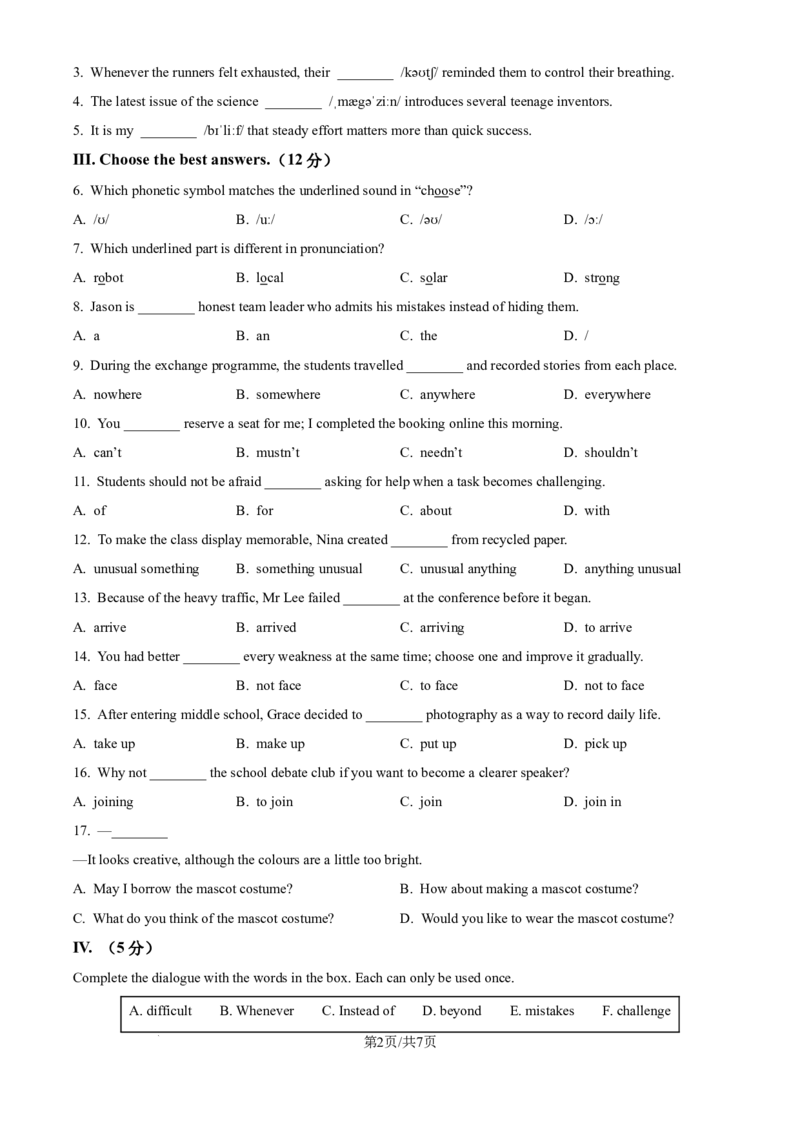
III. Choose the best answers.(12 分)
6. Which phonetic symbol matches the underlined sound in “choose”?
A. /ʊ/
B. /uː/
C. /əʊ/
D. /ɔː/
7. Which underlined part is different in pronunciation?
A. robot
B. local
C. solar
D. strong
8. Jason is ________ honest team leader who admits his mistakes instead of hiding them.
A. a
B. an
C. the
D. /
9. During the exchange programme, the students travelled ________ and recorded stories from each place.
A. nowhere
B. somewhere
C. anywhere
D. everywhere
10. You ________ reserve a seat for me; I completed the booking online this morning.
A. can’t
B. mustn’t
C. needn’t
D. shouldn’t
11. Students should not be afraid ________ asking for help when a task becomes challenging.
A. of
B. for
C. about
D. with
12. To make the class display memorable, Nina created ________ from recycled paper.
A. unusual something
B. something unusual
C. unusual anything
D. anything unusual
13. Because of the heavy traffic, Mr Lee failed ________ at the conference before it began.
A. arrive
B. arrived
C. arriving
D. to arrive
14. You had better ________ every weakness at the same time; choose one and improve it gradually.
A. face
B. not face
C. to face
D. not to face
15. After entering middle school, Grace decided to ________ photography as a way to record daily life.
A. take up
B. make up
C. put up
D. pick up
16. Why not ________ the school debate club if you want to become a clearer speaker?
A. joining
B. to join
C. join
D. join in
17. —________
—It looks creative, although the colours are a little too bright.
A. May I borrow the mascot costume?
B. How about making a mascot costume?
C. What do you think of the mascot costume?
D. Would you like to wear the mascot costume?
IV. (5 分)
Complete the dialogue with the words in the box. Each can only be used once.
A. difficult    B. Whenever    C. Instead of    D. beyond    E. mistakes    F. challenge
第3页/共7页
学科网(北京)股份有限公司
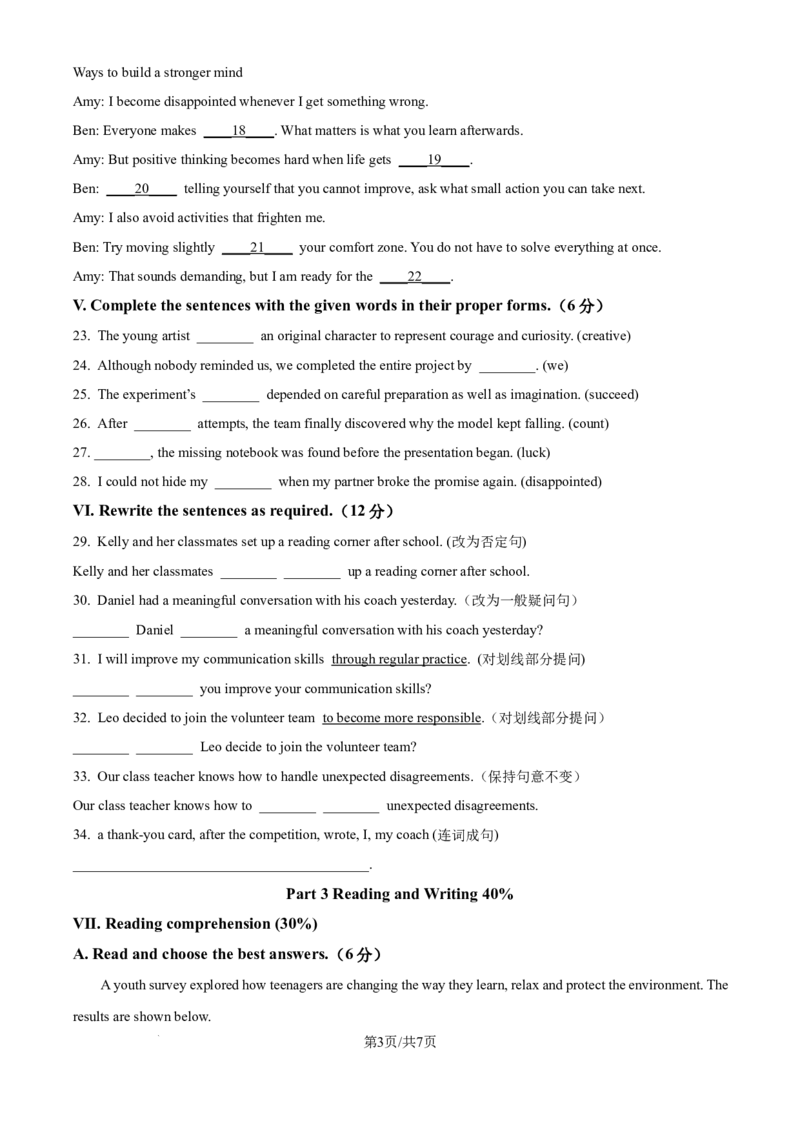
Ways to build a stronger mind
Amy: I become disappointed whenever I get something wrong.
Ben: Everyone makes ____18____. What matters is what you learn afterwards.
Amy: But positive thinking becomes hard when life gets ____19____.
Ben: ____20____ telling yourself that you cannot improve, ask what small action you can take next.
Amy: I also avoid activities that frighten me.
Ben: Try moving slightly ____21____ your comfort zone. You do not have to solve everything at once.
Amy: That sounds demanding, but I am ready for the ____22____.
V. Complete the sentences with the given words in their proper forms.(6 分)
23. The young artist ________ an original character to represent courage and curiosity. (creative)
24. Although nobody reminded us, we completed the entire project by ________. (we)
25. The experiment’s ________ depended on careful preparation as well as imagination. (succeed)
26. After ________ attempts, the team finally discovered why the model kept falling. (count)
27. ________, the missing notebook was found before the presentation began. (luck)
28. I could not hide my ________ when my partner broke the promise again. (disappointed)
VI. Rewrite the sentences as required.(12 分)
29. Kelly and her classmates set up a reading corner after school. (改为否定句)
Kelly and her classmates ________ ________ up a reading corner after school.
30. Daniel had a meaningful conversation with his coach yesterday.(改为一般疑问句)
________ Daniel ________ a meaningful conversation with his coach yesterday?
31. I will improve my communication skills through regular practice. (对划线部分提问)
________ ________ you improve your communication skills?
32. Leo decided to join the volunteer team to become more responsible.(对划线部分提问)
________ ________ Leo decide to join the volunteer team?
33. Our class teacher knows how to handle unexpected disagreements.(保持句意不变)
Our class teacher knows how to ________ ________ unexpected disagreements.
34. a thank-you card, after the competition, wrote, I, my coach (连词成句)
__________________________________________.
Part 3 Reading and Writing 40%
VII. Reading comprehension (30%)
A. Read and choose the best answers.(6 分)
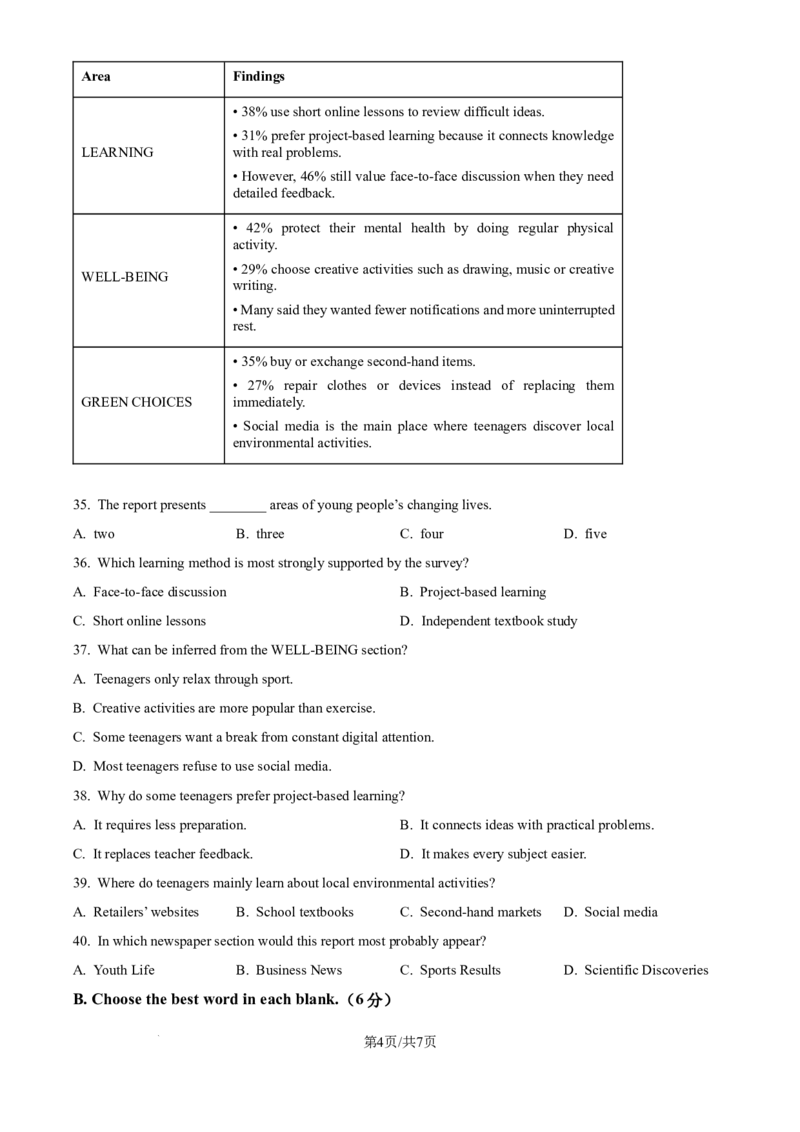
A youth survey explored how teenagers are changing the way they learn, relax and protect the environment. The
results are shown below.
第4页/共7页
学科网(北京)股份有限公司
Area
Findings
LEARNING
• 38% use short online lessons to review difficult ideas.
• 31% prefer project-based learning because it connects knowledge
with real problems.
• However, 46% still value face-to-face discussion when they need
detailed feedback.
WELL-BEING
• 42% protect their mental health by doing regular physical
activity.
• 29% choose creative activities such as drawing, music or creative
writing.
• Many said they wanted fewer notifications and more uninterrupted
rest.
GREEN CHOICES
• 35% buy or exchange second-hand items.
• 27% repair clothes or devices instead of replacing them
immediately.
• Social media is the main place where teenagers discover local
environmental activities.
35. The report presents ________ areas of young people’s changing lives.
A. two
B. three
C. four
D. five
36. Which learning method is most strongly supported by the survey?
A. Face-to-face discussion
B. Project-based learning
C. Short online lessons
D. Independent textbook study
37. What can be inferred from the WELL-BEING section?
A. Teenagers only relax through sport.
B. Creative activities are more popular than exercise.
C. Some teenagers want a break from constant digital attention.
D. Most teenagers refuse to use social media.
38. Why do some teenagers prefer project-based learning?
A. It requires less preparation.
B. It connects ideas with practical problems.
C. It replaces teacher feedback.
D. It makes every subject easier.
39. Where do teenagers mainly learn about local environmental activities?
A. Retailers’ websites
B. School textbooks
C. Second-hand markets
D. Social media
40. In which newspaper section would this report most probably appear?
A. Youth Life
B. Business News
C. Sports Results
D. Scientific Discoveries
B. Choose the best word in each blank.(6 分)
第5页/共7页
学科网(北京)股份有限公司
The Repair Table
When a desk lamp stopped working, thirteen-year-old Noah nearly threw it away. His grandfather suggested
opening it first. The inside looked ____41____, with wires crossing in several directions, so Noah did not know
where to begin.
Instead of guessing, he decided to ____42____ the problem step by step. He checked the plug, the bulb and
finally a loose wire. To ____43____ that the wire was truly responsible, he connected it carefully and tested the
lamp again. The light came on. Noah felt ____44____, not simply because the lamp worked, but because he had
understood the cause.
The experience changed the way Noah looked at broken objects. He began to ask whether an item had truly
reached the end of its useful life or whether one small part could be repaired. Before touching electronic equipment,
he read safety instructions and asked an adult to disconnect the power. He also photographed each step so that he
could put every part back in the correct place.
He later started a lunchtime repair ____45____ at school. Students brought broken pencil cases, toys and simple
electronic devices. At first, several students wanted to work as quickly as possible, but Noah encouraged them to
describe the problem before choosing a solution. The group did not repair everything successfully, but each attempt
taught them something. Noah discovered that patience and careful observation could make a real ____46____ to
both people and the environment.
41. A. ordinary
B. tidy
C. confusing
D. colourful
42. A. avoid
B. examine
C. hide
D. create
43. A. prove
B. imagine
C. discuss
D. improve
44. A. embarrassed
B. proud
C. careless
D. disappointed
45. A. project
B. performance
C. journey
D. magazine
46. A. decision
B. mistake
C. promise
D. difference
C. (5 分)
Complete the passage with proper words. The first letter is given.
A good result rarely comes from studying everything at the last minute. You may f____47____ an exam if you
remain inactive for months and depend on several rushed days of preparation.
To improve English, read, write and listen regularly. Songs, podcasts and films can gradually strengthen your
listening s____48____, but they work best when you also notice unfamiliar expressions. Keep a short record of
repeated mistakes instead of copying every correct answer. This helps you recognise patterns and decide which
weakness needs the most attention. Before an exam, rest properly instead of studying until midnight. A tired brain
may remember less, even after several extra hours of study.
第6页/共7页
学科网(北京)股份有限公司
During the exam, read every instruction c____49____ so that you understand exactly what is required. Plan
before writing, and leave enough time for difficult sections rather than becoming trapped by one question. When
you f____50____ the paper, check your answers and correct avoidable mistakes. Most importantly, make sure that
you have t____51____ your best throughout the whole learning process.
D. Read the passage and complete the tasks.(13 分)
Learning to Speak Up
Giving a speech once seemed impossible to me. Whenever I stood in front of the class, my hands shook and my
thoughts disappeared. Last autumn, however, our teacher asked everyone to give a three-minute talk about a personal
interest.
At first, I wanted to choose the easiest topic and read every sentence from a card. My teacher suggested speaking
about urban birds because I often photographed them. She also advised me to practise in smaller stages. I first
explained one photograph to a friend. Then I recorded a one-minute talk and listened to it. My voice sounded too
quiet and I spoke so quickly that several ideas were unclear. Surprisingly, noticing these weaknesses made me calmer
because I finally knew what to improve.
I rewrote the opening so that it began with a question rather than a list of facts. I also removed several scientific
names that were difficult to pronounce and replaced them with clear descriptions. These changes did not make the
topic less serious. Instead, they helped the audience follow the main idea without becoming lost in details.
During the following week, I practised pausing after important points and looking up from my notes. My younger
brother acted as the audience and asked unexpected questions. Answering him was difficult, but it taught me to
understand my ideas instead of memorising exact sentences. I gradually reduced my notes from a full page to five
key words.
On presentation day, I was still nervous. Halfway through the speech, I forgot a word. Instead of stopping, I
described the idea in another way and continued. When I finished, I realised that success did not mean speaking
without fear. It meant continuing even when fear was present.
The experience changed more than my speaking. Now, when a difficult task appears, I divide it into smaller
steps, look honestly at my weaknesses and keep improving. I have also learned that useful feedback is not criticism
to avoid; it is information that can guide the next attempt.
52. Task 1 Complete the table with NO MORE THAN THREE WORDS in each blank.
Time/Stage
What happened?
Feeling/Result
Before practising
The writer feared
speaking in class.
She felt nervous.
第7页/共7页
学科网(北京)股份有限公司
First small step
She

explained

a
photograph

to
________.
The

task

felt
manageable.
After recording
She noticed that she
spoke too quietly and
________.
She became calmer.
Further practice
She practised pausing
and

answering
________.
She understood her
ideas better.
Presentation day
She forgot a word but
________.
She completed the
speech.
Lesson learned
She now divides
difficult tasks into
________.
She keeps improving.
53. Task 2 Choose either question A or B and answer.
A. How do you understand “success did not mean speaking without fear” in Paragraph 5?
B. Do you think identifying weaknesses can increase confidence? Give reasons.
I choose ________ (A/B).
__________________________________________________________
VIII. Writing(10 分)
54. Think of a skill you found difficult to master. Write at least 60 words about the difficulties, the methods
you used and what the experience taught you.
How I learned ______________________
____________________________________________________________________________________________
____________________________________________________________________________________________
____________________________________________________________________________________________
____________________________________________________________________________________________
____________________________________________________________________________________________
____________________________________________________________________________________________
____________________________________________________________________________________________
_________________________________________