绝密★启用前
2024 年高三一轮名校培优筑基复习方案(北师大 2019)
Unit 4 Humour同步综合检测题【考案】
目录 内容提要
阅读 A 篇 介 绍 四 部 经 典 的 英 国 幽 默 电 影
阅读 B 篇 自 闭 症 男 孩 激 励 青 少 年 实 现 梦 想
阅读 C 篇 介绍当前流行的“病态幽默”含义
阅读 D 篇 幽 默 可 以 化 解 跨 文 化 旅 行 的 尴 尬
阅读七选五 侧重介绍保持心情愉快的几条建议
完形填空 文章主要介绍了歌剧这一古老艺术
语法填空 梁朝伟获威尼斯电影节终身成就金狮奖
应用文写作 学 校 心 理 健 康 英 语 征 文 比 赛 投 稿
读后续写 从来不写作业男孩蜕变为阳光学生
第一部分 听力 (共两节,满分30分)
第一节(共5小题;每小题l.5分,满分7.5分)
听下面5段对话。每段对话后有一个小题,从题中所给的 A、B、C三个选项中选出最佳选项。
听完每段对话后,你都有10秒钟的时间来回答有关小题和阅读下一小题。每段对话仅读一遍。
1. What will the woman do about the dress?
A. She’ll change it. B. She’ll return it. C. She’ll buy it.
2. What are the speakers talking about?
A. Buying DVDs. B. Borrowing DVDs. C. Sharing DVDs.
3. What did the woman think of Dana’s speech?
A. Boring. B. Important. C. Well-prepared.
4. What does the man mean?
A. He is unable to give help. B. He will carry the boxes later. C. He refuses to pay for boxes.
5. When is Simon supposed to arrive?
A. 7:30. B. 8:00. C. 8:10.
第二节(共15小题;每小题1.5分,满分22.5分)
听下面5段对话或独白。每段对话或独白后有几个小题,从题中所给的A、B、C三个选项中选出
最佳选项。听每段对话或独白前,你将有时间阅读各个小题,每小题5秒钟;听完后,各小题将给出5秒钟
的作答时间。每段对话或独白读两遍。
听第6段材料,回答第6、7题。
6. Where do the speakers plan to go?
A. The woman’s home. B. A museum. C. A library.
7. Why does the woman want to go on Saturday afternoon?
A. To enjoy nice weather. B. To sleep late in the morning. C. To avoid the crowd.
听第7段材料,回答第8至10题。
8. Why did the man borrow the woman’s computer last time?
A. He needed it for his paper. B. His computer was broken. C. He used it for his computer class.
9. Why does the woman feel happy?A. The man can lend her a computer now.
B. The man will use his own computer.
C. The man will study better.
10. What has the man been doing with his new computer?
A. Doing homework. B. Searching for information. C. Watching DVDs.
听第8段材料,回答第11至13题。
11. Where did Tom get the idea of becoming a businessman?
A. From the grown-ups around him.
B. From his high school teachers.
C. From his college friends.
12. How much does Tom own of the company he works for?
A. 60%. B. 18%. C. 6%.
13. What mistake did Tom and his company make in the past?
A. Making all the products themselves.
B. Wasting lots of materials.
C. Producing simple things.
听第9段材料,回答第14至17题。
14. What kind of jobs seems to be in short supply?
A. Writers. B. School teachers. C. Newspaper reporters.
15. Where is Sharon most likely to go?
A. New York. B. Boston. C. California.
16. What does James plan to do if he can’t find a job?
A. Continue his education. B. Start a newspaper. C. Write a book.
17. Who are the speakers?
A. Fellow students. B. Laid-off workers. C. High school teachers.
听第10段材料,回答第17至20题。
18. Why does the university offer the two programs?
A. To keep students safe walking late or alone.
B. To provide better health care for students.
C. To help visitors tour around the college.
19. When can students call Campus Safety Office?
A. From 7 p.m. to 7 a.m. B. Anytime of the day. C. From midnight to 7 a.m.
20. To whom is the speaker mainly talking?
A. Tourists at the college. B. New teachers. C. Parents of students.
第二部分 阅读(共两节,满分50分)
第一节(共15小题:每小题2.5分,满分37.5分)
阅读下列短文,从每题所给的A、B、C、D四个选项中选出最佳选项。
A
If you want to know something about British life, their spirit, and even their humor, watching some classic
British films will certainly help. Here are some recommended to you.
Notting Hill
After the success of his film Four Weddings and a Funeral, writer and producer Richard Curtis captured the
essence of being British in 1999’s Notting Hill. Set against the background of rich West London, the film became
popular for its charming and funny portrayal (刻画) of a British nobody trying to impress a Hollywood star.
The Full Monty
This 1997 film is a Sheffield-based comedy (喜剧) about six unemployed men who form a group to makemoney for a better life. Despite its humour, the film dives deeper into some serious issues surrounding working-
class culture. The Full Monty is an uplifting film that gives an insight into the work and life of the working class in
Britain.
Trainspotting
Danny Boyle’s 1996 comedy-drama Trainspotting is about a group of Scots in the 1980s, based on the book by
Irvine Welsh. With a cast of truly great actors including Ewan McGregor, the tale impressed the audience globally.
It rapidly became a critical success.
Monty Python’s Life of Brian
Featuring a jam-packed cast of comedic stars, Monty Python’s Life of Brian tells the story of a young man
who is in a case of mistaken identity. The film reflects the unusual and wonderful British sense of humour. As a
film guaranteed to entertain, Monty Python’s Life of Brian is not to be missed by those looking for an insight into
what makes the British laugh.
21. What can the audience learn about by watching The Full Monty?
A. Hardships of comedic stars.
B. Life of the British working class.
C. Unique experiences of some Scots.
D. Daily life of people in West London.
22. What kind of film does Monty Python’s Life of Brian belong to?
A. A horror movie.
B. A comedy film.
C. An action movie
D. A science fiction film.
23. Which of the following films is adapted from a book?
A. Notting Hill.
B. The Full Monty.
C. Trainspotting.
D. Monty Python’s Life of Brian.
B
Daniel, at age 17, is a student support captain at Armidale High School, a motivational speaker and a
published author. He also has autism (自闭症), something he says doesn’t define him but inspires him.
At just six months old Daniel had a stroke (中风) that left him physically impaired (受损的), unable to bear
weight in his legs or move the left side of his body. Unable to walk and in a wheelchair until he was six years old,
Daniel turned to books and could read fluently at age four.
According to the Autism Association of Western Australia, it is estimated that one in 100 people in Australia
have autism. In 2018, there were 205, 200 Australians with autism, a 25. 1 percent increase from 164, 000 in 2015.
The idea of writing a book had been in Daniel’s mind for as long as he could remember. “It’s been one of my
long-term goals and I feel very passionate and happy about doing it,” he said. With Mum’s help, Cracked As A
Crab was born, the story of Chip, a crab who has autism and uses humour to make friends. “The response to it has
been very positive. People are happy and excited for me,” Jacob said.Now a published author, Daniel has plans to write more books. Not content with sitting idle (无所事事) while
most students are studying for their exams, Daniel is busy involving others in his role as student support captain.
He saw a gap in student support leaders within his school and wanted students with autism to be included. He is
determined to have a long and successful career, and wants to inspire other people living with autism to achieve
their dreams.
24. What happened to Daniel when he was 6?
A. He started to read.
B. He was able to walk.
C. He suffered a serious stroke.
D. He experienced a sudden weight gain.
25. What do we know about the book Cracked As A Crab?
A. It has won positive recognition.
B. It was finished by Daniel independently.
C. It is based on Daniel’s personal experiences.
D. It received financial support from Daniel’s friends.
26. What might Daniel do after publishing his book?
A. Prepare for his exams.
B. Continue writing books.
C. Learn from other student support leaders.
D. Provide autistic students with career advice.
27. What is a suitable title for the text?
A. More Autistic Students Serve as Support Leaders
B. Mum Turns to Writing to Support Her Autistic Child
C. High School Pays More Attention to Autistic Students
D. Teenager Author with Autism Inspires Other Autistic Students
C
Most funny stories are based on comic situations. In spite of national differences, certain funny situations have
a universal attraction. No matter where you live, you would find it difficult not to laugh at, say Charlie Chaplin’s
early films. However, a new type of humour, which starts largely from the US, has recently come into fashion. It is
called “sick humour”.
Comedians base their jokes on tragic situations like violent deaths or serious accidents. The following “sick
humour” will enable you to amuse yourself.
A man who had broken his right leg was taken to hospital a few weeks before Christmas From the moment he
arrived there, he kept on bothering his doctor to tell him when he would be able to go home. He was afraid of
having to spend Christmas in hospital. Though the doctor did his best, the patient’s recovery was slow. On
Christmas Day, the man still had his right leg in plaster(石膏).
He spent a miserable day in bed thinking of all the fun he was missing. The following day, however, the doctor
consoled him by telling him that his chances of being able to leave hospital in time for New Year celebrations were
good. The man took heart and, sure enough, on New Year’s Eve he was able to hobble(蹒跚) along to a party. To
make up for his unpleasant experiences in hospital, the man drank a little more than what was good for him. In theprocess, he enjoyed himself thoroughly and kept telling everybody how much he hated hospitals. He was still
murmuring something about hospitals at the end of the party when he slipped on a piece of ice and broke his left
leg.
28. What can we infer from the passage?
A. No pains,no gains.
B. Extreme joy begets sorrow.
C. Once a thief,always a thief.
D. Good medicine tastes bitter.
29. What’s the main idea of the passage?
A. A new kind of humour came into being.
B. How to cure your legs is important.
C. Christmas is more necessary than anything else.
D. Holding a party is interesting for the westerners.
30. Which of the following is RIGHT according to the passage?
A. All the humour stories are funny in spite of different nationalities.
B. One can realise the humour of the stories in his own country.
C. Charlie Chaplin made it difficult to laugh at his action.
D. Almost all the audience can be made to laugh at some famous comedians’ action.
31. What does the underlined word “consoled” mean?
A. Comforted. B. Overcame.
C. Confused. D. Disturbed.
D
Culture shock or thinking differences can depress even the most experienced traveller. Remember that
unlucky accidents with service providers may take place because of cultural or linguistic misunderstandings, and
that getting angry will make communication more difficult and cause bad feelings. A taste of humour can make
hard situations more meaningful and enjoyable to you, your fellow travellers and the local friends you’ve made.
Keep a journal or carry a small tape recorder and make regular entries or recordings. Taking a step back and
telling an experience after some time will open the door to humour. Write a letter or an email to a friend when you
find your humour reducing. Challenge yourself to tell at least one good story in this message and you’ll be
surprised at how funny things can look when told to someone outside the situation.
Keep a list of funny things that you observe during your first few days in a new culture, and an explanation of
what you think these things are all about. Look back on these lists later in the trip;what seemed strange before is
probably familiar now, and your explanations may be funnier than the things themselves! Imagine writing an entry
in a guidebook about a frustrating experience. How would you describe your experience to the later travellers?What
travel advice would you offer?
Try to see yourself through the eyes of the locals. What might they find strange or funny about what you are
doing at this moment? When you find it difficult to overcome cultural differences, taking a new look at yourself can
be very funny. Be careful not to sacrifice (牺牲) respect for local culture in order to lighten things up for yourself
and fellow travellers.
32. Why will the travellers often get depressed according to the text?
A. Because of being short of money.B. Because of the different thoughts on the same thing.
C. Because of not having enough clothes.
D. Because of the unlucky fellow travellers’ trouble.
33. What should you do when you try to keep your sense of humour in foreign countries?
A. Tell anything that you find entertaining.
B. Learn to respect the local customs.
C. Know how to overcome cultural differences.
D. Try to tell anything particularly funny.
34. What can you infer from the passage?
A. The funny things will be always interesting and never change.
B. The funny things will always make people happy.
C. If the people didn’t experience the things, they would find them funny.
D. The things seemed strange before are surely becoming the familiar things.
35. Who is the text intended for?
A. The performers who act in the music hall.
B. The actors who often act in the theatre.
C. The travellers who are experienced.
D. The travellers who want to be humorous.
第二节(共5小题:每小题2.5分,满分12.5分)
阅读下面短文,从短文后的选项中选出可以填入空白处的最佳选项。选项中有两项为多余选项。
Are you truly happy? What does it mean to be happy? What does it take to achieve happiness? 3 6
The following are a few tips that I follow to create happiness in my life.
Make a plan for achieving goals that you believe will make you happy. Your moods (心情) will very likely
increase if you are going after something you value.
3 7 It is easy to begin to think negatively when you are surrounded by people who think that way. On
the contrary, if you are around people who are happy, their emotional state will be infectious.
When something goes wrong, try to figure out a solution (解决办法) instead of being absorbed in self-pity.
Truly happy people don’t allow setbacks to affect their mood because they know that with a little thought they can.
Spend a few minutes each day thinking about the things that make you happy. 3 8 And this will lead
you to continuous happiness.
3 9 Whether you treat yourself to lunch, take a long, relaxing bath or simply spend a few extra minutes
on your appearance, you will be subconsciously putting yourself in a better mood.
Finding the humor in situations can also lead to happiness. Find a way to make light of a situation that would
otherwise make you happy.
Keeping healthy is another way to achieve happiness. 4 0
A. Surround yourself with happy people.
B. There are some tips in life that lead to happiness.
C. Eating healthy foods or being fit can have a great effect on your mood.
D. These few minutes will help you focus on the positive things in your life.E. What makes you happy may be different from what makes someone else happy.
F. It is also important to take some time each day to do something nice for yourself.
G. These are important questions for anyone who is seeking happiness to ask themselves.
第三部分语言运用(共两节,满分30分)
第一节(共15小题; 每小题1分,满分15分)
阅读下面短文,从每题所给的A、B、C、D四个选项中选出可以填入空白处的最佳选项。
The ancient art of opera can be brilliant entertainment; it is a(n) 41 of music, drama, and sometimes
dance, staged with elaborate(精心制作的) sets of costumes. Opera is often 4 2 by many, however, partly
because of some of the stereotypes(成见) associated with it. Some of its critics say that the narratives are too
complex. Others complain that operas cannot be understood because they are often performed in 4 3
languages. Stereotypes aside, opera is an art form enjoyed by many 44 lovers. Operas can be comedies or
tragedies or stories taken from history.
The story of an opera is generally simple so as to avoid 45 the audience from the music. The
libretto, or script, sets each scene and describes the action in both words and stage directions. The music of an
opera—the way it advances the action and the feelings it inspires in the listeners—is 46 important. The
three principal musical 47 are the overture(前奏曲), the recitative(朗诵调), and the aria(咏叹调).
The overture is the instrumental introduction to the opera, the purpose of which has been 48 over
time. During the nineteenth century, the overture began to combine snippets of melodies from arias, ballets, and
other musical elements in a medley of the opera’s musical themes.
A recitative is less a song than a monologue(独白) that is sung rather than 49 . A recitative is an
element, older than the overture, which was invented at the beginning of the seventeenth century as a means of
telling 50 in music; the first operas were actually a series of recitatives joined by musical interludes.
Because an opera is basically a play set to music, the recitative is a means of telling the 51 what is
going on and what is about to happen.
An aria is a solo performance—often one of the highlights of the opera. Arias can be declarations of love or
5 2 of hope, happiness, sorrow, or anguish. Many composers have written arias to 5 3 the vocal
gifts of singers; some sopranos(女高音歌手) were indeed famous for the very high notes that they could sing.
54 , arias are not the only songs in opera. Duets, compositions for three or four voices, and large-group
numbers are also common. These diverse musical elements, 55 visual elements in costumes and sets as
well as the dramatic content of the story, make the opera the complex art form that it is.
41. A. exploration B. mixture C. research D. experiment
42. A. unappreciated B. composed C. enjoyed D. favored
43. A. local B. native C. foreign D. official
44. A. gossip B. history C. movie D. music
45. A. releasing B. separating C. distracting D. disappointing
46. A. particularly B. rarely C. originally D. historically
47. A. tastes B. elements C. skills D. talents
48. A. stated B. described C. lacked D. evolved
49. A. imagined B. reminded C. spoken D. written50. A. stories B. news C. jokes D. lies
51. A. musicians B. audience C. directors D. performers
52. A. rights B. reasons C. expressions D. expenses
53. A. improve B. show C. involve D. practise
54. A. Moreover B. Otherwise C. Therefore D. However
55. A. broken into B. applied to C. combined with D. matched with
第二节(共10小题; 每小题1.5分,满分15分)
阅读下面短文,在空白处填入1个适当的单词或括号内单词的正确形式。
Tony Leung wins lifetime achievement award in Venice
chinadaily.com.cn | Updated: 2023-09-03 16:52
Hong Kong superstar Tony Leung Chiu-wai received the Golden Lion award for lifetime achievement at the 56
(eighty) Venice Film Festival on Saturday, making history as the first Chinese actor to be awarded with the high honor.
Iconic director Ang Lee, who collaborated(协作) with Leung in the 2007 film Lust, Caution, which won a Golden Lion
for Best Picture at the 64th Venice Film Festival, 57 (deliver) an emotional, six-minute-long speech to praise
Leung as a gifted and kind-hearted star.
Referring to Leung 58 "a director's dream", Lee highlighted Leung's gift in conveying complex emotion
through his eyes. "There is something in his eyes that's thrilling, not just his physical eyes or skill, 5 9 the soul that
shines through them. He can say 6 0 (much) in one look than many actors can with a full monologue," said Lee.
When hearing that he won the award, Leung couldn't hold back his tears and 61 (fill) with emotion. The
61-year-old star expressed deep gratitude to his wife, Hong Kong 6 2 (act) Carina Lau Kar-ling.
He also said that he felt grateful for having grown up in Hong Kong and having been nurtured by the local film industry,
63 his acting career began.
The news of his award win, which has also made Leung the third Chinese film celebrity 64 (receive) a
lifetime achievement award at Venice Film Festival, 65 (follow) directors John Woo and Ann Hui, has caused
quite a buzz on major social platforms like Sina Weibo.
第四部分 写作(共两节,满分40分)
第一节(满分15分)
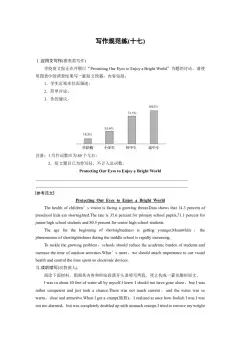
你校将举办以心理健康为主题的英语征文比赛,请你写一篇短文投稿。内容包括:
1. 说明心理健康的重要性;
2. 谈谈如何保持心理健康。
注意:
1. 词数80左右;
2. 可以适当增加细节,以使行文连贯。
____________________________________________________________________________________________
____________________________________________________________________________________________
____________________________________________________________________________________________
____________________________________________________________________________________________
____________________________________________________________________________________________
第二节(满分25分)
阅读下面材料,根据其内容和所给段落开头语续写两段,使之构成一篇完整的短文。
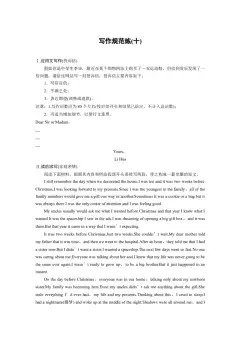
Trevor, a thirteen-year-old boy who could read well. Yet, in spite of his reading skills, Trevor was failing.
He had been failing exams since first grade, as he was passed on from Grade 1 to Grade 7. Trevor was a big boy,looking much bigger than a thirteen year old. However, Trevor went unnoticed… until Miss Brown.
Miss Brown was smiling, young, and Trevor was attracted! Yet, still he failed. He never did his homework,
and he was always in trouble with Miss Brown. His heart would break under her sharp words! Still, he did not
study.
One day, the entire grade was tested for basic skills. Trevor hurried through his tests, and continued to dream
of other things. His heart was in the woods, where he often escaped alone. No one checked on him. No one knew he
was gone. Strangely, Trevor never missed a day of school.
The next day, Miss Brown’s impatient voice broke into his daydreams.
“Trevor, pay attention!”
Trevor locked his look on Miss Brown as she began to go over the test results for the seventh grade.
“You all did pretty well,” she told the class, “except for one boy, and it breaks my heart to tell you this, but…
the smartest boy is failing my class!”
She just stared at Trevor, as the class turned around for a good look. Trevor dropped his eyes and carefully
examined his fingertips.
After that, it was war! Trevor still wouldn’t do his homework. Even as the punishments became more severe,
he remained stubborn (固执的).
“Just try it! ONE WEEK!” Miss Brown shouted. But Trevor was unmoved.
“You’re smart enough! You’ll see a change!” Totally unmoved.
“Trevor! Please! I care about you!”
Suddenly, Trevor got it! Someone cared about him? Someone, CARED ABOUT HIM?!
Trevor went home from school, thoughtful, that afternoon. Walking into the house, he took one look around.
He, for the first time ever, gathered up his schoolbooks and did his homework.
注意:
1.续写词数应为150左右;
2.请按如下格式在答题卡的相应位置作答。
The following Monday he arrived at school earlier, waiting for Miss Brown to enter the classroom.
____________________________________________________________________________________________
____________________________________________________________________________________________
____________________________________________________________________________________________
____________________________________________________________________________________________
____________________________________________________________________________________________
_______________
“The smartest boy in our class had just passed his first test on homework!” announced Miss Brown.