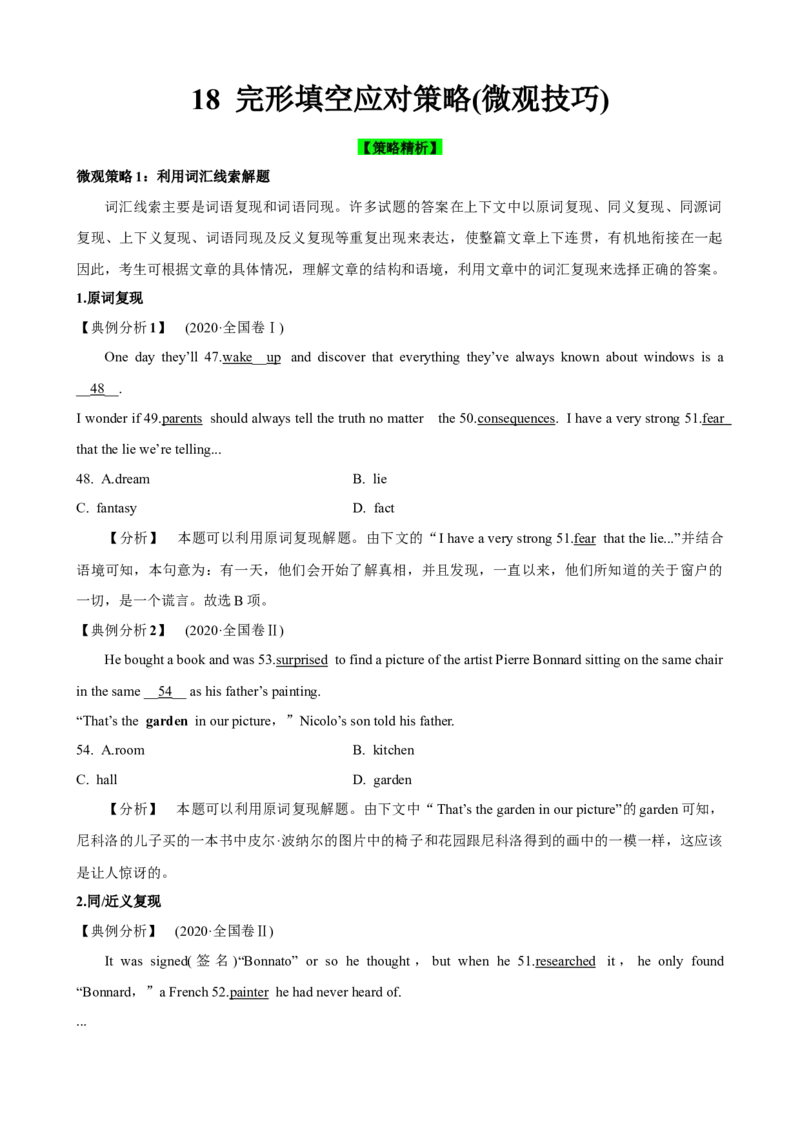
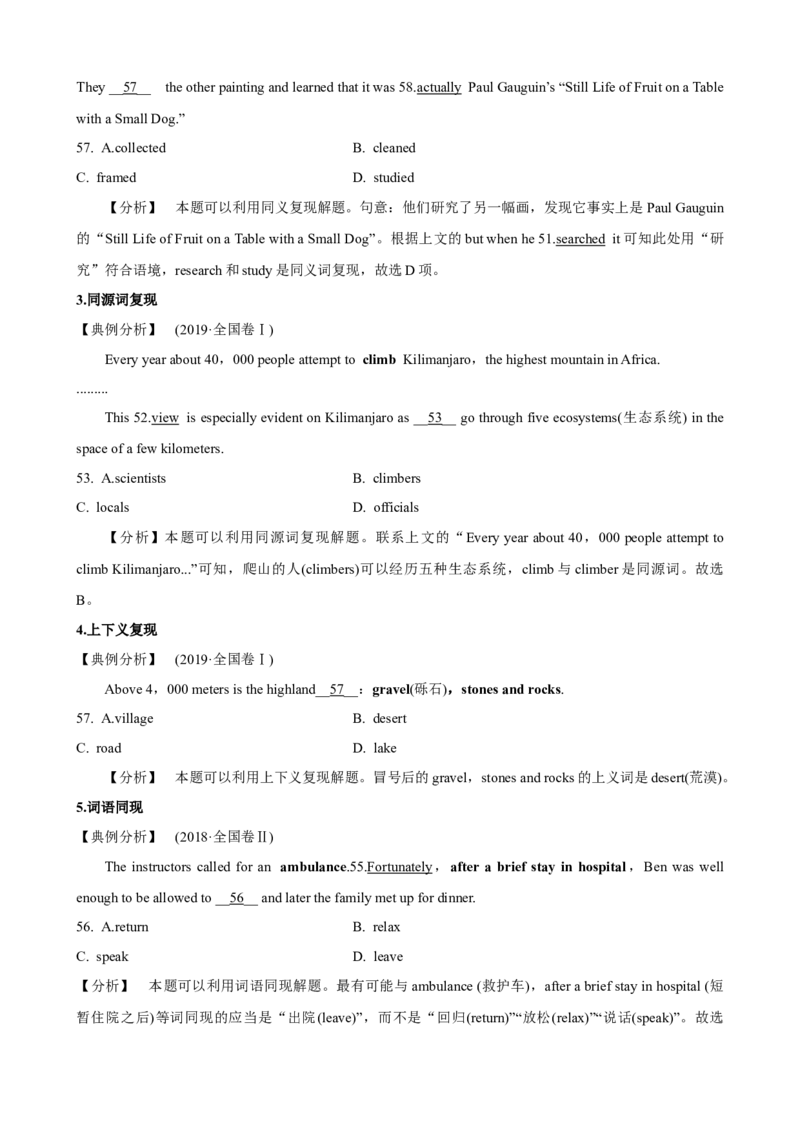
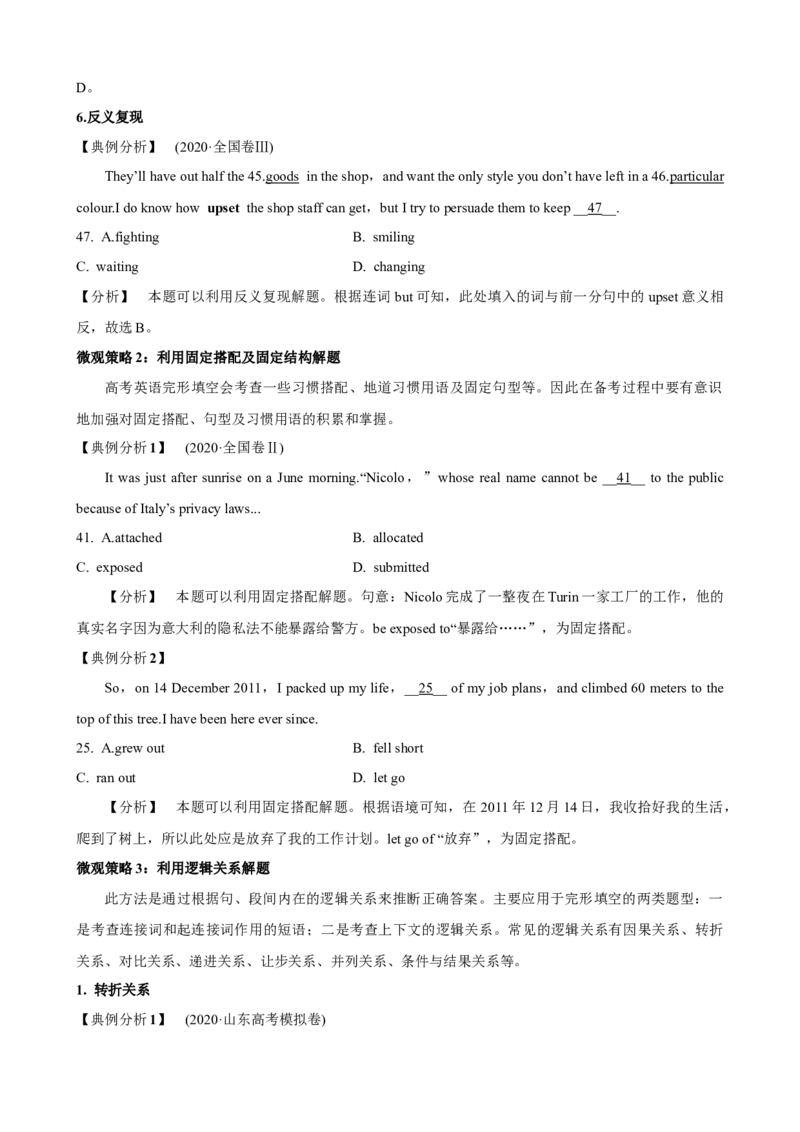
18 完形填空应对策略(微观技巧)
【策略精析】
微观策略1:利用词汇线索解题
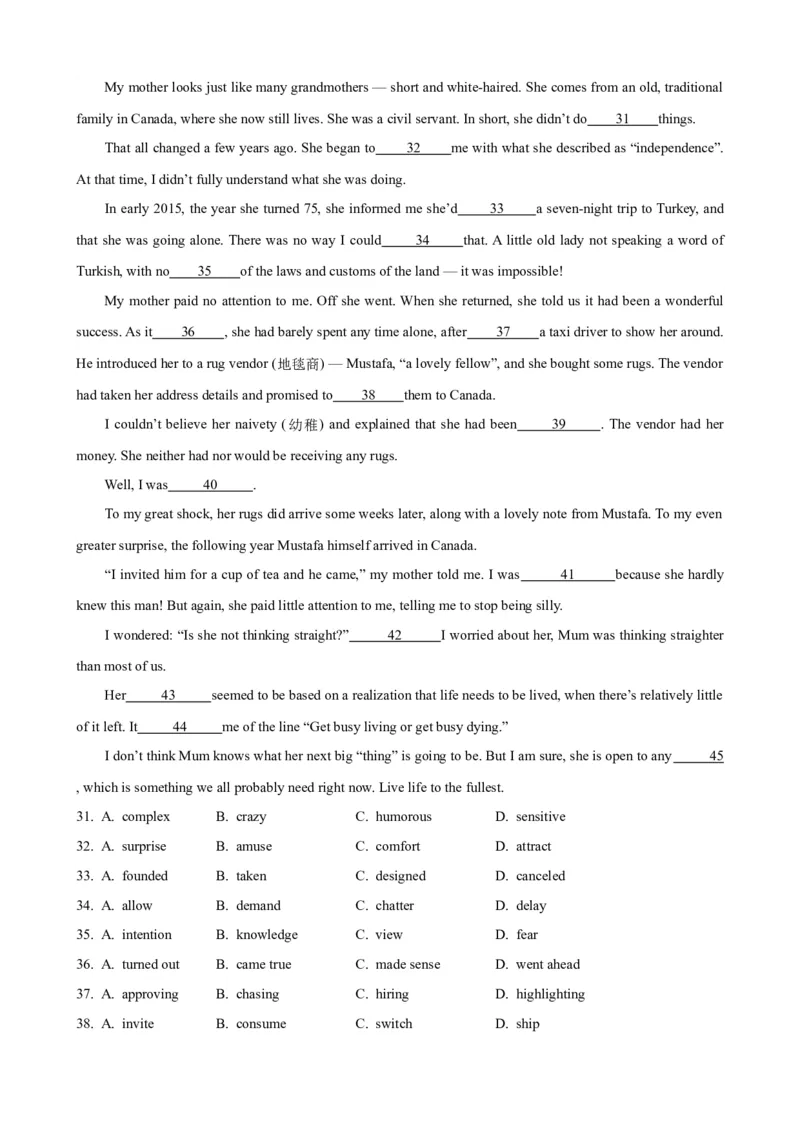
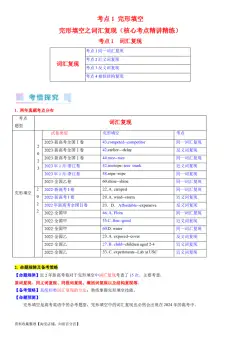
词汇线索主要是词语复现和词语同现。许多试题的答案在上下文中以原词复现、同义复现、同源词
复现、上下义复现、词语同现及反义复现等重复出现来表达,使整篇文章上下连贯,有机地衔接在一起
因此,考生可根据文章的具体情况,理解文章的结构和语境,利用文章中的词汇复现来选择正确的答案。
1.原词复现
【典例分析1】 (2020·全国卷Ⅰ)
One day they’ll 47.wake__up and discover that everything they’ve always known about windows is a
__48__.
I wonder if 49.parents should always tell the truth no matter the 50.consequences. I have a very strong 51.fear
that the lie we’re telling...
48. A.dream B. lie
C. fantasy D. fact
【分析】 本题可以利用原词复现解题。由下文的“I have a very strong 51.fear that the lie...”并结合
语境可知,本句意为:有一天,他们会开始了解真相,并且发现,一直以来,他们所知道的关于窗户的
一切,是一个谎言。故选B项。
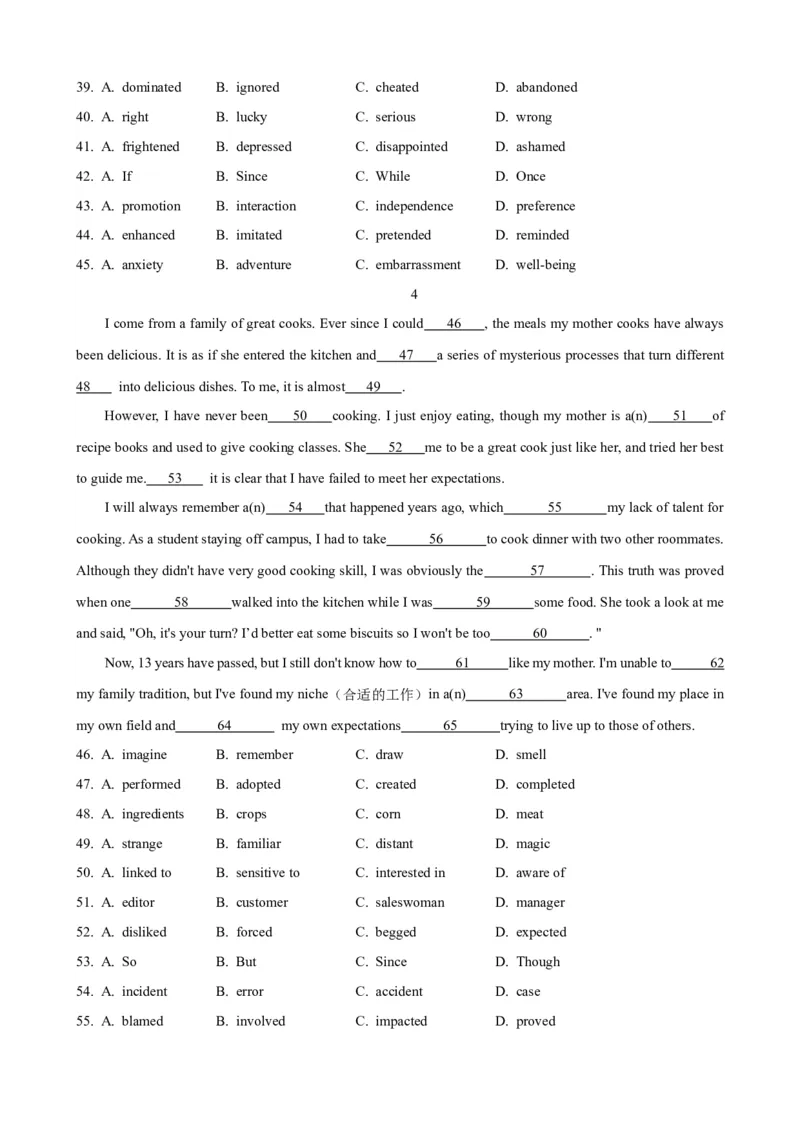
【典例分析2】 (2020·全国卷Ⅱ)
He bought a book and was 53.surprised to find a picture of the artist Pierre Bonnard sitting on the same chair
in the same __54__ as his father’s painting.
“That’s the garden in our picture,”Nicolo’s son told his father.
54. A.room B. kitchen
C. hall D. garden
【分析】 本题可以利用原词复现解题。由下文中“That’s the garden in our picture”的garden可知,
尼科洛的儿子买的一本书中皮尔·波纳尔的图片中的椅子和花园跟尼科洛得到的画中的一模一样,这应该
是让人惊讶的。
2.同/近义复现
【典例分析】 (2020·全国卷Ⅱ)
It was signed( 签 名 )“Bonnato” or so he thought , but when he 51.researched it , he only found
“Bonnard,”a French 52.painter he had never heard of.
...They __57__ the other painting and learned that it was 58.actually Paul Gauguin’s “Still Life of Fruit on a Table
with a Small Dog.”
57. A.collected B. cleaned
C. framed D. studied
【分析】 本题可以利用同义复现解题。句意:他们研究了另一幅画,发现它事实上是Paul Gauguin
的“Still Life of Fruit on a Table with a Small Dog”。根据上文的but when he 51.searched it可知此处用“研
究”符合语境,research和study是同义词复现,故选D项。
3.同源词复现
【典例分析】 (2019·全国卷Ⅰ)
Every year about 40,000 people attempt to climb Kilimanjaro,the highest mountain in Africa.
.........
This 52.view is especially evident on Kilimanjaro as __53__ go through five ecosystems(生态系统) in the
space of a few kilometers.
53. A.scientists B. climbers
C. locals D. officials
【分析】本题可以利用同源词复现解题。联系上文的“Every year about 40,000 people attempt to
climb Kilimanjaro...”可知,爬山的人(climbers)可以经历五种生态系统,climb与climber是同源词。故选
B。
4.上下义复现
【典例分析】 (2019·全国卷Ⅰ)
Above 4,000 meters is the highland__57__:gravel(砾石),stones and rocks.
57. A.village B. desert
C. road D. lake
【分析】 本题可以利用上下义复现解题。冒号后的gravel,stones and rocks的上义词是desert(荒漠)。
5.词语同现
【典例分析】 (2018·全国卷Ⅱ)
The instructors called for an ambulance.55.Fortunately,after a brief stay in hospital,Ben was well
enough to be allowed to __56__ and later the family met up for dinner.
56. A.return B. relax
C. speak D. leave
【分析】 本题可以利用词语同现解题。最有可能与ambulance (救护车),after a brief stay in hospital (短
暂住院之后)等词同现的应当是“出院(leave)”,而不是“回归(return)”“放松(relax)”“说话(speak)”。故选D。
6.反义复现
【典例分析】 (2020·全国卷Ⅲ)
They’ll have out half the 45.goods in the shop,and want the only style you don’t have left in a 46.particular
colour.I do know how upset the shop staff can get,but I try to persuade them to keep __47__.
47. A.fighting B. smiling
C. waiting D. changing
【分析】 本题可以利用反义复现解题。根据连词 but可知,此处填入的词与前一分句中的upset意义相
反,故选B。
微观策略2:利用固定搭配及固定结构解题
高考英语完形填空会考查一些习惯搭配、地道习惯用语及固定句型等。因此在备考过程中要有意识
地加强对固定搭配、句型及习惯用语的积累和掌握。
【典例分析1】 (2020·全国卷Ⅱ)
It was just after sunrise on a June morning.“Nicolo,”whose real name cannot be __41__ to the public
because of Italy’s privacy laws...
41. A.attached B. allocated
C. exposed D. submitted
【分析】 本题可以利用固定搭配解题。句意:Nicolo完成了一整夜在Turin一家工厂的工作,他的
真实名字因为意大利的隐私法不能暴露给警方。be exposed to“暴露给……”,为固定搭配。
【典例分析2】
So,on 14 December 2011,I packed up my life,__25__ of my job plans,and climbed 60 meters to the
top of this tree.I have been here ever since.
25. A.grew out B. fell short
C. ran out D. let go
【分析】 本题可以利用固定搭配解题。根据语境可知,在 2011年12月14日,我收拾好我的生活,
爬到了树上,所以此处应是放弃了我的工作计划。let go of “放弃”,为固定搭配。
微观策略3:利用逻辑关系解题
此方法是通过根据句、段间内在的逻辑关系来推断正确答案。主要应用于完形填空的两类题型:一
是考查连接词和起连接词作用的短语;二是考查上下文的逻辑关系。常见的逻辑关系有因果关系、转折
关系、对比关系、递进关系、让步关系、并列关系、条件与结果关系等。
1. 转折关系
【典例分析1】 (2020·山东高考模拟卷)I am willing to stay up here for as long as it takes,__33__ I honestly hope it won’t be too long before I can
put my feet on the ground below and stand in a forest that will never be logged.
33. A.but B. though
C. because D. so
【分析】 本题可以利用转折关系解题。空前提到我愿意待在树上,空后说,我不希望待在树上太
长时间,由此可知,前后语义为转折关系,故填but。故选A。
【典例分析2】 (2019·全国卷Ⅲ)
The 3,500 residents cannot all 56.enjoy the sunshine at the same time.__57__,the new light feels like
more than enough for the town’s 58. sun - starved residents.
57. A.Instead B. However
C. Gradually D. Similarly
【分析】 本题可以利用逻辑关系解题。空前提到居民不能同时享受阳光,空后说,新光线对小镇
居民而言感觉绰绰有余,由此可知,前后语义为转折关系,故选however (然而)。
2.因果关系
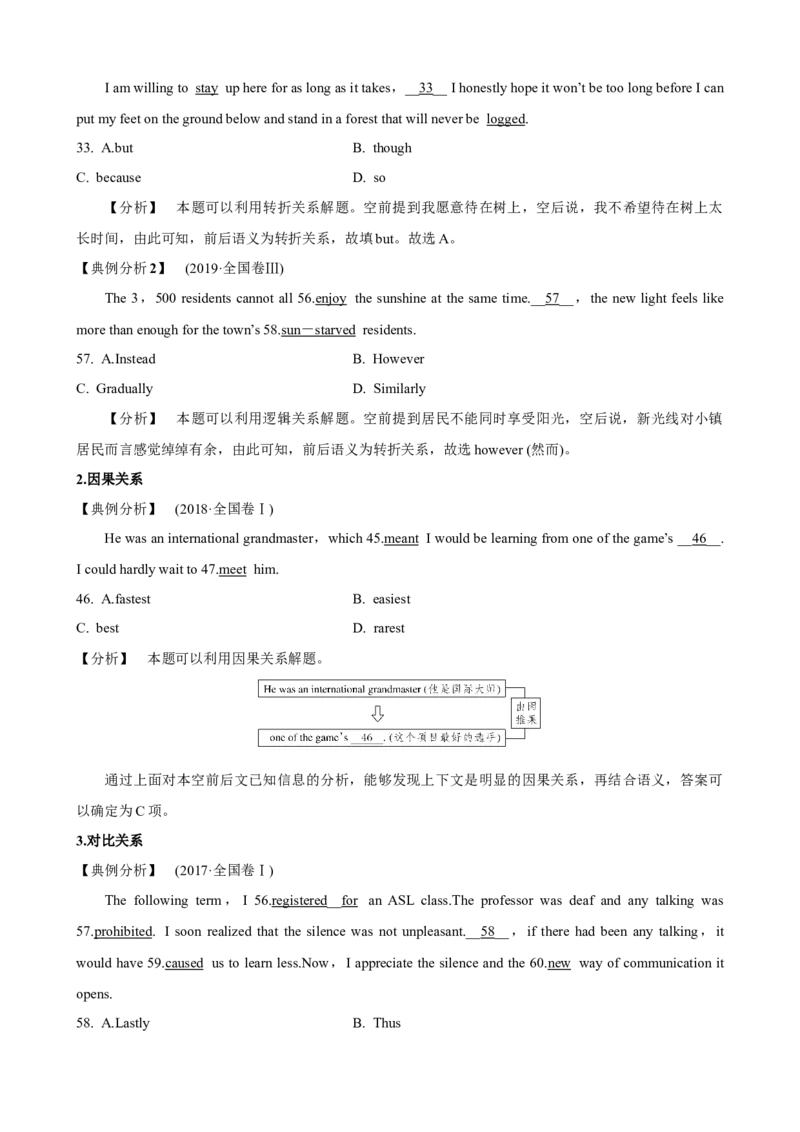
【典例分析】 (2018·全国卷Ⅰ)
He was an international grandmaster,which 45.meant I would be learning from one of the game’s __46__.
I could hardly wait to 47.meet him.
46. A.fastest B. easiest
C. best D. rarest
【分析】 本题可以利用因果关系解题。
通过上面对本空前后文已知信息的分析,能够发现上下文是明显的因果关系,再结合语义,答案可
以确定为C项。
3.对比关系
【典例分析】 (2017·全国卷Ⅰ)
The following term,I 56.registered__for an ASL class.The professor was deaf and any talking was
57.prohibited. I soon realized that the silence was not unpleasant.__58__,if there had been any talking,it
would have 59.caused us to learn less.Now,I appreciate the silence and the 60.new way of communication it
opens.
58. A.Lastly B. ThusC. Instead D. However
【分析】 本题可以利用对比关系解题。根据上下文的语境可知,作者很快意识到无声并非是不愉
快的,相反(Instead),如果有任何谈话的话,会导致作者他们学习得更少。所以,前后文是对比关系,故
选C项。Instead“相反地”;Lastly“最后,终于”;Thus“因此”;However“然而”。
4.递进关系
【典例分析】 (2018·全国卷Ⅰ)
In order to 50.pass the class,among other criteria,we had to write a paper on how we plan to 51.apply
what we would learn in class to our future professions and,__52__,to our lives.
52. A.eventually B. naturally
C. directly D. normally
【分析】 本题可以利用递进关系解题。第一层:为了通过这门课程,我们得写一篇论文,在论文
中我们要说明如何把在课堂上学到的东西“应用到”未来的职业中去;第二层:“最终”应用到自己的
生活中去。结论:第一、二层之间为“递进”关系。故选A项。
5.让步关系
【典例分析】 (2018·全国卷Ⅰ)
And,even if I weren’t__43__ enough about free credits,news about our 44.instructor was appealing
enough to me.
43. A.excited B. worried
C. moved D. tired
【分析】 本题可利用让步关系解题。
结合句意可确定答案为A。
微观策略4:利用语境暗示解题
在完形填空的短文中常常设置前后互相暗示的考题。这种暗示多为后面暗示前面,也就是说前面的
某些填空从当时的情况来看,或是线索不清,或是语境不明,无法得出正确答案,但只要我们继续往后
看,就会发现此空在后面的某个地方有暗示。所以,在做题时一定要充分利用前后的语境线索,以提高
做题的正确率。
【典例分析】 (2020·全国卷Ⅰ)
I wonder if 49.parents should always tell the truth no matter the 50.consequences. I have a very strong51.fear that the lie we’re telling is doing __52__ damage to our children.
52. A.physical B. biological
C. spiritual D. behavioral
【分析】 本题可以利用语境暗示解题。由语境可知此处意为:我有一种强烈的害怕,害怕我们正
在说的谎言会对孩子们造成心灵上的伤害。故选C。
微观策略5:利用作者态度和情感色彩解题
在做完形填空题时,我们一定要在快速阅读文章的过程中,仔细找出能够反映作者态度和感情色彩
的重要词汇,它们往往是名词、形容词、副词或动词。这些词汇通常是我们做题时重要的参照线索,可
以帮助我们快速确定某些题目的正确答案。
【典例分析】 (2019·全国卷Ⅱ)
Ehlers eventually succeeded in coaxing the animal to him.Nervousness and fear were replaced with__49__.
It just started licking (舔) Ehlers’ face.
49. A.surprise B. joy
C. hesitation D. anxiety
【分析】 本题可以利用作者态度和情感色彩解题。根据空格前面的 nervousness and fear were
replaced(紧张不安和恐惧被取代了)以及后面的“It just started licking Ehlers’ face.(它就开始舔Ehlers的脸)”
可知,它的不安和恐惧被快乐(joy)取代。答案可以确定为B项。
微观策略6:利用生活常识和文化背景解题
高考完形填空提供了相对完整的语篇信息,但其间渗透着各类相关的文化背景知识和常识。考生在
做题时可充分利用社会文化知识和生活常识来进行分析判断,以节省宝贵的时间,顺理成章地选出正确
的答案。完形填空的语篇中往往渗透着诸如文化科学、历史地理、风俗民情等方面的知识。考生在做题
时,若能积极地调动自己掌握的文化背景知识和生活常识,巧妙地加以运用,特别是注意中西文化的差
异,将会大大简化复杂的分析与判断过程,节省宝贵的时间,从而轻松地做出正确判断。
【典例分析】 (2020·全国卷Ⅱ)
The 59.family called the Italian Culture Ministry;the official confirmed that the paintings were __60__ and
worth as much as $50 million.
60. A.copies B. originals
C. models D. presents
【分析】 本题利用生活常识和文化背景解题。句意:这家人给意大利文化部打电话,官员肯定这
些画是原版,价值高达5 000万美元。根据下文的as much as $50 million,结合生活常识可知只有画家的
原版才值这么多钱,故选B项。
【策略精练】1
After a tearless farewell with my daughter, we left her new dorm room. But soon in the campus we saw her
running against the August heat. I quickly 1 down the car window and Sarina didn’t miss a step as she
turned and happily waved goodbye. I was in 2 why the tears hadn’t come when we parted on her first
day in university.
Our first 3 , the day she left my body, was a nightmare of pain and suffering. 4 , our
togetherness following the birth was so sweet that I felt her small body still seemed to be 5 to mine. In
the years to come, the sound of her feet running around our house was like the gentle 6 that reminded
me that my little girl was here and that someday she would run the 7 I couldn’t follow.
Last year Sarina turned 16 and decided to 8 art in college: She was 9 about college life
with so much to expect, but I was uneasy because it would be a long plane ride away from home. I tried to
imagine what separation would be like, but I couldn’t. Separation, although on the horizon, 10 felt
distant.
Until the next morning when I awoke in a house 11 of her footsteps, the tears 12 came
and wouldn’t stop. I understood that Sarina had left the house, and I 13 the memory of her running.
When the tears stopped, I was 14 that with our love and support, she had the 15 to run to an
unfamiliar distance, to glance back, yet to keep moving forward.
1. A. wound B. put C. turned D. brought
2. A. disappointment B. disorder C. disbelief D. discouragement
3. A. meeting B. cooperation C. association D. separation
4. A. However B. Therefore C. Hence D. Furthermore
5. A. addicted B. attached C. devoted D. meant
6. A. pace B. exercise C. ray D. beat
7. A. rooms B. schools C. paths D. sports
8. A. like B. pursue C. purchase D. follow
9. A. serious B. cautious C. thrilled D. concerned
10. A. but B. even C. hardly D. still
11. A. full B. absent C. tired D. afraid
12. A. actually B. eventually C. clearly D. specially
13. A. hold up B. hold back C. hold on to D. hold out
14. A. relieved B. astonished C. ashamed D. grateful
15. A. glory B. energy C. spirit D. courage2
Ten years ago when I was diagnosed with a serious illness, my first thought was, “Why me?” And this
thought 16 me throughout my journey. It wasn’t until I was 17 enough to look back that I realized
how much of my life was 18 by my illness not in a bad way.
Being 19 for our past experiences and 20 can be a hard thing to do. We sometimes wish
events in our past could be 21 so we could start a new life. But without these events, we wouldn’t learn,
change and grow.
The day I 22 this was volunteering with my boyfriend. A friend’s wife came up to me and asked me
how school was, 23 I said I didn’t like it that much. She then 24 by saying, “Well, if you hadn’t
gone, you wouldn’t have met him,” and pointed at my 25 .
This really opened my eyes, and after I left I started seeing everything in my life in this 26 . If I
hadn’t gone to that school, I would never have met my future husband. If I hadn’t battled 27 the illness,
I wouldn’t have found my true 28 . At first I didn’t see how my illness could have ever been a blessing.
But when I looked at it as an experience for me, I started to see that I had a lot to be grateful for.
I grew closer to my mother while 29 . I gained knowledge about myself that I could 30
gain through struggle, and learned how to take care of my wants and needs in a way that made me happy.
16. A. injured B. followed C. delivered D. struck
17. A. well B. brave C. scared D. ill
18. A. widened B. lengthened C. shaped D. unified
19. A. mindful B. thankful C. hopeful D. cheerful
20. A. stories B. replies C. rewards D. struggles
21. A. ruined B. caught C. swept D. taught
22. A. recalled B. reminded C. removed D. realized
23. A. but B. and C. so D. for
24. A. responded B. collected C. refused D. lectured
25. A. boyfriend B. girlfriend C. husband D. teacher
26. A. way B. system C. regard D. case
27. A. through B. for C. within D. against
28. A. hope B. self C. relief D. friend
29. A. living B. losing C. recovering D. searching
30. A. never B. already C. only D. also
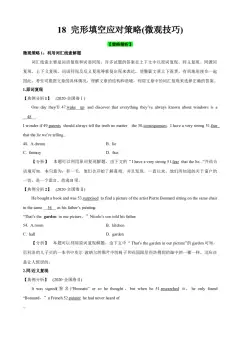
3My mother looks just like many grandmothers — short and white-haired. She comes from an old, traditional
family in Canada, where she now still lives. She was a civil servant. In short, she didn’t do 31 things.
That all changed a few years ago. She began to 32 me with what she described as “independence”.
At that time, I didn’t fully understand what she was doing.
In early 2015, the year she turned 75, she informed me she’d 33 a seven-night trip to Turkey, and
that she was going alone. There was no way I could 34 that. A little old lady not speaking a word of
Turkish, with no 35 of the laws and customs of the land — it was impossible!
My mother paid no attention to me. Off she went. When she returned, she told us it had been a wonderful
success. As it 36 , she had barely spent any time alone, after 37 a taxi driver to show her around.
He introduced her to a rug vendor (地毯商) — Mustafa, “a lovely fellow”, and she bought some rugs. The vendor
had taken her address details and promised to 38 them to Canada.
I couldn’t believe her naivety (幼稚) and explained that she had been 39 . The vendor had her
money. She neither had nor would be receiving any rugs.
Well, I was 40 .
To my great shock, her rugs did arrive some weeks later, along with a lovely note from Mustafa. To my even
greater surprise, the following year Mustafa himself arrived in Canada.
“I invited him for a cup of tea and he came,” my mother told me. I was 41 because she hardly
knew this man! But again, she paid little attention to me, telling me to stop being silly.
I wondered: “Is she not thinking straight?” 42 I worried about her, Mum was thinking straighter
than most of us.
Her 43 seemed to be based on a realization that life needs to be lived, when there’s relatively little
of it left. It 44 me of the line “Get busy living or get busy dying.”
I don’t think Mum knows what her next big “thing” is going to be. But I am sure, she is open to any 45
, which is something we all probably need right now. Live life to the fullest.
31. A. complex B. crazy C. humorous D. sensitive
32. A. surprise B. amuse C. comfort D. attract
33. A. founded B. taken C. designed D. canceled
34. A. allow B. demand C. chatter D. delay
35. A. intention B. knowledge C. view D. fear
36. A. turned out B. came true C. made sense D. went ahead
37. A. approving B. chasing C. hiring D. highlighting
38. A. invite B. consume C. switch D. ship39. A. dominated B. ignored C. cheated D. abandoned
40. A. right B. lucky C. serious D. wrong
41. A. frightened B. depressed C. disappointed D. ashamed
42. A. If B. Since C. While D. Once
43. A. promotion B. interaction C. independence D. preference
44. A. enhanced B. imitated C. pretended D. reminded
45. A. anxiety B. adventure C. embarrassment D. well-being
4
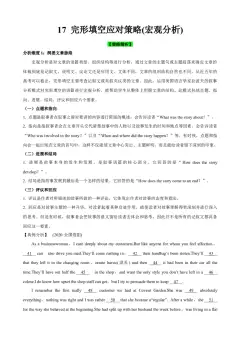
I come from a family of great cooks. Ever since I could 46 , the meals my mother cooks have always
been delicious. It is as if she entered the kitchen and 47 a series of mysterious processes that turn different
48 into delicious dishes. To me, it is almost 49 .
However, I have never been 50 cooking. I just enjoy eating, though my mother is a(n) 51 of
recipe books and used to give cooking classes. She 52 me to be a great cook just like her, and tried her best
to guide me. 53 it is clear that I have failed to meet her expectations.
I will always remember a(n) 54 that happened years ago, which 55 my lack of talent for
cooking. As a student staying off campus, I had to take 56 to cook dinner with two other roommates.
Although they didn't have very good cooking skill, I was obviously the 57 . This truth was proved
when one 58 walked into the kitchen while I was 59 some food. She took a look at me
and said, "Oh, it's your turn? I’d better eat some biscuits so I won't be too 60 . "
Now, 13 years have passed, but I still don't know how to 61 like my mother. I'm unable to 62
my family tradition, but I've found my niche(合适的工作)in a(n) 63 area. I've found my place in
my own field and 64 my own expectations 65 trying to live up to those of others.
46. A. imagine B. remember C. draw D. smell
47. A. performed B. adopted C. created D. completed
48. A. ingredients B. crops C. corn D. meat
49. A. strange B. familiar C. distant D. magic
50. A. linked to B. sensitive to C. interested in D. aware of
51. A. editor B. customer C. saleswoman D. manager
52. A. disliked B. forced C. begged D. expected
53. A. So B. But C. Since D. Though
54. A. incident B. error C. accident D. case
55. A. blamed B. involved C. impacted D. proved56. A. turns B. attempts C. risks D. excuses
57. A. best B. worst C. least D. most
58. A. roommate B. teacher C. friend D. neighbor
59. A. storing B. eating C. holding D. preparing
60. A. frustrated B. hungry C. annoyed D. weak
61. A. behave B. cook C. fish D. adjust
62. A. carry on B. make up C. go with D. search for
63. A. professional B. different C. amazing D. similar
64. A. met B. raised C. created D. promoted
65. A. regardless of B. far from C. but for D. instead of
5
I had worried myself sick over Simon’s mother coming to see me. I was a new teacher, and I gave an honest
66 of the students’ work. In Simon’s case, the grades were awfully low. He couldn’t read his own
handwriting. 67 he was a bright student. He discussed adult subjects with nearly adult comprehension.
His work in no way reflected his 68 .
So when Simon’s mother entered the room, my palms(手掌心)were 69 . I was completely 70
for her kisses on both my cheeks. “I came to thank you,” she said, surprising me beyond speech. 71 me,
Simon had become a different person. She talked of how he 72 me, he had begun to make friends, and
for the first time in his twelve years, he had 73 spent an afternoon at a friend’s house. She wanted to tell
me how grateful she was for the 74 I had nurtured(培养)in her son. She kissed me again and left.
I sat, stunned(惊呆), for about half an hour, 75 what had just happened. How did I make such a
life-changing difference to that boy without 76 knowing it? What I finally came to 77
was one day, several months before, when some students were 78 reports in the front of the class,
Jeanne spoke 79 , and to encourage her to raise her voice, I had said, “Speak up. Simon’s the expert
on this. He is the only one you have to convince, and he can’t hear you in the 80 of the room.” That
was it. From that day on, Simon had sat up straighter, paid more attention, 81 more, and became
happy. And it was all because 82 to be the last kid in the last row. The boy who most needed 83
was the one who took the last seat that day.
It taught me the most 84 lesson over the years of my teaching career, and I’m thankful that it
came early and positively. A small kindness can indeed 85 .
66. A. introduction B. favour C. discussion D. account
67. A. Or B. And C. But D. So68. A. courage B. abilities C. feelings D. dream
69. A. hurting B. trembling C. sweating D. clapping
70. A. desperate B. responsible C. unprepared D. unsuitable
71. A. Because of B. In addition to C. Apart from D. As for
72. A. loved B. envied C. pleased D. criticized
73. A. gradually B. constantly C. recently D. obviously
74. A. self-respect B. self-doubt C. self-pity D. self-defence
75. A. imaging B. observing C. wondering D. regretting
76. A. also B. even C. still D. ever
77. A. expect B. remember C. believe D. accept
78. A. writing B. reviewing C. editing D. giving
79. A. quietly B. repeatedly C. quickly D. firmly
80. A. entrance B. middle C. front D. back
81. A. slept B. smiled C. shouted D. quarreled
82. A. intended B. pretended C. refused D. happened
83. A. change B. praise C. thanks D. visits
84. A. painful B. stressful C. valuable D. enjoyable
85. A. take power B. have a point C. make a difference D. catch attention
6
As is known to us, doing something small makes a difference.
Last night, my husband and I were taking a post-dinner walk in a nearby parking lot, when we saw a man
breaking something with a rock. He was completely 86 his task and didn’t look up at anyone passing by.
We kept 87 him as we walked around the parking lot and talked between ourselves about what he might be
doing. I 88 he was breaking stones to make sand, but why would he do that?
89 , we decided to go up and speak to him. He was 90 pieces of leftover bread that he had
collected from his housemates to make 91 for the birds that come there every morning. The large pieces of
bread would be 92 for the birds to eat, so he ground them into a fine powder with the 93 .
It was moving to hear that he’s been doing this every 94 ,by himself, for the last three or four years.
What 95 us more was that he was surprised we were even taking 96 in this, since for him it
wasn’t a big deal. Every night, he 97 leftover bread from his housemates. He then spends the next one or
two hours in the parking lot crushing each piece of 98 and making a neat pile for the birds, which he
says will be 99 by the next evening. He also 100 fresh water and adds birdseed on top of thepile.
When we asked him why he does this small and simple act of 101 , he shrugged and said, “It’s just
something 102 I do so that the leftover bread doesn’t go into the 103 and the birds get food.”
We shared his story with the hope that it might remind us to be more 104 with our leftover food.
Perhaps it might 105 someone to do something similar in their own area.
86. A. worried about B. satisfied with C. tired from D. focused on
87. A. questioning B. showing C. noticing D. helping
88. A. discussed B. thought C. wondered D. admitted
89. A. Naturally B. Finally C. Surely D. Patiently
90. A. picking up B. spreading C. breaking up D. piling
91. A. drink B. food C. nests D. desserts
92. A. perfect B. healthy C. enough D. difficult
93. A. rock B. stick C. cage D. rope
94. A. morning B. night C. afternoon D. weekend
95. A. moved B. pleased C. confused D. embarrassed
96. A. a role B. part C. an interest D. pride
97. A. buys B. collects C. borrows D. steals
98. A. cake B. chocolate C. bread D. birdseed
99. A. removed B. lost C. discovered D. gone
100. A. leaves B. takes C. drops D. saves
101. A. faith B. choice C. service D. courage
102. A. special B. small C. interesting D. useful
103. A. plate B. ground C. market D. trash
104. A. careful B. content C. patient D. fun
105. A. inspire B. guide C. allow D. require
7
Last week, I had a wisdom tooth (智齿) pulled, which left me swollen and unable to speak. It was very
strange spending a few days in this 106 , but judging from other people’s responses, not as strange as it
was for them.
I thought my husband would be the first to feel upset. I tried to imagine how 107 it must be to have
half of the house go silent. 108 , when I found him in the kitchen at midnight, cooking potatoes for my
recovery and 109 the silence by singing “your lovely swollen face” to the tune of My Humps, I, too, wassurprised, but also 110 .
When I felt 111 I went to my local shop. It still hurt when I moved my face, so when I 112
a friend, I couldn’t say anything. The friend wanted my 113 on a Twitter disagreement that I didn’t seem
bothered. I was not bothered — and it felt good to remember that.
Later I visited my mom, who chatted away as normal. She didn’t even 114 that I was on the silent
mode. This makes me certainly believe that my family role is part 115 , part listener.
People say 116 is golden and that sometimes it is wise to say nothing and to let people reveal (吐
露) themselves. Perhaps that is the 117 of the wisdom tooth. Maybe when they arrive with all their
pain, forcing us —even just for a while—to move our 118 a little less, they give a lesson for living
well: Listen, 119 and try being quiet now and then. Then maybe adulthood won’t be quite like 120
teeth.
106. A. room B. state C. position D. period
107. A. embarrassing B. lively C. pleasant D. frightening
108. A. Finally B. Luckily C. However D. Therefore
109. A. enjoying B. filling C. keeping D. welcoming
110. A. amazed B. annoyed C. disappointed D. touched
111. A. hungry B. weaker C. stronger D. thirsty
112. A. called up B. looked at C. turned to D. ran into
113. A. study B. opinion C. report D. information
114. A. accept B. expect C. hear D. notice
115. A. daughter B. patient C. speaker D. friend
116. A. health B. family C. silence D. love
117. A. lesson B. secret C. treatment D. wisdom
118. A. arms B. eyes C. mouths D. faces
119. A. observe B. smell C. review D. suggest
120. A. cutting B. pulling C. brushing D. losing
8
Esther encourages her two kids to make crafts and drawings from old bits of packaging. She began 121
her family’s wastage when she moved house and decided that she would leave all single-use 122 behind and
buy everything she need from second-hand shops.
She said, “It’s cheaper and you know that the items will 123 being used instead of being set aside — so
it’s just perfect! Each of us plays a big 124 in taking care of the environment. It’s 125 to try to helprather than just keep complaining about the current situation.”
Any glass container is 126 and repurposed for something else. This means that the family only send a
piece of 127 to landfill every two weeks on average. She tries not to buy any plastic at all, but when she
does, she will get it 128 washed and recycled.
The family also grow their own tomatoes, lettuce, and some other vegetables in the garden, and have orange
trees outdoors. Esther has also 129 herself in a community of friends who 130 items with each other
that they need, like furniture or plates.
She said, “We tried to use the minimum 131 and take some toys and baby equipment from friends
and relatives. If we really had to 132 anything, first we tried at the 133 market.”
To educate her kids, Esther takes them out on nature walks to the forest where they 134 rubbish as
they go.” They enjoy this 135 , because they know it’s better for the environment,” she said.
121. A. considering B. reducing C. increasing D. dividing
122. A. bins B. chopsticks C. items D. collections
123. A. continue B. avoid C. deny D. delay
124. A. game B. lead C. match D. role
125. A. useless B. enjoyable C. cautious D. normal
126. A. attended to B. left out C. washed up D. taken away
127. A. equipment B. furniture C. glass D. rubbish
128. A. thoroughly B. partly C. mostly D. casually
129. A. devoted B. found C. exposed D. buried
130. A. create B. trade C. discuss D. clarify
131. A. necessary B. valuable C. ordinary D. possible
132. A. purchase B. recycle C. decrease D. preserve
133. A. far-away B. duty-free C. second-hand D. open-air
134. A. put out B. pick up C. throw away D. keep off
135. A. activity B. idea C. theme D. jungle
9
When my sisters and brother and I were little, we took naps. We did not have to sleep every time, but we
were expected to go to our rooms and be 136 for at least an hour.
The summer I was seven, I was 137 to take my naps in a tree in the orchard. Everybody knew I
liked being outside better than 138 .
I had a favorite apple tree in the orchard, the place I went to when I wanted to be alone and 139 .This tree became my “nap tree” even though I never 140 fell asleep in it.
During my nap times, I 141 to roost in the tree, the way a bird sits on a nest. I learned to keep
still enough that 142 visitors, such as sparrows and magpies, came to 143 in the tree the
same way they always had.
One afternoon I 144 the tree as usual, grabbing branches and placing my feet carefully until I was
comfortable. Then I searched the leaves for whatever creature might be 145 and was astonished to
meet the wide-eyed 146 of a great horned owl. The owl 147 for one second before it lifted
its wings and dropped away into space. I 148 watched it go, praying it would return.
After that, I climbed into the tree every day hoping to see the owl. Several times it flew close, but 149
when it saw me.
I began to spend more than my official nap hour in the tree. I imagined I would make myself so 150
to the tree that the owl would not take offense at my being there. I had a great desire to 151 the owl that
it was safe to come back.
One day the owl did return, and this time it 152 . The owl landed on a thick 153 and
held it with her claws. She pressed her 154 to her sides and settled down. We 155 the tree
as if we had done so all our lives.
136. A. still B. quiet C. calm D. silent
137. A. allowed B. requested C. ordered D. demanded
138. A. everything B. something C. anything D. nothing
139. A. grateful B. careful C. delightful D. peaceful
140. A. finally B. immediately C. actually D. smoothly
141. A. decided B. pretended C. tried D. tended
142. A. regular B. enthusiastic C. rare D. normal
143. A. arrive B. rest C. settle D. nest
144. A. protected B. visited C. reached D. climbed
145. A. clumsy B. obvious C. present D. asleep
146. A. look B. attack C. stare D. arrival
147. A. wandered B. stayed C. waited D. hesitated
148. A. just B. already C. ever D. even
149. A. switched off B. ran off C. set off D. flew off
150. A. common B. natural C. typical D. friendly
151. A. remind B. warn C. convince D. inform152. A. stayed B. lasted C. escaped D. continued
153. A. spot B. leave C. forest D. branch
154. A. wings B. feet C. ears D. claws
155. A. enjoyed B. shared C. survived D. helped
10
Twenty years ago, I was told a story of Little Brother at a party which has delighted and inspired me ever
since.
Little Brother, who was an ambitious painter and trying to be an artist, went to France to 156
himself with beauty and inspiration. One afternoon, he 157 a conversation in a cafe with a group of
charming young people. They took a liking to Little Brother and invited him to a party that weekend in a 158
in the Loire Valley. It would be 159 by the rich and famous and by several crowned heads of Europe.
Best of all, it was a masquerade ball (假面舞会).
160 , Little Brother worked all week on a costume and held back on neither the details nor the
craziness of this creation. Then he rented a car and drove three hours to the castle. Little Brother entered the
ballroom, head 161 high.
Upon which he immediately realized his 162 .
This was 163 a costume party but he had missed one 164 in translation: This was a
themed costume party. The theme was “a medieval (中世纪的) court” 165 Little Brother was dressed
as a lobster (龙虾).
He stood at the top of the steps for one long, horrible moment. Running away in 166 seemed
like the most dignified (有尊严的) response. But he didn’t run. 167 , he found his solution. He’d
come this far, after all. He’d worked tremendously hard to make this costume, and he was 168 of it.
He took a deep breath and walked onto the dance floor.
As he moved into the crowd, a silence 169 . The other guests gathered around Little Brother.
Finally someone asked him what on earth he was.
Little Brother bowed deeply and 170 , “I am the court lobster.”
Then: laughter.
Not ridicule — just 171 . They loved him. They loved his sweetness, his weirdness, his giant red
claws, his skinny legs in his bright tights. He was the happy clown among them, and he 172 the
party. Little Brother even ended up dancing with the queen of Belgium.
I have never created anything in my life that did not make me feel like I was the guy who just walked into a
fancy ball wearing a homemade lobster costume. But you must 173 walk into that room, and youmust hold your head high. Never 174 for it, never explain it away, and never be ashamed of it. You
did your best with what you knew, and you worked with what you had, in the time you were given.
Sometimes it’s like that. What you absolutely must not do is walk out. Otherwise you will miss the party, and
that would be a pity 175 we did not come all this great distance, and make all this great effort, only to
miss the party at the last moment.
156. A. occupy B. surround C. content D. busy
157. A. started up B. put up C. followed up D. drew up
158. A. resort B. palace C. reserve D. castle
159. A. constructed B. exploited C. attended D. inspired
160. A. Excited B. Tired C. Frustrated D. Terrified
161. A. pulled B. reached C. stuck D. held
162. A. dream B. ambition C. mistake D. potential
163. A. otherwise B. indeed C. yet D. just
164. A. account B. detail C. description D. expression
165. A. when B. until C. while D. as
166. A. surprise B. relief C. peace D. shame
167. A. Somehow B. Anyway C. Meanwhile D. Therefore
168. A. ignorant B. sceptical C. proud D. tolerant
169. A. exploded B. fell C. approached D. deepened
170. A. admitted B. defined C. whispered D. announced
171. A. hatred B. praise C. trust D. joy
172. A. made B. organized C. threw D. hosted
173. A. stubbornly B. swiftly C. cautiously D. quietly
174. A. search B. apologize C. wish D. push
175. A. although B. once C. because D. unless
11
Last May I bought some sweet potatoes for food. Several days later, a tuber (块茎) left in the kitchen was
sprouting (发芽). I 176 the tuber into a pot hoping that it might take root and produce something that
could be put on the dinner table.
177 , the tuber did take root and began to grow. In the following months I 178 it when
necessary and it grew very well. One day. I decided to harvest. I pulled out the plant, which took some 179
and began to dig with my fingers to see if there was any tuber in the pot.When my fingers could almost touch the 180 of the pot, I took the root and pulled it carefully, for
the potato could break easily. As almost no earth was left, I tried to pull but I failed to lift it up. In 181 .
I pushed the pot over and found the root was outside the pot! It had grown through one of the holes in the bottom
of the pot.
Then and there I changed my opinion of this plant, for the seemingly weak plant gained the 182 of
me.
Very carefully I emptied all the soil out of the pot, 183 the root might be harmed or broken.
Holding the root. I was deep in thought. The root outside the pot looked like a 184 and strong finger of
an old farmer who had fought his way to make a living. The end of the root was dark gray and 185 .
Obviously, the peel must have been removed during its struggle with the 186 of the heavy pot. It
struck me that the tuber, though seriously 187 , had struggled hard and it seemed that it had never
188 . Such is a sweet potato, an ordinary-looking plant with 189 characteristics. It managed to
grow where I thought it was almost impossible to 190 .
176. A. cut B. cooked C. accessed D. put
177. A. Surprisingly B. Sadly C. Awfully D. Unluckily
178. A. threw B. watered C. gathered D. inspired
179. A. scent B. relief C. effort D. talent
180. A. button B. net C. bottom D. top
181. A. puzzlement B. shame C. excitement D. silence
182. A. respect B. energy C. grace D. reward
183. A. clapping B. fearing C. insisting D. proving
184. A. tidy B. private C. thick D. clean
185. A. skinless B. useless C. faceless D. endless
186. A. target B. defense C. nature D. pressure
187. A. destroyed B. polluted C. wounded D. attacked
188. A. given in B. found out C. taken off D. set off
189. A. horrible B. gentle C. previous D. tough
190. A. rest B. exist C. roast D. perform
12
The Mutianyu section of the Great Wall was the part of the Great Wall I liked to visit. 191 , one day in
May 2000, I chose something wilder, more 192 : Simatai. This section of the Great Wall has far fewer
visitors than most other sections of the wall.At the entrance to Simatai was a group of vendors (小贩) trying to 193 postcards. One tiny old lady
seemed to 194 me wherever I went, and I was becoming increasingly 195 . “How many times
does it take for ‘No!' to sink in?” I thought. I finally ended up running away just to 196 this tiny woman.
Once I caught sight of the Great Wall, 197 overtook me, and the tiny old lady with the postcards
198 from my thoughts. I raced up the Great Wall 199 . Then, halfway up, I stopped and suddenly
realised I was rushing along a 200 “path” no wider than a meter. There were 201 “walls” —
only steep drops on either side. I remembered then that 202 had fallen to their deaths in this section. I
was so fearful that I 203 there completely stock-still.
Suddenly, I felt a small hand on my back and a 204 voice telling me, in Chinese, not to be 205
, that she would slowly lead me to the top. Half an hour later, we 206 a section that had a few remnants
(剩余的小部分) of the wall. I was able to turn around to see who had given such 207 to me in my hour
of greatest 208 . It was the tiny old lady I'd told a dozen times — eventually shouting at her — that I
didn't want any 209 . I felt really 210 of myself. I gave her a big hug, and then later bought
every one of her postcards.
191. A. Instead B. However C. Therefore D. Besides
192. A. pleasant B. important C. popular D. challenging
193. A. sell B. count C. write D. collect
194. A. support B. follow C. need D. protect
195. A. puzzled B. upset C. lonely D. active
196. A. meet B. help C. escape D. greet
197. A. doubt B. surprise C. nervousness D. excitement
198. A. learned B. benefited C. disappeared D. suffered
199. A. recently B. impatiently C. secretly D. immediately
200. A. familiar B. dangerous C. correct D. crowded
201. A. no B. some C. enough D. many
202. A. shoppers B. owners C. vendors D. tourists
203. A. hid B. sat C. lay D. stood
204. A. silly B. female C. sleepy D. childish
205. A. afraid B. sorry C. lazy D. shy
206. A. left B. crossed C. avoided D. reached
207. A. friendship B. experience C. kindness D. imagination
208. A. pain B. fear C. anger D. regret209. A. guides B. routes C. postcards D. foods
210. A. proud B. certain C. careful D. ashamed
13
Every year about 40, 000 people attempt to climb Kilimanjaro (乞力马扎罗山), the highest mountain in
Africa. They 211 with them lots of waste. The 212 might damage the beauty of the place.
The glaciers (冰川) are disappearing, changing the face of Kilimanjaro.
Hearing these stories, I'm 213 about the place - other destinations are described as “purer” natural
experiences.
However, I soon 214 that much has changed since the days of disturbing reports of 215
among tons of rubbish. I find a 216 mountain, with toilets at camps and along the paths. The
environmental challenges are 217 but the efforts made by the Tanzania National Park Authority seem to
be 218 .
The best of a Kilimanjaro 219 , in my opinion, isn't reaching the top. Mountains are 220
as spiritual places by many cultures. This view is especially evident on Kilimanjaro as 221 go through
five ecosystems (生态系统) in the space of a few kilometers. At the base is a rainforest. It ends suddenly at 3,000
meters, 222 lands of low growing plants. Further up, the weather 223 - low clouds envelop
the mountainsides, which are covered with thick grass. I counted twelve shades of green from where I stand.
Above 4, 000 meters is the highland desert :gravel (砾石), stones and rocks. 224 you climb into an
arctic-like zone with permanent (永久的) snow and the glaciers that may soon disappear.
Does Kilimanjaro deserve (值得) its reputation as a crowded mountain with lines of tourists 225
the atmosphere of peace? I found the opposite to be true.
211. A. keep B. mix C. connect D. bring
212. A. stories B. buildings C. crowds D. reporters
213. A. silent B. skeptical C. serious D. crazy
214. A. discover B. argue C. decide D. admit
215. A. equipment B. grass C. camps D. stones
216. A. clean B. quiet C. tall D. faraway
217. A. new B. special C. significant D. necessary
218. A. fading away B. spreading out C. carrying on D. paying off
219. A. atmosphere B. experience C. experiment D. sight
220. A. regarded B. observed C. explored D. studied
221. A. scientists B. climbers C. locals D. officials222. A. holding on to B. going back to C. setting out to D. giving way to
223. A. changes B. clears C. improves D. permits
224. A. Obviously B. Easily C. Absolutely D. Finally
225. A. keeping B. ruining C. replacing D. creating
14
A famous theorist once said, “I don’t divide the world into the weak and the strong: or the successes and the
failures...I divide the world into the learners and the non-learners.”
What on earth would make someone a non-learner? Everyone is born with an intense 226 to learn.
Babies rise to the learning challenge daily. Not just for 227 tasks, but the most difficult ones of a lifetime,
like leaning to walk and talk. They never decide it’s too hard or not worth the 228 . Babies don’t worry
about making mistakes or 229 themselves. They walk, they fall, they 230 .
What puts an end to this fearless learning? A fixed mindset. As soon as children become able to evaluate
themselves, some of them become 231 of challenges. They worry about not being 232 . My
research team have studied thousands of people from preschoolers on, and It’s breathtaking how many 233
an opportunity to learn.
We offered four-year-olds a 234 :they could redo an easy jigsaw (拼图) or try a harder one. Even at
this young age, children with a fixed mindset stuck with the 235 one. They believe smart kids don’t
make 236 .
Children with a growth mindset, however, thought it was a 237 choice. Why would anyone want
to keep doing the same puzzle 238 ? They chose increasingly difficult-ones instead.
Believing that success is about learning, children with a growth mindset seized the chance. But those with a
fixed mindset didn’t want to expose their 239 . This is how a fixed mindset makes people into 240
.
226. A. fear B. drive C. competition D. concentration
227. A. crucial B. mental C. ordinary D. particular
228. A. attention B. effort C. interest D. time
229. A. confusing B. behaving C. punishing D. hurting
230. A. get up B. give up C. show up D. shut up
231. A. afraid B. ashamed C. confident D. ignorant
232. A. adorable B. curious C. modest D. smart
233. A. seize B. ruin C. reject D. require
234. A. lesson B. choice C. gift D. game235. A. challenging B. interesting C. new D. simple
236. A. decisions B. jigsaws C. mistakes D. predictions
237. A. strange B. promising C. profitable D. difficult
238. A. repeatedly B. unwillingly C. automatically D. properly
239. A. secrets B. thoughts C. preferences D. weaknesses
240. A. theorists B. perfectionists C. non-learners D. risk-takers
15
Waiting for the airplane to take off, I was happy to get a seat by myself. Just then, an air hostess came to me
and asked, “Would you mind 241 your seat? A couple would like to sit together.” The only 242
seat was next to a girl with her arms in casts (石膏绷带), a black-and-blue face, and a sad expression. “ 243
am I going to sit there.” I thought immediately.
But a soft voice spoke, “She needs help.” Finally, I 244 to move to that seat. The girl was named
Kathy. She was injured in a car accident and now was on her way for 245 . When the snack and juice
arrived, it did not take me long to 246 that Kathy would not be able to 247 herself. I considered
248 to feed her but hesitated (犹豫), as it seemed too 249 to offer such a service to a 250 .
But then I realized that Kathy′s need was more 251 than my discomfort. I offered to help her eat and
although she was uncomfortable to accept, she 252 as I expected. We became closer and closer in a
short period of time. By the end of the five-hour trip, my heart had 253 , and the time was really better
spent than if I had just sat by myself. I was very glad I had reached beyond my comfort zone to sit next to Kathy
and feed her. Love sometimes flows beyond human borders and removes the fears that keep us 254 .
When we are trying our best to 255 another, we grow to live in a larger and more rewarding world.
241. A. losing B. changing C. taking D. giving
242. A. comfortable B. suitable C. available D. favorable
243. A. No problem B. No doubt C. Nowhere D. No way
244. A. decided B. wanted C. regretted D. promised
245. A. treatment B. travel C. pleasure D. business
246. A. challenge B. address C. realize D. pretend
247. A. consider B. feed C. choose D. support
248. A. offering B. needing C. stopping D. trying
249. A. annoyed B. fast C. frightened D. impolite
250. A. couple B. neighbor C. passenger D. stranger
251. A. unusual B. direct C. important D. shameful252. A. refused B. wondered C. cried D. did
253. A. warmed B. jumped C. broken D. cheered
254. A. separate B. independent C. silent D. upset
255. A. miss B. serve C. impress D. improve